
Northwestern University engineers have achieved a groundbreaking feat: the development of printed artificial neurons that transcend mere imitation, capable of establishing direct, functional connections with living brain cells. These novel, cost-effective, and flexible electronic devices generate electrical impulses that closely mirror the patterns of endogenous neural signaling, thereby possessing the capacity to stimulate and engage biological neural tissue. In rigorous experimental trials involving explanted sections of murine cerebral tissue, these synthesized neural units demonstrably elicited responsive activity within native neurons, signifying a profound advancement in the seamless integration of electronic systems with intricate biological neural architectures.
This breakthrough represents a significant stride toward the creation of sophisticated electronics engineered for direct interfacing with the human nervous system. The potential applications are vast and transformative, encompassing the development of advanced brain-machine interfaces, crucial for controlling external devices with thought, and sophisticated neuroprosthetics designed to restore lost sensory or motor functions, such as hearing, vision, or limb movement. Beyond direct biological augmentation, this innovative technology also heralds the advent of a new paradigm in computing systems, drawing profound inspiration from the brain’s inherent operational principles. By meticulously replicating the intricate communication dynamics of biological neurons, future hardware architectures could achieve the execution of highly complex computational tasks with an unprecedented degree of energy efficiency. The human brain, a marvel of biological engineering, remains the undisputed champion of energy efficiency in computation, and scientists are increasingly looking to its fundamental mechanisms as a blueprint for next-generation technological solutions.
The foundational research underpinning this achievement is slated for formal publication on April 15th in the esteemed scientific journal, Nature Nanotechnology. Mark C. Hersam, a leading figure in brain-inspired computing at Northwestern University and the principal investigator of this study, emphasized the critical need for more efficient hardware to support the burgeoning field of artificial intelligence. "The contemporary world is undeniably shaped by artificial intelligence," Hersam stated, highlighting the escalating demands of AI training. "The conventional method to enhance AI capabilities involves processing ever-larger datasets. This data-intensive training process, however, results in a monumental energy consumption challenge. Consequently, it is imperative that we devise more efficient hardware solutions to manage vast amounts of data and advance AI. Given that the brain operates with an energy efficiency five orders of magnitude greater than that of a digital computer, it logically follows that we should seek inspiration from its architecture for the development of next-generation computing systems."
Hersam, a distinguished expert in brain-inspired computing, holds multiple influential positions within Northwestern University. He is the Walter P. Murphy Professor of Materials Science and Engineering at the McCormick School of Engineering, a professor of medicine at the Northwestern University Feinberg School of Medicine, and a professor of chemistry at the Weinberg College of Arts and Sciences. Furthermore, he serves as the chair of the department of materials science and engineering, the director of the Materials Research Science and Engineering Center, and is an integral member of the International Institute for Nanotechnology. This seminal study was co-led by Vinod K. Sangwan, a research associate professor at the McCormick School of Engineering.
The inherent limitations of conventional silicon-based computing, which strives for complexity through the sheer aggregation of billions of identical transistors on rigid, two-dimensional chips, stand in stark contrast to the brain’s operational elegance. Each component in a silicon chip functions uniformly, and once fabricated, the system’s architecture is static. The brain, conversely, operates through a vast and diverse array of neuron types, each endowed with specialized functions, interconnected within flexible, three-dimensional networks. These neural networks are not static entities; they possess a remarkable plasticity, dynamically forming and reconfiguring connections in response to learning and experience. "Silicon achieves complexity by utilizing billions of identical devices," Hersam elaborated. "Every element is uniform, rigid, and fixed once manufactured. The brain presents a fundamentally different model: it is heterogeneous, dynamic, and three-dimensional. To emulate this biological paradigm, we require novel materials and innovative fabrication methodologies for electronics."
While the concept of artificial neurons has been explored previously, many existing iterations produce signals that are overly simplistic, failing to capture the nuanced complexity of biological neural activity. To achieve more sophisticated computational behaviors, researchers have typically resorted to constructing extensive networks of these simplified artificial neurons, a strategy that invariably leads to increased energy expenditure.
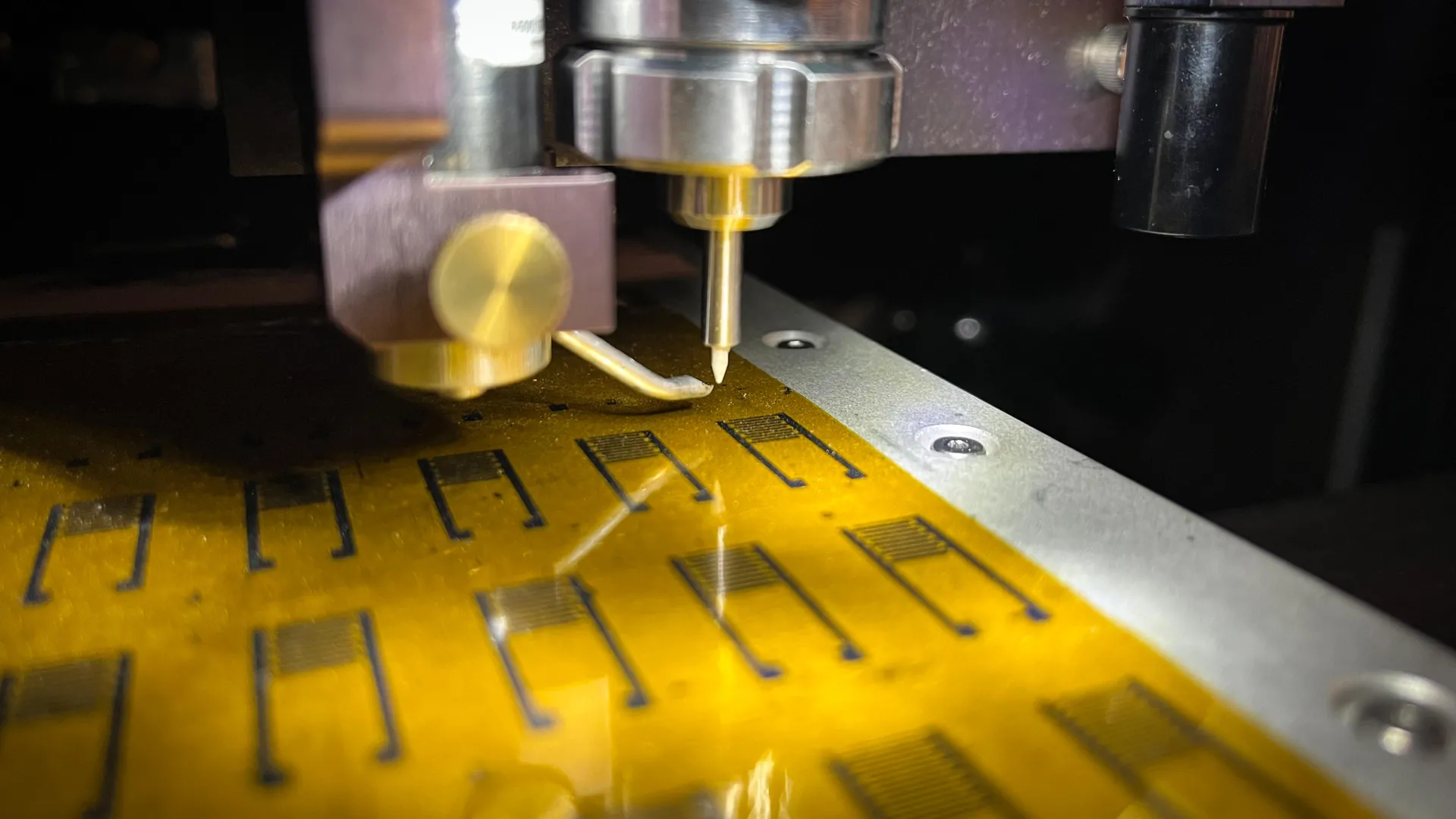
The innovative approach developed by Hersam’s team overcomes these limitations by employing soft, printable materials that more closely approximate the brain’s intrinsic structural characteristics, thereby enabling more authentic replication of real neural activity. Their methodology centers on the creation of electronic inks formulated from nanoscale flakes of molybdenum disulfide (MoS2), a material with semiconductor properties, and graphene, which functions as an electrical conductor. These specialized inks are then precisely deposited onto flexible polymer substrates using aerosol jet printing techniques.
Historically, researchers viewed the polymer component within these electronic inks as an impediment, as it tended to interfere with optimal electrical performance, and consequently, it was meticulously removed post-printing. In a significant departure from previous practices, this research team ingeniously leveraged this same polymer characteristic to enhance device functionality. "Instead of completely eliminating the polymer," Hersam explained, "we subject it to partial decomposition. Subsequently, when an electrical current is passed through the device, this process instigates further decomposition of the polymer. This decomposition occurs in a spatially non-uniform manner, leading to the formation of a conductive filament. This filament effectively constricts all current flow into a narrow spatial region."
This localized conductive pathway is instrumental in generating a sudden, sharp electrical response that closely resembles the firing of a biological neuron. The resulting artificial neuron exhibits a remarkable capacity to produce a diverse spectrum of signal patterns, including discrete electrical spikes, sustained firing, and intricate bursting sequences, all of which bear a striking resemblance to the communication patterns observed in natural neural systems. Crucially, because each artificial neuron can generate more complex signals, the overall number of components required to perform advanced computational tasks can be significantly reduced, leading to a substantial enhancement in computing efficiency.
To rigorously assess the capacity of these artificial neurons to interact effectively with living biological systems, the research team collaborated with Indira M. Raman, the Bill and Gayle Cook Professor of Neurobiology at Weinberg College. Her team meticulously applied the synthesized electrical signals generated by the artificial neurons to precisely prepared slices of the murine cerebellum. The experimental outcomes unequivocally demonstrated that the electrical impulses produced by the artificial neurons aligned with critical biological parameters, specifically in terms of their temporal characteristics and duration. These precisely shaped signals were found to reliably activate endogenous neurons and initiate neural circuit activity in a manner highly analogous to natural brain processes. "Previous attempts by other research groups to fabricate artificial neurons using organic materials resulted in signals that were too slow," Hersam noted. "Conversely, those utilizing metal oxides produced signals that were excessively rapid. Our current technology operates within a temporal range that has not been previously achieved by artificial neurons. The direct observation of living neurons responding to our artificial neuron’s output provides compelling evidence of successful integration. Thus, we have successfully demonstrated signals that not only possess the appropriate temporal resolution but also the characteristic spike shape necessary for direct interaction with living neurons."
Beyond their superior performance characteristics, the novel manufacturing approach offers significant environmental and practical benefits. The fabrication process is characterized by its simplicity and cost-effectiveness. Furthermore, the additive printing technique ensures that material is precisely applied only where it is needed, thereby minimizing material waste. The imperative to enhance energy efficiency in computing is particularly pronounced as artificial intelligence systems continue to increase in computational complexity and demand. Existing large-scale data centers already consume enormous quantities of electrical power and require substantial water resources for cooling operations. "To meet the escalating energy demands of AI, technology corporations are investing in the construction of gigawatt-scale data centers, often powered by dedicated nuclear facilities," Hersam stated, underscoring the gravity of the situation. "It is evident that this colossal power consumption will inevitably impose limitations on the further scaling of computing capabilities, as it becomes increasingly challenging to envision next-generation data centers that would necessitate the equivalent of one hundred nuclear power plants. Compounding this energy issue is the substantial heat generated when dissipating gigawatts of power. Since data centers rely on water for cooling, the immense water requirements of AI are placing severe strain on global water supplies. Regardless of the perspective, the development of more energy-efficient hardware for AI applications is an absolute necessity." The groundbreaking study, titled "Multi-order complexity spiking neurons enabled by printed MoS2 memristive nanosheet networks," received crucial support from the National Science Foundation.
About the Author












