Optimizing Senior Fitness: Five Foundational Exercises for Sustained Strength and Mobility
As individuals navigate the landscape of life beyond their seventh decade, maintaining physical strength often becomes a significant concern. The perception that a substantial decline in muscular capacity is an inevitable consequence of aging can be a deterrent to pursuing physical activity. However, contemporary scientific understanding and practical experience in fitness coaching for older adults firmly challenge this notion. While the physiological mechanisms governing muscle recovery and retention undergo changes with advancing age, the fundamental capacity for the human body to adapt and strengthen in response to appropriate resistance training remains remarkably robust, even for those over 70. Reclaiming a level of physical vigor reminiscent of earlier decades, such as one’s fifties, is not only achievable but essential for preserving independence, enhancing quality of life, and mitigating the effects of age-related decline.
The journey toward improved strength in later life is not about attempting to replicate youthful feats of maximum lifting, but rather about a strategic, gradual, and consistent application of progressive resistance. This approach prioritizes foundational movements that engage major muscle groups, adapting the intensity and complexity to an individual’s current capabilities. The objective is to consistently provide muscles with a stimulus challenging enough to provoke adaptation and growth, while carefully managing recovery and preventing overexertion. This measured progression is paramount, far outweighing the impulse to demonstrate immediate maximal effort. Experienced coaches working with older populations frequently observe that the most profound successes stem from establishing an accessible starting point. Once a movement feels secure and controlled, incrementally increasing resistance or advancing to more demanding variations becomes a natural and empowering next step. This philosophy underpins the selection of the following five exercises, designed to foster continuous improvement within a sustainable and effective routine.
A crucial concept in understanding age-related strength changes is sarcopenia, the progressive and generalized loss of skeletal muscle mass and strength. This natural process begins around age 30, accelerating after 60, and can significantly impact daily activities, balance, and metabolic health. However, robust evidence, including studies published in journals like PMC NCBI, consistently demonstrates that resistance training is the most effective intervention to counteract sarcopenia. It stimulates muscle protein synthesis, leading to hypertrophy (muscle growth) and improved neuromuscular efficiency, which translates directly to greater functional strength. Beyond muscle mass, engaging in strength training offers a myriad of benefits for seniors, including enhanced bone density to combat osteoporosis, improved balance and coordination to reduce fall risk, better glucose regulation, and even positive impacts on cognitive function and mood. These exercises, therefore, are not merely about lifting weights; they are about investing in a more vibrant, independent, and resilient future.
The selected exercises cover fundamental human movement patterns: squatting, pressing, pulling, and hinging. These movements are integral to daily life, from standing up from a chair to reaching for an object overhead, and strengthening them directly translates into improved functional independence.
1. The Goblet Hold Box Squat: Building Foundational Lower Body Strength
The box squat serves as an exceptional starting point for individuals seeking to re-establish or enhance lower body strength, particularly for quadriceps, glutes, and hamstrings. Its primary advantage lies in the consistent depth provided by the box, which acts as a reliable target for each repetition. This consistency helps individuals learn the proper mechanics of a squat, ensuring they descend to a safe and effective depth without overextending or losing balance. Holding a dumbbell or kettlebell against the chest in a "goblet" position offers adjustable external resistance, increasing the challenge to the leg muscles and engaging the core for stability.
Execution Guidance:
- Setup: Stand facing a sturdy box or bench, feet shoulder-width apart, toes pointing slightly outward. Hold a kettlebell or dumbbell vertically against your chest with both hands.
- Descent: Initiate the movement by pushing your hips back and bending your knees, as if sitting down into a chair. Maintain an upright chest and keep your gaze forward. Control the descent until your glutes lightly tap the box. The touch should be gentle, not a complete relaxation onto the surface.
- Ascent: Drive through your heels and mid-foot, pushing yourself back up to the starting standing position. Squeeze your glutes at the top.
- Muscles Engaged: Quadriceps, glutes, hamstrings, and core stabilizers.
- Repetition Scheme: Aim for 2 to 3 sets of 6 to 10 repetitions, allowing 60 to 90 seconds of rest between sets.
- Progression: As the exercise becomes less challenging, gradually increase the weight of the goblet hold, or use a slightly lower box to increase the range of motion. For initial stages, a bodyweight box squat is an excellent starting point.
2. Half-Kneeling Dumbbell Press: Cultivating Unilateral Upper Body and Core Stability
The half-kneeling dumbbell press is an invaluable exercise for developing overhead pushing strength, primarily targeting the shoulders and triceps, while simultaneously demanding significant core stability. The half-kneeling stance intentionally minimizes the contribution from the lower body, forcing the upper body and core musculature to bear the brunt of the effort. This makes a moderate dumbbell feel considerably more challenging, creating an effective stimulus without requiring excessively heavy loads, which can be crucial for protecting shoulder joints in older adults.
Execution Guidance:
- Setup: Kneel on one knee, with the opposite foot flat on the floor in front of you, forming a 90-degree angle at both knees. Ensure your front foot, knee, and hip are aligned. Hold a dumbbell in the hand corresponding to the knee that is down, with your palm facing forward at shoulder height. Your core should be braced, and your ribs pulled down to prevent arching your lower back.
- Press: Exhale and press the dumbbell directly overhead until your arm is fully extended, keeping your bicep near your ear. Maintain a stable torso, resisting any tendency to lean or twist.
- Lower: Inhale and slowly lower the dumbbell back to the starting shoulder-height position with control.
- Muscles Engaged: Shoulders (deltoids), triceps, and core musculature (obliques, rectus abdominis, transverse abdominis).
- Repetition Scheme: Perform 2 to 3 sets of 6 to 10 repetitions per side, with 45 to 60 seconds of rest between sets.
- Progression: Begin with a lighter dumbbell or even a seated dumbbell press if stability is a concern. As strength improves, increase the dumbbell weight or progress to a standing single-arm press, which further challenges core stability.
3. Incline Push-Up: Accessible Upper Body Pushing Power

For many, the traditional floor push-up presents an immediate and often insurmountable challenge when beginning a strength training regimen, particularly after a period of inactivity. The incline push-up offers a highly scalable and effective alternative for developing strength in the chest, shoulders, and triceps, while also engaging the abdominal muscles for core stability. By performing the push-up with hands elevated on a stable surface (e.g., a wall, counter, or sturdy bench), individuals can control the amount of body weight they are pressing. The higher the incline, the less body weight is supported, making the exercise easier.
Execution Guidance:
- Setup: Stand facing a stable elevated surface (e.g., a wall, kitchen counter, or sturdy bench). Place your hands slightly wider than shoulder-width apart on the surface, keeping your body in a straight line from head to heels. The farther your feet are from the surface, the more challenging the exercise becomes.
- Descent: Inhale and bend your elbows, lowering your chest towards the surface. Keep your core tight and maintain the straight body line, avoiding any sagging in the hips or arching of the back.
- Ascent: Exhale and push through your hands, extending your arms to return to the starting position.
- Muscles Engaged: Chest (pectorals), shoulders (anterior deltoids), triceps, and abdominal muscles.
- Repetition Scheme: Complete 2 to 3 sets of 8 to 12 repetitions, resting for 45 to 60 seconds between sets.
- Progression: To increase the difficulty, gradually lower the height of the elevated surface over time. Starting with wall push-ups and progressing to a countertop, then a sturdy bench, provides a clear pathway for advancement without altering the fundamental movement pattern.
4. Standing Band Row: Enhancing Posterior Chain and Postural Strength
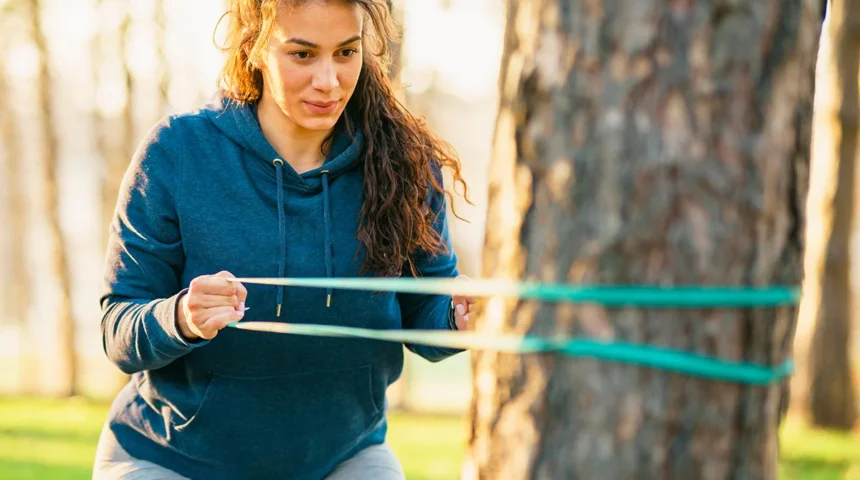
While many daily activities and common exercises focus on pushing movements, developing adequate pulling strength is equally, if not more, vital for overall upper body health, posture, and injury prevention. The standing band row specifically targets the upper back, latissimus dorsi, rear shoulders, and biceps, addressing imbalances that can arise from a sedentary lifestyle or overemphasis on anterior chain muscles. Resistance bands offer an excellent, easily adjustable form of resistance, making this exercise highly versatile for older adults.
Execution Guidance:
- Setup: Secure a resistance band around a sturdy anchor point at chest height. Stand facing the anchor point, holding one end of the band in each hand (or both ends in one hand for a single-arm variation). Step back until there is light tension in the band, with your arms extended forward. Maintain a slight bend in your knees and engage your core.
- Pull: Exhale and pull the band towards your torso, squeezing your shoulder blades together. Focus on initiating the movement with your back muscles, keeping your elbows close to your body. Avoid leaning backward to generate momentum.
- Release: Inhale and slowly control the band as your arms extend back to the starting position, resisting the pull of the band.
- Muscles Engaged: Upper back (rhomboids, trapezius), latissimus dorsi, posterior deltoids, and biceps.
- Repetition Scheme: Perform 2 to 3 sets of 10 to 15 repetitions, resting for approximately 45 seconds.
- Progression: To increase the challenge, step farther away from the anchor point to increase band tension, or use a resistance band with a stronger resistance level. Introducing a pause at the peak of the pull can also enhance muscle activation.
5. Kettlebell Deadlift: Mastering the Hip Hinge for Functional Power
The kettlebell deadlift is a foundational exercise for developing strength in the posterior chain—the glutes and hamstrings—as well as the lower back and core. It teaches the crucial hip hinge movement pattern, which is fundamental to safely lifting objects from the floor, gardening, and many other daily tasks. The design of the kettlebell allows the weight to remain close to the body, making the setup and execution more manageable and often safer than traditional barbell deadlifts, especially for those new to the movement.
Execution Guidance:
- Setup: Place a kettlebell on the floor directly between your feet, which should be about hip-width apart. Hinge at your hips, pushing your glutes back, and keeping a soft bend in your knees. Maintain a neutral spine (flat back) and reach down to grasp the kettlebell handle with both hands. Your chest should be up, and your shoulders pulled back.
- Lift: Take a deep breath, brace your core, and initiate the lift by driving through your heels and extending your hips and knees simultaneously. Stand tall, squeezing your glutes at the top of the movement. Keep the kettlebell as close to your body as possible throughout the ascent.
- Lower: Control the descent by reversing the movement, hinging at your hips first, allowing the kettlebell to track down your thighs and shins until it lightly touches the floor. Maintain a neutral spine throughout.
- Muscles Engaged: Glutes, hamstrings, quadriceps, lower back erectors, and core stabilizers.
- Repetition Scheme: Aim for 2 to 3 sets of 6 to 10 repetitions, with 60 to 90 seconds of rest between sets.
- Progression: Once the movement pattern is solid and performed with impeccable form, increase the weight of the kettlebell. For individuals who struggle with the initial range of motion, placing the kettlebell on a slight elevation (e.g., a low step or thick mats) can reduce the distance it needs to travel.
Key Principles for Sustained Progress
Embarking on a strength training journey after 70 requires more than just performing exercises; it demands a holistic approach. Consistency is paramount; regular engagement, typically 2-3 times per week, allows for continuous adaptation. Adequate rest and recovery are equally vital, as muscle repair and growth occur outside of the training session. Nutrition, particularly sufficient protein intake, supports muscle synthesis. Hydration plays a critical role in cellular function and overall well-being. Furthermore, listening to one’s body, recognizing the difference between muscle fatigue and pain, and adapting training as needed are essential for long-term adherence and injury prevention.
It is always advisable for individuals over 70, or anyone with pre-existing health conditions, to consult with a healthcare professional before beginning any new exercise program. Additionally, seeking guidance from a certified personal trainer specializing in older adults can provide personalized instruction, ensure proper form, and help tailor a program that aligns with individual goals and physical capabilities.
The notion that significant strength gains are unattainable after the age of 70 is a myth that needs to be dispelled. By adopting a progressive, evidence-based approach to resistance training, focusing on fundamental movement patterns, and prioritizing proper form and gradual overload, individuals can not only restore a remarkable degree of the strength they enjoyed in their fifties but also forge a path toward enhanced vitality, independence, and an improved quality of life for years to come. The power to build a stronger self, regardless of chronological age, remains within reach.

Related News