
A common human reflex, particularly when straining to discern a faint auditory signal amidst a cacophony, is to close one’s eyes. This instinctive action is widely presumed to enhance hearing acuity by eliminating visual distractions, thereby allowing the brain to dedicate more processing power to sound. However, recent scientific inquiry suggests this widely held belief may be a miscalculation, especially in environments saturated with ambient noise. Researchers have embarked on an investigation to rigorously test the efficacy of this auditory enhancement strategy, yielding findings that counter deeply ingrained assumptions about sensory processing.
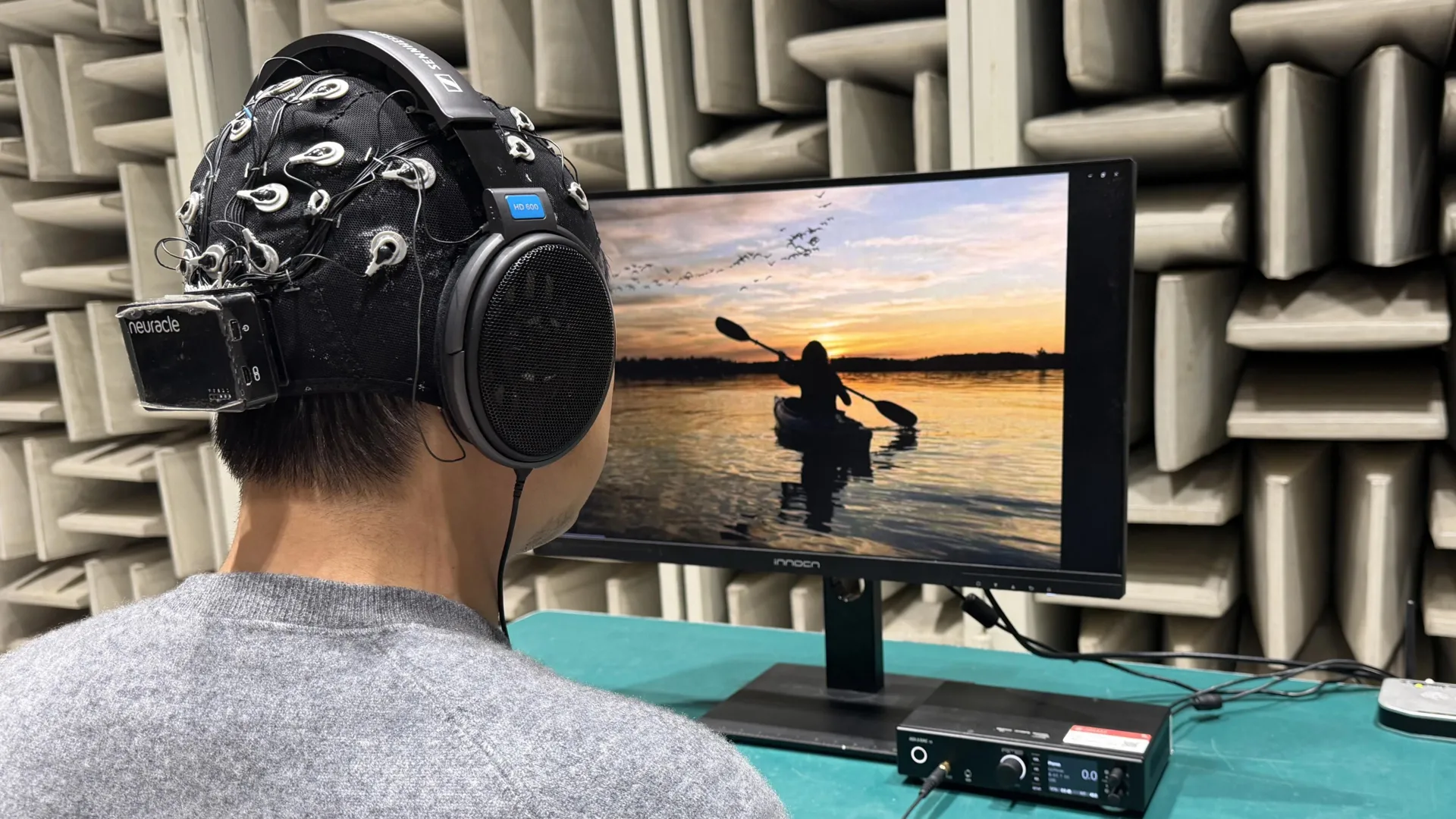
A significant study, published in the esteemed journal JASA (Journal of the Acoustical Society of America) by AIP Publishing, was specifically designed to dissect the relationship between visual input and auditory detection capabilities under challenging acoustic conditions. The research team, hailing from Shanghai Jiao Tong University, sought to empirically determine the precise impact of visual information – or the absence thereof – on an individual’s capacity to perceive sounds. Their methodology involved a meticulously designed experimental setup to probe the intricate interplay between our senses.
The core of the experimental design centered on participants engaging with a series of auditory stimuli while simultaneously being exposed to a controlled level of background noise. Participants were tasked with a specific objective: to meticulously adjust the volume of the presented sounds until each one reached the threshold of audibility, meaning it could be just barely detected above the pervasive noise. This threshold determination is a standard psychophysical technique used to quantify sensory sensitivity.
To systematically evaluate the influence of visual engagement, the study incorporated a range of visual conditions. Initially, participants performed the auditory detection task with their eyes deliberately closed. Following this baseline, they were instructed to repeat the same task under several distinct visual circumstances. These included having their eyes open while fixating on a uniformly blank screen, a condition designed to minimize any potential visual stimulation. Subsequently, participants viewed a static, still image that was thematically linked to the auditory stimulus being presented. The final visual condition involved participants watching a dynamic video segment that precisely synchronized with the sounds they were hearing, creating a congruent multisensory experience.
The empirical outcomes of this rigorous investigation presented a stark departure from the prevailing popular assumption. Contrary to the widespread notion that sensory deprivation in the visual domain amplifies auditory perception, the study’s findings indicated the opposite. Lead author Yu Huang articulated that "contrary to popular belief, closing one’s eyes actually impairs the ability to detect these sounds." This assertion directly challenges the intuitive appeal of the "eyes closed for better hearing" maxim. The research further illuminated the significant benefits derived from engaging with relevant visual information, demonstrating that "seeing a dynamic video corresponding to the sound significantly improves hearing sensitivity." This suggests that instead of facilitating the perception of faint sounds in noisy environments, the act of closing one’s eyes may, in fact, create a disadvantage. Conversely, the presence of congruous visual input appears to confer a distinct and measurable advantage in auditory processing.
To delve deeper into the neurological underpinnings of these observed phenomena, the researchers employed electroencephalography (EEG), a non-invasive technique that monitors electrical activity in the brain. This allowed them to track and analyze brain activity patterns as participants underwent the various experimental conditions. The EEG data revealed a fascinating neurological shift associated with eye closure. The researchers discovered that the act of closing one’s eyes appears to transition the brain into a specific operational state referred to as neural criticality. Within this state, the brain exhibits an amplified propensity for filtering incoming sensory information.
This heightened filtering mechanism, while potentially beneficial for excluding irrelevant stimuli, carries a significant caveat. It is not merely background noise that is suppressed; the same heightened filtering can inadvertently dampen the very target sounds that individuals are attempting to perceive. Huang elaborated on this mechanism, explaining that "in a noisy soundscape, the brain needs to actively separate the signal from the background." The research suggests that the introspective focus induced by closing the eyes can be counterproductive in this scenario, leading to an "over-filtering" effect. In contrast, active visual engagement appears to serve as an external anchor, helping to "anchor the auditory system to the external world," thereby facilitating a more effective separation of auditory signal from noise.
It is crucial to note that the observed detriments of eye closure are not universally applicable across all auditory conditions. The research team pointed out that the effect appears to be specifically pronounced in environments characterized by significant background noise. In scenarios where ambient noise levels are minimal, the traditional benefit attributed to closing one’s eyes – potentially enhancing the detection of very subtle sounds by minimizing visual interference – might still hold true. However, considering the ubiquity of background noise in everyday life, from bustling city streets to conversations in moderately crowded rooms, maintaining an open and engaged visual field may represent a more consistently effective strategy for optimal auditory perception in a majority of situations.
The researchers are keen to expand upon these foundational findings and have outlined plans for future investigations into the intricate relationship between vision and hearing. A primary question guiding their subsequent research is the extent to which the observed benefits of visual input stem from the mere presence of visual information versus the specific congruence between visual and auditory stimuli. Dr. Huang indicated their intention to explore scenarios involving "incongruent pairings," posing the intriguing hypothetical: "what happens if you hear a drum but see a bird?" This line of inquiry aims to differentiate whether the auditory enhancement is a general consequence of increased visual processing, or if it hinges on a more specific form of multisensory integration where the visual and auditory information must align. Clarifying this distinction, they believe, will be instrumental in disentangling the broader effects of attentional allocation from the specialized advantages conferred by perfectly matched multisensory experiences.
About the Author












