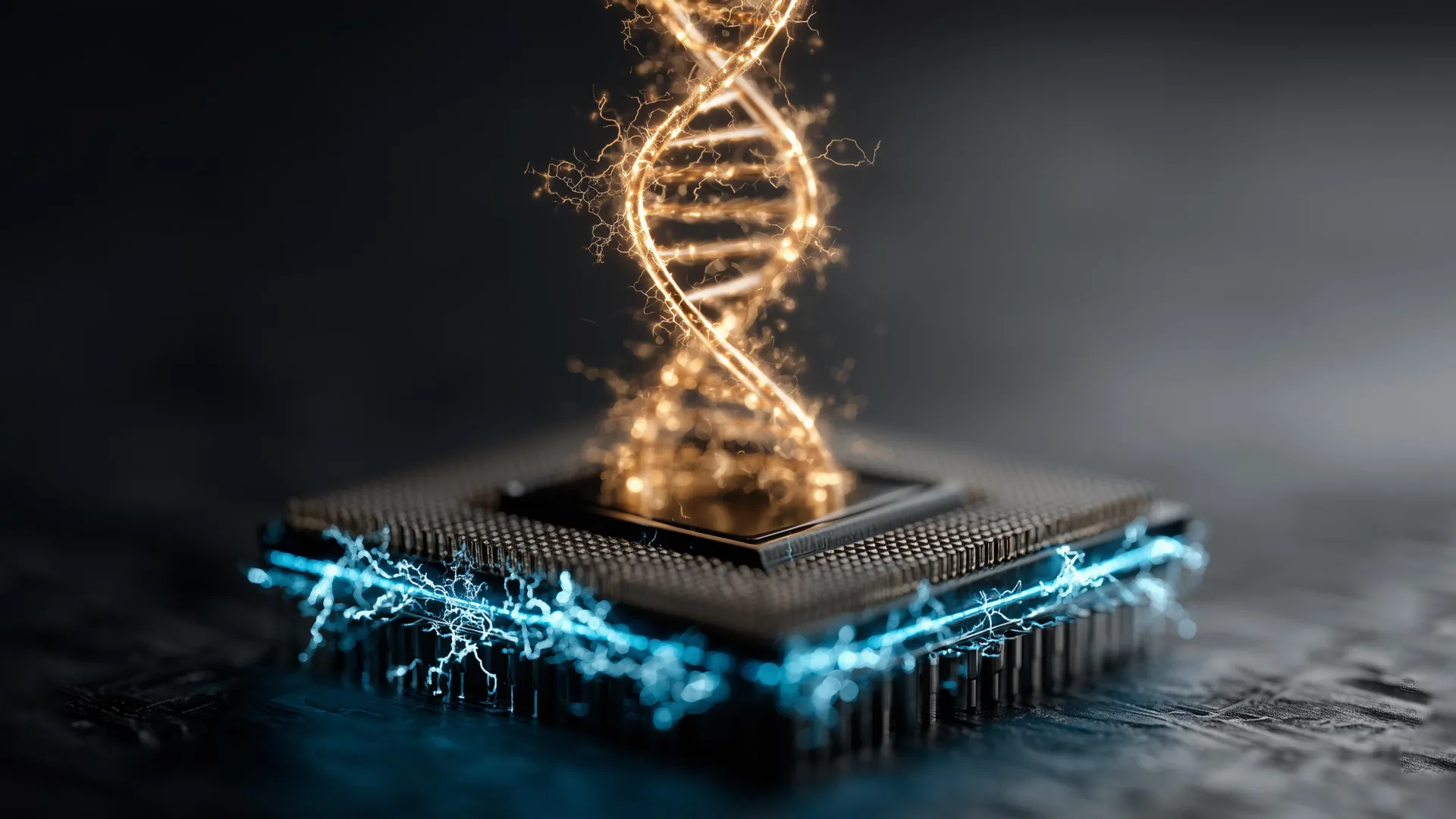
The foundational role of semiconductor technology, long central to digital computation, is undergoing a profound redefinition as researchers increasingly harness its capabilities to interact with biological systems. Beyond its traditional function of processing data, silicon-based platforms are now being engineered to probe neural networks, decode genetic information, and, most recently, to construct DNA sequences with unprecedented precision. A groundbreaking study, detailed in the scientific journal Nature Electronics, highlights a significant leap in this interdisciplinary convergence, revealing a novel silicon chip adept at simultaneously fabricating 64 distinct DNA strands. This innovation represents a pivotal departure from conventional synthetic DNA manufacturing, opting for an environmentally conscious, aqueous enzymatic methodology meticulously controlled by localized electrical currents.
This pioneering endeavor was spearheaded by Donhee Ham, a distinguished engineering and applied sciences professor at Harvard University’s John A. Paulson School of Engineering and Applied Sciences (SEAS), marking a critical advancement in the field of synthetic biology.
The Indispensable Role of Synthetic DNA and the Limitations of Current Methods
Synthetic deoxyribonucleic acid (DNA) is an indispensable tool across a vast spectrum of modern scientific and medical disciplines. Its applications span from the development of advanced diagnostic assays and the precise engineering of genomes to the creation of novel therapeutic agents, including mRNA vaccines, and sophisticated research into complex diseases like cancer. The ability to custom-design and produce specific DNA sequences is critical for understanding biological processes, developing targeted treatments, and pushing the boundaries of biotechnology.
Presently, the vast majority of custom DNA sequences are generated through phosphoramidite chemistry, a well-established and highly effective method renowned for its capacity to synthesize millions of unique sequences in parallel. While robust, this process is not without its drawbacks. It relies heavily on a battery of hazardous organic solvents, necessitating operations within specialized, centrally located facilities equipped to handle and dispose of these chemicals responsibly. This centralized model, coupled with the environmental burden of solvent usage, presents logistical and ecological challenges that limit the scalability and distributed potential of DNA synthesis.
In response to these limitations, scientists have actively explored enzymatic DNA synthesis as a more sustainable and biologically inspired alternative. This approach utilizes water as a solvent, closely mirroring the natural mechanisms by which living cells construct DNA. The inherent gentleness and biocompatibility of enzymatic methods hold the promise of enabling smaller, safer, and potentially more accessible DNA synthesis platforms, which could democratize access to this critical technology. However, a significant hurdle has persisted: enzymatic methods have historically lagged far behind the throughput of conventional phosphoramidite chemistry, with prior demonstrations typically limited to synthesizing only around a dozen sequences concurrently. The Harvard team’s latest achievement, fabricating 64 distinct DNA sequences, each comprising up to 39 nucleotides, establishes a new benchmark for this burgeoning technology, dramatically expanding the parallel synthesis capabilities of enzymatic approaches.
Deciphering the Chip’s DNA "Writing" Mechanism
The process of constructing a DNA strand is a meticulous, step-by-step affair, where nucleotides are added one at a time. Following the incorporation of each new nucleotide, a temporary chemical "blocking group" is appended to prevent premature or uncontrolled further growth. For the next nucleotide to be successfully attached, this blocking group must be precisely removed through a process known as deprotection. In the context of the Harvard chip’s enzymatic method, this deprotection step is triggered by specific acidic conditions, or a localized reduction in pH, within an aqueous environment.
The ability to synthesize multiple, diverse DNA sequences concurrently demands the precise control of pH reduction, ensuring it occurs only at designated locations during each cycle of synthesis. The Harvard chip achieves this sophisticated control through the ingenious application of minute electrical currents. Its meticulously engineered surface features 64 independent synthesis sites. Each of these sites is equipped with a pair of concentric ring electrodes positioned around the DNA molecules, which are anchored at the center of the site. When a particular synthesis location requires activation, the inner electrode is energized, initiating the generation of protons that effectively lower the local pH within that specific, confined region. Simultaneously, the outer electrode acts as a proton scavenger, actively removing any protons that might diffuse outwards, thereby ensuring the acidic microenvironment remains strictly localized to the intended site. By iteratively repeating this highly controlled process over multiple synthesis cycles, the chip can independently and simultaneously construct 64 unique DNA sequences across its surface.
An Unforeseen Evolution: From Brain Research to Genetic Engineering
Intriguingly, the innovative semiconductor platform at the heart of this DNA synthesis breakthrough was not originally conceived for genetic engineering applications. Its initial design brief was rooted in neuroscience. Jeffrey Abbott, a former doctoral candidate in Professor Ham’s laboratory, first developed the silicon electronics with the aim of recording electrical activity from large populations of neurons. The technology was designed to achieve precise current injection, enabling researchers to temporarily permeabilize neuronal membranes for intracellular access, thereby gaining deeper insights into neural communication.
It was through a subsequent re-evaluation and redesign of the surface electrodes that the researchers realized the profound versatility of their underlying technology. The same precise electrical control mechanisms, initially developed to manipulate cellular environments, could be repurposed to exquisitely control the specific chemical conditions required for DNA synthesis. As Professor Ham himself articulated, "A defining feature of the chip was precision current injection, which we used to permeabilize neuronal membranes for intracellular access. At a certain point, we wondered whether that same current control could be redirected from cells to molecules, replacing the neuron-facing electrodes with ring-electrode pairs that could localize pH for DNA synthesis. It worked." This unexpected cross-application underscores the interconnectedness of scientific principles and the potential for technological innovation to transcend disciplinary boundaries.
Far-Reaching Implications and the Vision of DNA Data Storage
Beyond its immediate applications in synthetic biology and advanced medical diagnostics, the research team demonstrated a compelling future possibility: the use of the 64 synthesized DNA sequences to encode digital information, successfully storing a 169-byte text. This demonstration highlights the immense potential of DNA for data storage, a concept that has garnered significant interest in an increasingly data-intensive world.
DNA-based data storage, while still a long-term aspiration, offers tantalizing advantages. Its unparalleled information density means that vast quantities of data could theoretically be stored in minuscule volumes, far exceeding the capacities of current electronic or magnetic storage media. Furthermore, DNA boasts exceptional longevity, capable of preserving information for millennia under appropriate conditions, making it an ideal candidate for archival data. However, the realization of DNA data storage on a practical scale necessitates the ability to synthesize DNA at an enormous, industrial level. The researchers firmly believe that water-based enzymatic synthesis, with its inherent scalability and reduced environmental footprint, could become an increasingly attractive and viable pathway as the demand for high-volume DNA production grows. Reducing the reliance on hazardous organic solvents would significantly mitigate the environmental impact associated with large-scale DNA manufacturing, aligning perfectly with sustainability goals.
Woo-Bin Jung, a co-first author of the study and now an assistant professor of chemical engineering at Pohang University of Science and Technology (POSTECH), who conducted this work during his postdoctoral research in Ham’s lab, emphasized this point: "DNA data storage asks DNA synthesis to operate at a scale far beyond today’s needs. That is why enzymatic synthesis in water can matter. If far more than 64 sequences can be synthesized in parallel, it could offer an environmentally friendly route toward writing DNA at very large scale."
Navigating Future Obstacles: The Chemistry Challenge
In their pursuit of further scaling the technology, the research team conducted experiments with chips designed to accommodate synthesis sites positioned closer together, aiming to significantly increase the number of DNA sequences that could be produced concurrently. While this experiment did not achieve the desired increase in density, it yielded a crucial insight that redirects future research efforts. The chip itself, remarkably, demonstrated its ability to precisely confine the low pH conditions to the intended, microscopic locations, proving the efficacy of its electrical control mechanism.
The true limiting factor, it was discovered, lay not with the semiconductor technology but with the underlying chemistry employed during the deprotection step. Instead of directly removing the blocking groups through the acidic conditions, the low pH primarily generates intermediate molecules. It is these intermediate molecules that then perform the actual deprotection. The challenge arises because these intermediate molecules possess a degree of mobility; they can drift from their intended synthesis site into neighboring regions. This unwanted diffusion effectively reduces the spatial separation between adjacent reactions, even when the pH control at each site remains impeccably tight.
Han Sae Jung, another co-first author of the study and a former graduate student and current postdoctoral researcher at Harvard, succinctly summarized this finding: "The chip did what we asked it to do: it localized low pH at selected sites. The limitation came from the deprotection chemistry, not from the silicon. That leaves a clear next step for the field — develop a more direct acid-driven deprotection chemistry that can keep pace with the chip." This revelation underscores the iterative nature of scientific progress, highlighting that advancements often uncover new, previously unseen challenges that demand further interdisciplinary innovation in both engineering and chemistry.
A Collaborative Endeavor and Essential Support
This groundbreaking project represents a testament to collaborative scientific research, bringing together expertise from Harvard University, the Broad Institute, DNA Script, and later POSTECH. Harvard’s Office of Technology Development has diligently filed intellectual property related to this innovative platform, recognizing its significant potential. The comprehensive study, aptly titled "Parallel enzymatic DNA synthesis using a semiconductor chip," received vital financial backing from multiple sources, including the Office of the Director of National Intelligence (ODNI), the Intelligence Advanced Research Projects Activity (IARPA) via grant 2019-19081900002, Horizon Europe through the Hyperion project ID: 101115253, and Samsung Research Funding & Incubation Center for Future Technology of Samsung Electronics under Project Number SRFC-IT2402-09. This broad support underscores the strategic importance and potential impact of this research on future biotechnological landscapes.
About the Author