Maintaining robust lower body strength is a cornerstone of independent living and overall well-being, particularly as individuals progress beyond the age of 60. The natural physiological process of aging often brings challenges such as sarcopenia, a progressive and generalized loss of skeletal muscle mass and strength, which typically begins in one’s 30s and accelerates significantly after 50. This decline in muscle power can profoundly impact daily activities, balance, and increase the risk of debilitating falls. While traditional strength-building exercises like squats are highly effective, they can present difficulties for older adults due to concerns regarding joint pressure, balance requirements, and potential exacerbation of pre-existing conditions in the knees, hips, or lower back. Fortunately, a series of targeted, low-impact exercises performed from the comfort of a bed or floor can offer a highly effective and safer alternative for restoring and enhancing leg strength, often yielding quicker results than higher-impact movements for this demographic.
The emphasis on low-impact, supine (lying down) exercises for older adults stems from several critical advantages. Firstly, performing movements while lying down significantly reduces the gravitational load on weight-bearing joints such as the knees and hips, making these exercises accessible even for those managing arthritis, recovering from injuries, or experiencing chronic joint pain. Secondly, the stable base provided by a bed or floor eliminates the need for complex balance, which can be a major barrier for individuals with diminished proprioception or a fear of falling. This enhanced stability fosters a sense of security, encouraging consistent participation and allowing individuals to focus purely on muscle engagement and proper form. Thirdly, these exercises are remarkably convenient, requiring no specialized equipment and fitting easily into a daily routine, even upon waking or before sleep.
Expert insights underscore the efficacy of these modified strength training protocols. Nikkiey Stott, a certified coach, three-time Pro Bodybuilder (OCB), and co-founder of WarriorBabe, a leading voice in women’s health and fitness, champions this approach. Stott emphasizes that "when you’re lying down, you can still strengthen a lot of the same muscles that squats work—including your glutes, quads, hamstrings, and inner thigh muscles." She further elaborates on the key distinction: "The difference is that floor exercises remove the pressure from your knees and hips, and you don’t require balance. This makes them a great starting point for women over 60 who want to rebuild strength in a safe and controlled way." This philosophy highlights a strategic shift from high-load, multi-joint movements to isolated, controlled contractions that build foundational strength without unnecessary strain.
The primary muscle groups targeted by these bed-based exercises—the glutes, quadriceps, hamstrings, and adductors/abductors (inner and outer thigh muscles)—are fundamental for virtually all lower body movements. Strong gluteal muscles are essential for hip extension, propulsion, and maintaining an upright posture. Robust quadriceps support knee stability and enable actions like standing up from a chair or climbing stairs. Powerful hamstrings facilitate knee flexion and contribute to walking and running mechanics. Meanwhile, well-conditioned inner and outer thigh muscles contribute to hip stability, preventing lateral swaying and improving overall balance. By focusing on these specific muscle groups in a controlled environment, older adults can effectively counteract muscle atrophy and enhance their functional capacity.
Here are five highly effective bed-based exercises, offering a comprehensive approach to revitalizing lower body strength:
1. Glute Bridges: This foundational exercise is excellent for activating the glutes and strengthening the posterior chain without placing stress on the knees. To perform a glute bridge, lie on your back with knees bent and feet flat on the bed, hip-width apart, arms resting by your sides. Engage your core and glutes, then lift your hips off the bed until your body forms a straight line from your shoulders to your knees. Hold this position for a moment, squeezing your glutes at the top, then slowly lower your hips back down. This movement primarily targets the gluteus maximus, with secondary engagement of the hamstrings and core stabilizers. Regularly performing glute bridges can improve hip extension, alleviate lower back pain by strengthening supporting muscles, and enhance overall posterior chain power crucial for walking and standing. Aim for 10-15 repetitions, performing 2-3 sets.
2. Straight Leg Raises: This exercise effectively targets the quadriceps and hip flexors, vital for knee stability and lifting the legs. Lie flat on your back with one leg bent at the knee, foot flat on the bed, and the other leg extended straight. Keeping the extended leg straight and the foot flexed (toes pointing up), slowly lift it off the bed, engaging the quadriceps. Raise it to about a 45-degree angle or until it aligns with the bent knee, ensuring your lower back remains pressed into the bed. Hold briefly at the top, then slowly lower the leg back down, resisting gravity. Perform 10-15 repetitions on each leg for 2-3 sets. This exercise is particularly beneficial for individuals needing to strengthen the muscles around the knee joint or improve the ability to clear obstacles while walking. For an added challenge, a small ankle weight can be introduced as strength improves.
3. Inner Thigh Squeeze (Adductor Squeeze): This exercise specifically targets the adductor muscles, which are crucial for hip stability and controlling leg movement. Lie on your back with knees bent and feet flat on the bed, similar to the glute bridge starting position. Place a small pillow, rolled towel, or soft ball between your knees. Gently squeeze the object with your inner thighs, engaging the adductor muscles. Hold the squeeze for 5-10 seconds, feeling the contraction, then slowly release. The key is controlled pressure, not forceful exertion. Repeat this squeezing action for 10-15 repetitions, completing 2-3 sets. Strong adductors contribute to better balance, reduce the risk of knee pain, and support efficient walking patterns by preventing excessive outward rotation of the legs. This subtle movement is highly effective for building strength in often-neglected inner thigh muscles.
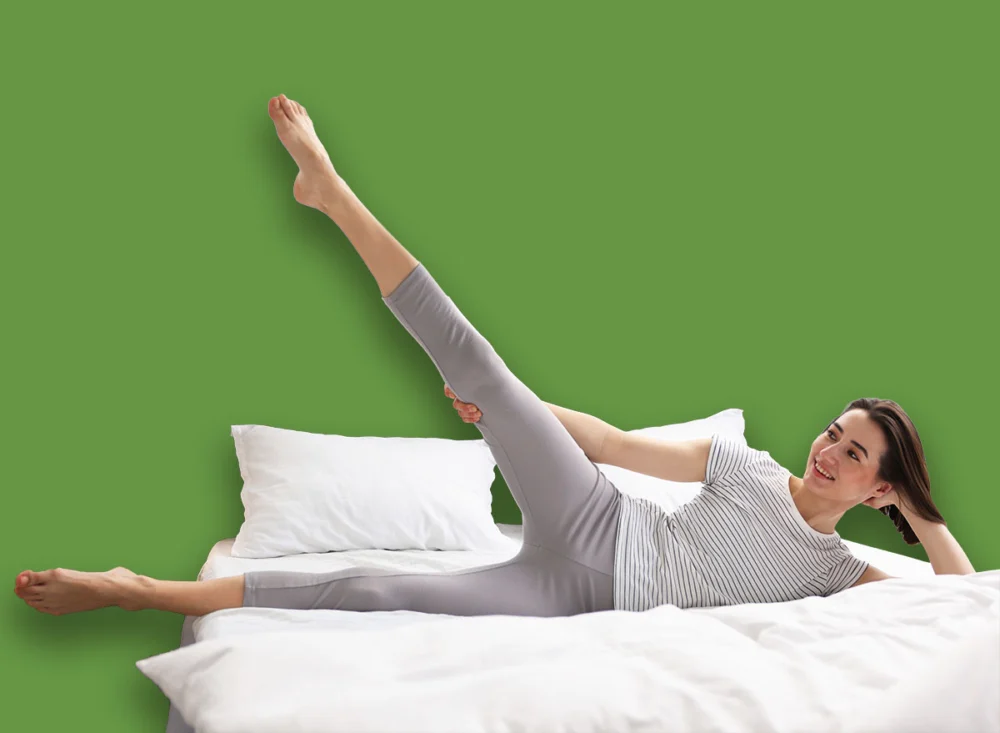
4. Side-Lying Leg Lifts: These lifts are excellent for strengthening the abductor muscles, particularly the gluteus medius, which plays a critical role in hip stability and preventing the pelvis from dropping during walking. Lie on your side, supporting your head with your lower arm or a pillow. Stack your legs one on top of the other, keeping them straight. Ensure your hips are stacked directly above each other, not rolled forward or backward. Keeping your top leg straight and foot flexed, slowly lift it towards the ceiling, leading with the heel. Only lift as high as comfortable, maintaining hip alignment. Avoid rocking your torso. Hold briefly at the peak of the movement, then slowly lower the leg back down. Complete 10-15 repetitions on each side for 2-3 sets. Strong hip abductors are fundamental for maintaining balance, supporting lateral movements, and reducing strain on the knees and lower back.
5. Heel Slides: This exercise is particularly beneficial for improving knee flexibility and strengthening the hamstrings and quadriceps in a controlled manner, making it ideal for rehabilitation or gentle strengthening. Lie flat on your back with both legs extended straight. Slowly slide one heel towards your glutes, bending the knee and keeping the heel in contact with the bed surface. Go only as far as comfortable, feeling a stretch in the hamstring and engaging the quadriceps as you extend. Once the knee is bent, gently slide the heel back down, returning the leg to the extended position. Perform 10-15 repetitions on each leg for 2-3 sets. This movement promotes healthy knee articulation, enhances hamstring flexibility, and builds strength in a non-weight-bearing context, which is perfect for individuals with sensitive knee joints.
As Stott advises, these bed or floor workouts serve as an excellent initial phase for building strength and confidence. Over time, the objective should be to gradually progress towards standing bodyweight exercises as balance and strength improve, further enhancing functional mobility. This gradual progression is key to sustainable fitness in older age. Beyond these specific exercises, a holistic approach to wellness for seniors also involves adequate protein intake to support muscle synthesis, sufficient hydration, and incorporating other forms of gentle physical activity such as walking or stretching.
In conclusion, for individuals over 60 seeking to revitalize their leg strength and maintain an active, independent lifestyle, low-impact, bed-based exercises offer a safe, effective, and accessible pathway. By specifically targeting crucial muscle groups—the glutes, quadriceps, hamstrings, and inner/outer thigh muscles—these routines can counteract age-related muscle loss, improve balance, and significantly reduce the risk of falls, often yielding faster results than more strenuous alternatives like squats. Prioritizing these controlled movements empowers older adults to build a robust physical foundation, supporting their mobility and enhancing their overall quality of life. As with any new exercise regimen, consulting with a healthcare professional or physical therapist before beginning is always recommended to ensure it aligns with individual health needs and capabilities.
About the Author