
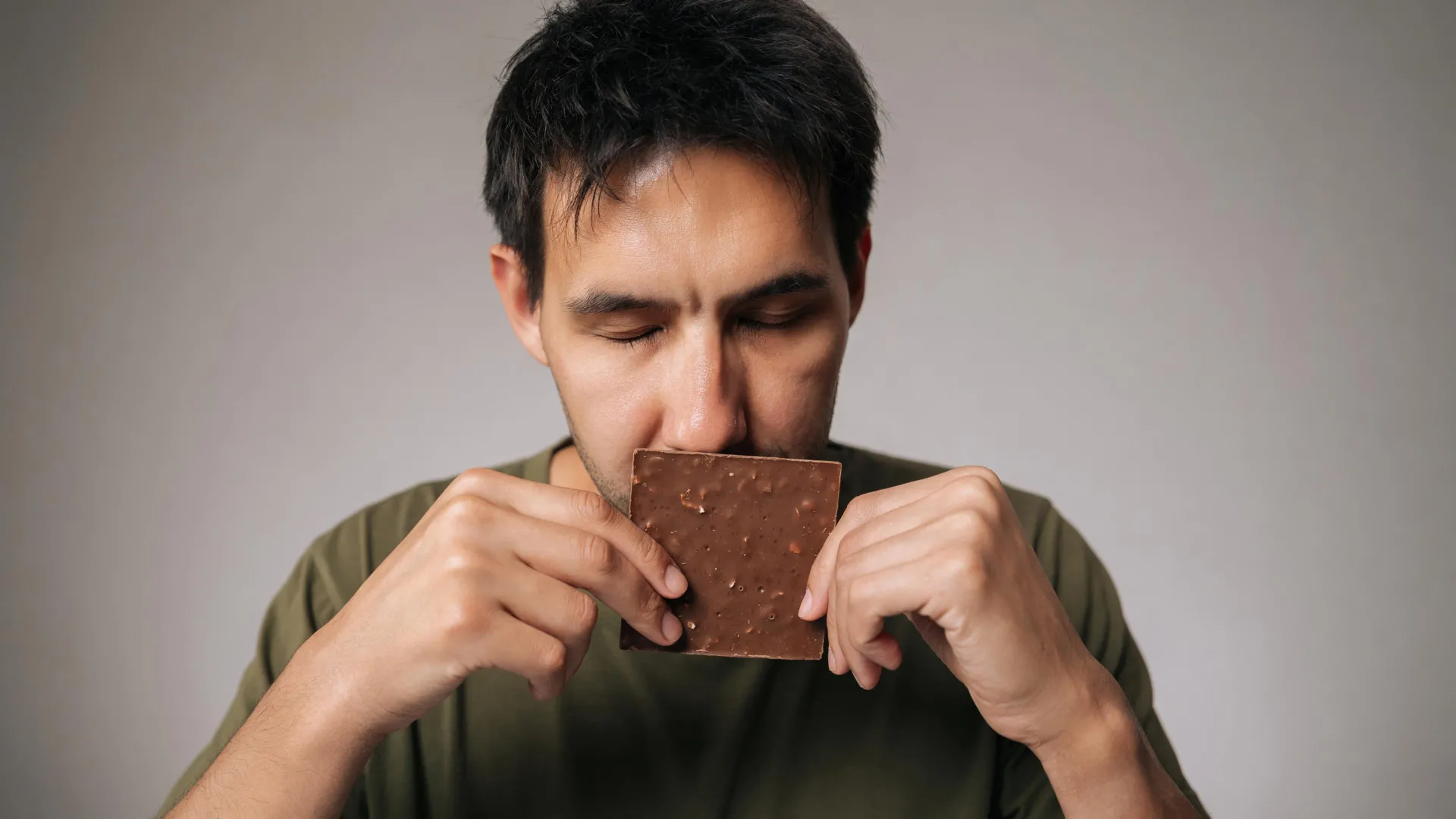
The intricate relationship between our sensory experiences and physical capabilities has long fascinated researchers, particularly in the realm of sports science and human performance. A recent investigation, detailed in Frontiers in Physiology, unveils a remarkable intersection of olfaction, appetite regulation, and athletic output, suggesting that the mere aroma of chocolate could significantly enhance exercise capacity without escalating the subjective feeling of exertion. This groundbreaking study posits that specific olfactory cues possess the potential to subtly recalibrate an individual’s perception of effort and even influence their physiological state, offering a novel avenue for improving physical training outcomes.
The research delved into the psychobiological effects of distinct chocolate aromas on moderately trained men undergoing resistance exercise. Lead author Dr. Mohamed Nashrudin bin Naharudin, an assistant professor at the Faculty of Sports and Exercise Science at the University of Malaya, highlighted the unexpected yet profound observation: "Exposing moderately trained men to chocolate odors right before and between sets of resistance exercise significantly increased their overall training volume without increasing their perceived exertion." He further emphasized the fascinating nature of witnessing a substantial increase in repetitions achieved by athletes who reported no additional strain, underscoring the powerful, yet often overlooked, influence of sensory input on physical performance.
To systematically explore this hypothesis, the study recruited 23 healthy males, primarily in their early to mid-twenties, who possessed a moderate level of physical training experience. These participants were carefully assigned to one of three experimental conditions, each involving exposure to a different olfactory stimulus. The chosen scents included a liquid preparation of dark chocolate, characterized by a high cocoa content of 90%; a liquid milk chocolate sample, containing 60% cocoa; and plain water, serving as the inert control. The decision to use liquid samples ensured a consistent and controlled release of aroma, allowing for precise delivery of the olfactory stimuli throughout the experimental protocol.
A crucial aspect of the study design involved a pre-exercise fasting period of at least ten hours for all participants. This rigorous protocol aimed to standardize baseline hunger levels and ensure that any observed shifts in appetite or performance were attributable to the olfactory stimuli rather than recent food intake. Participants then engaged in leg extensions, a widely utilized resistance exercise that isolates the quadriceps muscles. This specific exercise was selected for its ability to provide a measurable and repeatable metric of lower body strength and endurance. Researchers meticulously recorded performance metrics both prior to and continuously during the training session. Additionally, participants provided subjective ratings of their hunger, feelings of fullness, desire to consume food, and future eating intentions before commencing exercise. These appetite-related perceptions were subsequently reassessed after each 30-second interval of scent exposure during their sets, allowing for real-time monitoring of the aroma’s impact.
The findings revealed a fascinating divergence in how the two chocolate aromas influenced appetite regulation. The scent of dark chocolate, in particular, demonstrated a consistent association with a reduction in hunger, a diminished desire and intention to eat, and an amplified sense of satiety prior to the exercise regimen, when compared to both the water control and the milk chocolate condition. This suggests that the dark chocolate aroma primarily exerted its influence on appetite by actively decreasing hunger signals and promoting a feeling of fullness, even in a fasted state. In contrast, while the milk chocolate aroma was consistently rated as more pleasant than either dark chocolate or water, it did not produce a statistically significant alteration in participants’ baseline hunger or overall appetite levels. This qualitative difference in subjective pleasantness versus physiological impact hinted at distinct underlying mechanisms.
Beyond their differential effects on appetite, the chocolate aromas profoundly impacted the participants’ exercise capacity. The researchers observed a substantial increase in the number of repetitions completed during leg extensions under the influence of both chocolate scents. Specifically, inhaling the aroma of 90% dark chocolate corresponded to an average increase of approximately 18 additional repetitions, while the 60% milk chocolate scent facilitated an increase of about nine repetitions, both relative to the odorless water control. This outcome is particularly intriguing because these gains in training volume were achieved without participants reporting any corresponding increase in their perceived level of exertion. The implication is that the olfactory stimuli effectively decoupled physical output from subjective effort, allowing individuals to push beyond their normal limits without experiencing greater fatigue or discomfort.
The researchers propose that these observed effects are likely rooted in learned associations between specific food aromas and subsequent physiological or psychological states. From early childhood, individuals repeatedly encounter certain smells concurrently with the act of eating. Over time, these aromas become powerful conditioned cues, signaling to the brain and body what typically transpires after food consumption. These anticipatory expectations can be potent enough to shift an individual’s internal perception, moving them from a state of hunger towards one of perceived fullness, even before any caloric intake has occurred.
Dr. Nashrudin Naharudin elaborated on this hypothesis, suggesting that "the dark chocolate scent serves as a learned cue for a rich, bitter, and highly satiating food, which essentially tricks the system into an anticipatory state of fullness." This pre-emptive sense of satisfaction, even without actual consumption, could potentially contribute to a reduced perception of effort during physical activity. Conversely, he posited that "the sweeter milk chocolate scent acts more like a hedonic reward cue, enhancing training volume by creating a highly pleasant sensory environment rather than by shifting basic metabolic hunger signals." This implies that the more palatable milk chocolate aroma might function as a psychological motivator, enhancing performance through a positive sensory experience rather than through direct modulation of hunger or satiety pathways. This distinction is crucial, highlighting the complex and varied ways in which olfactory cues can influence human behavior and physiology.
The implications of these findings are particularly compelling, as they suggest that the mere anticipation of food, triggered solely by its aroma, could elicit responses akin to those induced by actual consumption. This phenomenon is especially remarkable given that the participants were in a fasted state when these effects were observed. Food aromas may, therefore, serve as powerful signals that prime the digestive system for an impending meal or induce a cascade of psychological and physiological adjustments as the body prepares for intake. Some of these anticipatory responses could mirror the changes that typically occur post-consumption, such as altered hormonal profiles or neural activity patterns associated with satiety and reward.
Despite the intriguing nature of these discoveries, the research team emphasizes that the precise biological mechanisms underpinning these effects remain largely speculative. A significant limitation of the study was the absence of direct measurements of blood hormone levels or detailed neural activity. Consequently, the investigation cannot definitively elucidate the exact biological pathways responsible for the observed changes in appetite and exercise performance. This gap means that while a correlation has been established, the causal chain at a molecular or neurobiological level is yet to be fully mapped.
Furthermore, several other methodological constraints warrant consideration. The researchers acknowledge that the perceived intensity of the dark and milk chocolate aromas might not have been perfectly equivalent, which could have subtly influenced the results. Moreover, the use of odorless water as the control sample posed a potential for participant awareness; individuals in the control group might have realized they were not receiving an active scent, potentially introducing a degree of bias or expectancy effect. The study’s relatively small sample size and its demographic restriction to healthy, moderately trained young men also limit the generalizability of the findings. Future research involving larger and more diverse populations, encompassing various age groups, fitness levels, and genders, will be essential to ascertain the broader applicability of these intriguing observations.
An important unanswered question pertains to the specificity of chocolate’s effects. Is there something inherently unique about chocolate that elicits these responses, or could other familiar food aromas produce similar outcomes? Dr. Nashrudin Naharudin concluded that while chocolate possesses "incredibly strong, universally recognized reward associations," it is unlikely to be entirely unique in its potential. He hypothesized that other foods strongly associated with feelings of satisfaction after eating might also yield comparable responses, though this concept has yet to be empirically tested. The critical factor, he suggested, is that "a person likely needs to find the odor familiar and appealing — or at least not repulsive — to trigger the psychological shift in appetite that’s needed to see a performance boost." This suggests a highly individualized component to the efficacy of olfactory cues, where personal preference and learned associations play a pivotal role.
In conclusion, this study opens a fascinating new chapter in our understanding of how sensory input, particularly olfaction, can be harnessed to influence human physiology and performance. While the precise biological mechanisms require further investigation, the findings provide compelling evidence that simple olfactory cues, like the smell of chocolate, hold the potential to enhance physical output without increasing perceived effort. This research not only contributes significantly to the field of psychobiology but also lays the groundwork for innovative, non-pharmacological interventions in sports training, rehabilitation, and potentially even appetite management, by leveraging the subtle yet powerful influence of scent.
About the Author









