
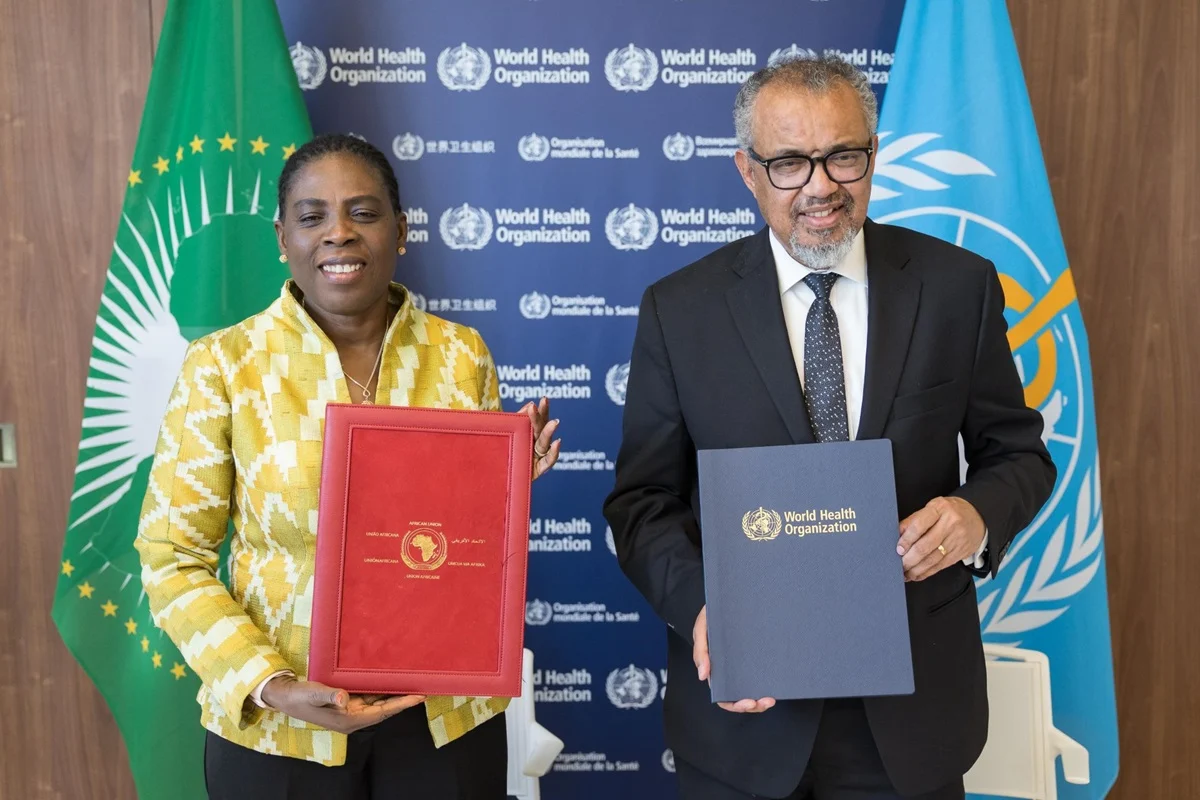
A significant advancement in continental public health strategy unfolded recently in Geneva, as the African Union (AU) Commission and the World Health Organization (WHO) formalized an enhanced framework for their enduring collaborative efforts. This critical development, marked by the signing of an updated Memorandum of Understanding (MoU), occurred on the margins of the 78th World Health Assembly, a pivotal annual gathering for global health leadership. The renewed agreement signals a profound commitment to fortifying health systems, achieving universal health coverage, and fostering sustainable development throughout the African continent, particularly in an era characterized by considerable fiscal pressures impacting worldwide health initiatives.
The formalization of this intensified partnership underscores the African Union’s increasing assertiveness and instrumental role in galvanizing collective action, cultivating inclusive alliances, and building regional resilience against health crises. It strategically positions the Department of Health, Humanitarian Affairs, and Social Development within the AU Commission as a central orchestrator of health policy implementation across Africa. This institutional alignment is designed to ensure that continent-wide health priorities are not only formulated but also effectively translated into tangible programs and outcomes at the national and sub-regional levels.
The updated accord was formally endorsed by Her Excellency Ambassador Amma Adomaa Twum-Amoah, the Commissioner for Health, Humanitarian Affairs and Social Development, representing His Excellency Mahmoud Ali Youssouf, Chairperson of the African Union Commission. Dr. Tedros Adhanom Ghebreyesus, the Director-General of the World Health Organization, signed on behalf of his institution. This moment is particularly noteworthy for its implications for advancing primary health care services and accelerating the journey towards comprehensive universal health coverage across Africa.
Ambassador Twum-Amoah articulated the profound strategic value embedded within this agreement, highlighting the AU’s pivotal role in shaping the future landscape of African health. She emphasized that this document signifies a fresh chapter in the collaborative narrative between the African Union and the World Health Organization. Through closer operational synergy, both entities aim to enhance their responsiveness to the diverse health requirements of African populations, ensuring that no individual or community is left behind in the pursuit of well-being. The Commissioner reiterated the African Union’s profound appreciation for WHO’s central and guiding position within the global health arena, expressing anticipation for a deeper engagement that supports their shared objectives. Crucially, she articulated a vision to transcend mere survival-oriented budgeting in health, advocating instead for strategic planning geared towards achieving genuine health sovereignty for the continent.
This updated MoU builds upon the groundwork laid by a previous agreement from 2019, systematically refining and strengthening the mechanisms for cooperation across all relevant African Union entities. It meticulously aligns their collective endeavors with Africa’s overarching health priorities, thereby establishing a robust foundation for more potent collaboration between the WHO and the AU. Furthermore, the agreement reasserts the World Health Organization’s indispensable function in providing expert technical guidance and establishing normative standards for health both globally and regionally. It also reiterates WHO’s unwavering dedication to assisting the African Union and its constituent institutions in realizing the health-related Sustainable Development Goals (SDGs).
Dr. Tedros Adhanom Ghebreyesus, in his remarks, pointed out the critical timing of this renewed agreement, particularly in light of current reductions in bilateral aid, which threaten the health and well-being of millions across Africa. He stated that the accord reflects a resolute commitment to transforming their partnership into demonstrable, impactful results for African communities. The Director-General emphasized the collective resolve to assist countries in transitioning beyond an era of aid dependency towards sustainable self-reliance in health. He concluded by expressing pride in standing alongside the African Union to propel the continent’s health agenda forward.
While the original document alluded to five key areas of collaboration without explicitly listing them, the comprehensive scope of this partnership can be understood to encompass several critical domains essential for advancing Africa’s health architecture. These inferred pillars likely include: enhancing disease surveillance and emergency preparedness to effectively manage outbreaks and health crises; strengthening primary health care systems as the bedrock of universal health coverage; fostering the local production of medicines, vaccines, and health technologies to reduce reliance on external supply chains; investing in the development of a robust and skilled health workforce; and advocating for equitable access to health innovations and financing mechanisms on the international stage. These areas are fundamental to building resilient, self-sustaining health ecosystems capable of addressing both endemic challenges and emerging threats.
The timing of this reinvigorated agreement holds considerable significance within the broader geopolitical context. It mirrors the African Union’s increasingly influential voice in global health governance, a stature notably augmented by its recent admission to the G20 as a permanent member. This enhanced diplomatic leverage allows the AU to champion African health priorities on a more prominent international platform. Concurrently, the agreement underscores the World Health Organization’s continuing and vital role as a trusted technical authority and operational ally, providing essential expertise and support to African nations.
This renewed Memorandum of Understanding injects fresh impetus into regional and multilateral cooperation efforts, targeting Africa’s most pressing health challenges. It sets the stage for delivering substantial and enduring positive transformations for the continent’s inhabitants. The journey towards health sovereignty, as envisioned by the AU, necessitates not only robust internal strategies but also strong, mutually beneficial international partnerships that respect and empower local leadership.
The global health landscape is in constant flux, marked by the persistent threat of infectious diseases, the rising burden of non-communicable diseases, the intensifying impacts of climate change on health, and persistent inequities in access to care. Against this backdrop, the strategic alignment between the AU, a political and economic continental body, and the WHO, the leading global health agency, is more crucial than ever. The AU’s comprehensive Agenda 2063, which outlines a vision for a prosperous and integrated Africa, places health at its core, recognizing it as a fundamental pillar for human capital development and economic growth. Similarly, WHO’s General Programme of Work prioritizes universal health coverage, addressing health emergencies, and promoting healthier populations globally. This MoU serves as a powerful bridge between these overarching strategic frameworks, ensuring coordinated action and maximizing impact.
The move towards reducing aid dependency, a key theme emphasized by both leaders, reflects a broader shift in development philosophy. It advocates for sustainable domestic financing mechanisms, robust health insurance schemes, and efficient resource allocation, moving away from fragmented, donor-driven interventions. This shift is not about rejecting international assistance but rather about empowering African nations to determine their own health destinies, build robust fiscal foundations for their health systems, and develop localized solutions that are culturally appropriate and contextually relevant. The AU’s G20 membership provides an invaluable platform to advocate for these shifts in global health financing and governance, ensuring that Africa’s perspectives are central to international dialogues on health equity and development.
In practical terms, the updated MoU is expected to streamline coordination mechanisms, avoiding duplication of efforts and ensuring that resources are deployed efficiently where they are most needed. It will likely facilitate joint planning, implementation, and monitoring of health programs, fostering greater accountability and transparency. For instance, joint initiatives might focus on strengthening supply chains for essential medicines and vaccines, enhancing laboratory capacities for disease diagnosis, or scaling up community-based health interventions that are crucial for reaching remote and underserved populations. The emphasis on primary health care means a renewed focus on preventative services, maternal and child health, immunization programs, and addressing endemic diseases like malaria, tuberculosis, and HIV/AIDS, which continue to exact a heavy toll on the continent.
Ultimately, this expanded cooperative framework represents a beacon of hope for improved health outcomes across Africa. It embodies a shared vision for a continent where robust health systems are self-reliant, resilient, and responsive to the evolving needs of its diverse populations, paving the way for a future defined by wellness and prosperity.
About the Author












