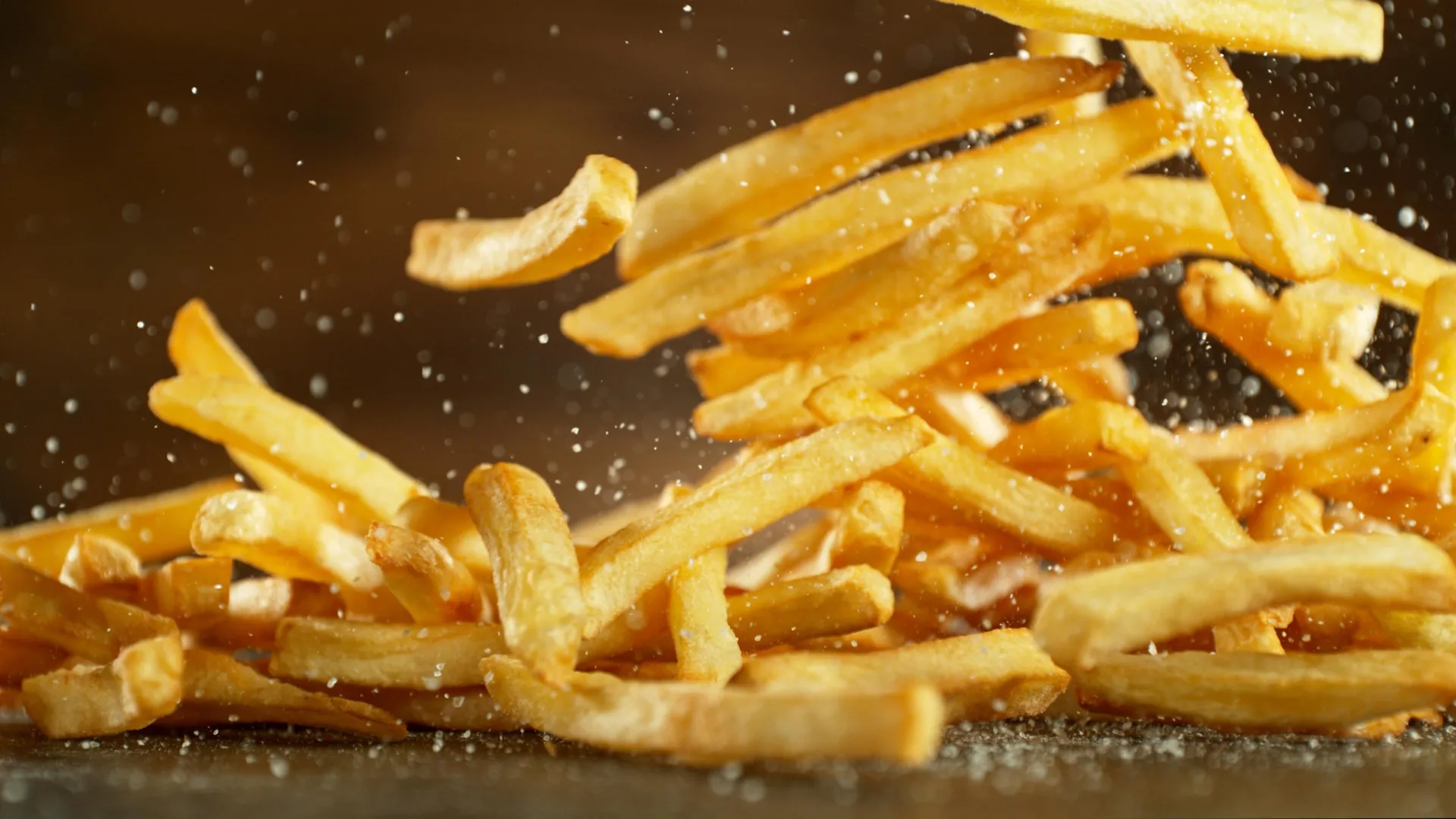
The allure of perfectly crisp french fries and other deep-fried delicacies often stems from their irresistible texture and rich, satisfying taste. However, the very process that imbues these foods with their desirable characteristics—immersion in hot oil—also leads to significant oil absorption, consequently elevating their fat and calorie density. The regular consumption of diets high in unhealthy fats has been extensively linked to a spectrum of adverse health outcomes, including the development of obesity, cardiovascular diseases, and hypertension. In a significant stride towards mitigating these health concerns without compromising consumer preferences, researchers at the University of Illinois Urbana-Champaign have embarked on an innovative exploration into the application of microwave energy within the frying process. Their groundbreaking findings indicate that a synergistic combination of microwave technology and conventional frying methods could usher in an era of significantly healthier fried foods, characterized by reduced oil uptake and enhanced nutritional profiles, while crucially retaining the sensory qualities that consumers cherish.
At the forefront of this pioneering research is Professor Pawan Singh Takhar, a distinguished expert in food engineering within the Department of Food Science and Human Nutrition at the University of Illinois’ College of Agricultural, Consumer and Environmental Sciences. Professor Takhar’s research endeavors are fundamentally driven by the intricate interplay between consumer demand for healthier food options and the deeply ingrained sensory appeal of traditionally prepared items. "Consumers express a desire for healthy food choices, yet at the critical moment of purchase, their cravings often exert a powerful influence," Professor Takhar observes. He elaborates on the inherent paradox: "While high oil content contributes significantly to flavor, it simultaneously represents a substantial source of energy and calories." His research team’s dedicated focus lies in re-engineering the frying process with the explicit objective of achieving diminished fat content without necessitating any appreciable compromise in taste or textural integrity.
The scientific investigation, meticulously detailed in two recent peer-reviewed publications, was spearheaded by Professor Takhar and his doctoral student, Yash Shah, a promising scholar in the Food Science and Human Nutrition program. These studies delve into the complex physical transformations that transpire within potato strips when subjected to the influence of microwave energy during the frying cycle. For their initial experimental phase, the Illinois-based research contingent collaborated with esteemed scientists at Washington State University. This collaboration was pivotal, as it granted them access to a specialized microwave fryer engineered with the unique capability to operate across two distinct microwave frequencies: 2.45 gigahertz, a frequency commonly utilized in standard household microwave ovens, and 5.8 gigahertz, a higher frequency band.
Understanding the significance of gigahertz is crucial to appreciating the underlying science. Gigahertz is the standard unit employed to quantify the frequency of electromagnetic waves, with one gigahertz representing one billion cycles per second. Different microwave frequencies possess the capacity to modulate the manner in which electromagnetic energy propagates through food materials and, consequently, influence the rate at which water molecules within the food respond to this energy during the cooking process. This differential interaction is a key factor in the altered cooking dynamics observed.
To rigorously analyze the internal mechanisms of frying, the researchers meticulously prepared potato samples. The potatoes were first rinsed to remove any surface debris and then peeled before being precisely cut into uniform strips, resembling the classic shape of french fries. Subsequently, these potato strips underwent a blanching process, a brief immersion in hot water or steam, followed by salting. The crucial frying stage then commenced, with the pre-treated potato strips being submerged in soybean oil maintained at a consistent temperature of 180 degrees Celsius. Blanching, a common preliminary step in potato processing, serves to initiate the softening of the potato tissues, thereby preparing the surface for more efficient and uniform frying.
Throughout the frying procedure and immediately following its conclusion, the research team employed a battery of sophisticated measurement techniques. They meticulously monitored parameters such as internal temperature, the pressure exerted within the potato structure, changes in volume, textural properties, moisture content, and, critically, the amount of oil absorbed. This comprehensive data collection was instrumental in elucidating the intricate pathways through which water vapor escapes from the potato during cooking and how, in turn, the displaced oil infiltrates the spaces vacated by this escaping moisture. Professor Takhar highlights a fundamental challenge inherent in conventional frying: the persistent tendency for oil to migrate into the food both during the active cooking phase and in the immediate aftermath.
At the inception of the frying process, the microscopic pores within the potato matrix remain largely saturated with water, thereby offering limited ingress for oil. However, as the potato is subjected to heat, this internal water undergoes vaporization, transforming into steam and escaping the potato’s structure. This exodus of water vapor creates voids, and a phenomenon known as negative pressure can develop within these spaces, exerting a suction effect that draws oil into the potato. Professor Takhar aptly illustrates this principle: "Imagine a straw immersed in a beverage. If you forcefully expel air through the straw, you create positive pressure, which will tend to push any liquid outward. Conversely, if you draw air through the straw, you create suction, and the liquid will be drawn upward." He extends this analogy to food materials, stating, "Now, envision food materials possessing numerous microscopic conduits akin to tiny straws. When positive pressure prevails within these conduits, oil is effectively repelled. However, in the presence of negative pressure, oil begins to infiltrate the structure."
The researchers’ findings underscore the profound impact of internal pressure dynamics on oil absorption. Their investigations revealed that a substantial proportion, as much as 90%, of the oil uptake during frying occurs when the food product is under negative pressure. This prolonged period of suction creates an environment highly conducive to oil migration into the food matrix as it expands. The quest for a more optimized frying methodology therefore centers on the imperative to maintain positive pressure within the potato for an extended duration, thereby minimizing the time spent under oil-attracting negative pressure. This strategic manipulation of pressure profiles holds the key to significantly curtailing the quantity of oil absorbed by the food.
Microwave energy emerges as a potential game-changer in this regard. By facilitating the heating of water molecules distributed throughout the potato, rather than relying solely on heat conduction from the exterior inwards, microwaves can induce a more uniform and rapid vaporization process. As water molecules absorb microwave energy, they gain kinetic energy, move more vigorously, and generate additional vapor. This increased vapor production elevates the internal pressure within the potato, creating a more positive pressure environment that actively resists the ingress of oil. Professor Takhar explains this phenomenon: "When we heat something in a conventional oven, the heat transfer is primarily from the outside to the inside. In contrast, a microwave oven heats from the inside out, because the microwaves penetrate the material uniformly. The microwaves cause water molecules to oscillate, leading to greater vapor formation and consequently shifting the pressure profile towards the positive side. This heightened pressure generated by microwaves plays a crucial role in inhibiting oil penetration."
Complementing their experimental investigations, the research team employed advanced mathematical modeling techniques to gain a more granular understanding of the frying process. These sophisticated computer simulations enabled them to meticulously examine the intricate interactions between various process variables and to forecast changes that would be exceedingly challenging to measure directly in every experimental iteration. The researchers conducted a comparative analysis of temperature, pressure, volume, texture, moisture content, and oil absorption across different frying conditions: at 2.45 GHz microwave frequency, at 5.8 GHz microwave frequency, and under conventional frying parameters.
Across the spectrum of experiments and simulations, a consistent observation emerged: microwave frying significantly accelerated the rate of moisture expulsion from the potato strips. Furthermore, it led to a reduction in the overall cooking time and a demonstrable decrease in the volume of oil absorbed by the fries. However, it is important to note that microwave frying employed in isolation did not yield the desired textural outcome. Fries cooked exclusively with microwave energy tended to retain a softer consistency, failing to develop the characteristic crisp exterior that is a hallmark of consumer-preferred french fries.
"However," Professor Takhar cautions, "if one relies solely on microwave frying, the resulting product tends to be unpleasantly soggy. To achieve the desired crispy texture and taste, conventional heating remains indispensable. Therefore, our proposed solution involves integrating these two approaches within a unified cooking unit. Conventional heating is essential for preserving and developing crispiness, while the microwave component is instrumental in expediting moisture removal and thereby minimizing oil absorption."
The envisioned hybrid frying system represents a sophisticated synergy of conventional and microwave heating technologies. This integrated approach would leverage the browning capabilities of conventional frying to develop the desirable surface crispiness, while simultaneously employing microwave energy to accelerate the removal of internal moisture. This dual action effectively creates an internal pressure environment that actively discourades the excessive infiltration of oil. Such a combined methodology holds the promise of enabling food manufacturers to produce french fries and similar products with a substantially reduced fat content, all while meticulously preserving the flavor profile and textural appeal that have cemented the popularity of fried foods. Moreover, the anticipated reduction in cooking times could translate into enhanced production efficiency within commercial settings.
The researchers also highlighted the practical implications of their findings for the food industry. They noted that continuous frying systems commonly employed in large-scale food processing facilities could be readily adapted to incorporate microwave generators. Given that these components are widely available and generally cost-effective, the proposed hybrid system presents a financially viable and practical solution for commercial-scale production.
The foundational research underpinning these advancements has been published in two seminal scientific papers. The first, titled "The Effect of Conventional and Microwave Frying on the Quality Characteristics of French Fries," has appeared in the prestigious Journal of Food Science. The second publication, "Predicting the quality changes during microwave frying of food biopolymers by solving the hybrid mixture theory-based unsaturated transport, and electromagnetics equations," has been featured in Current Research in Food Science. This groundbreaking research was generously supported by grants from the USDA National Institute of Food and Agriculture, specifically under awards 2020-67017-31194, ILLU-698-308, and ILLU-698-926.
About the Author