
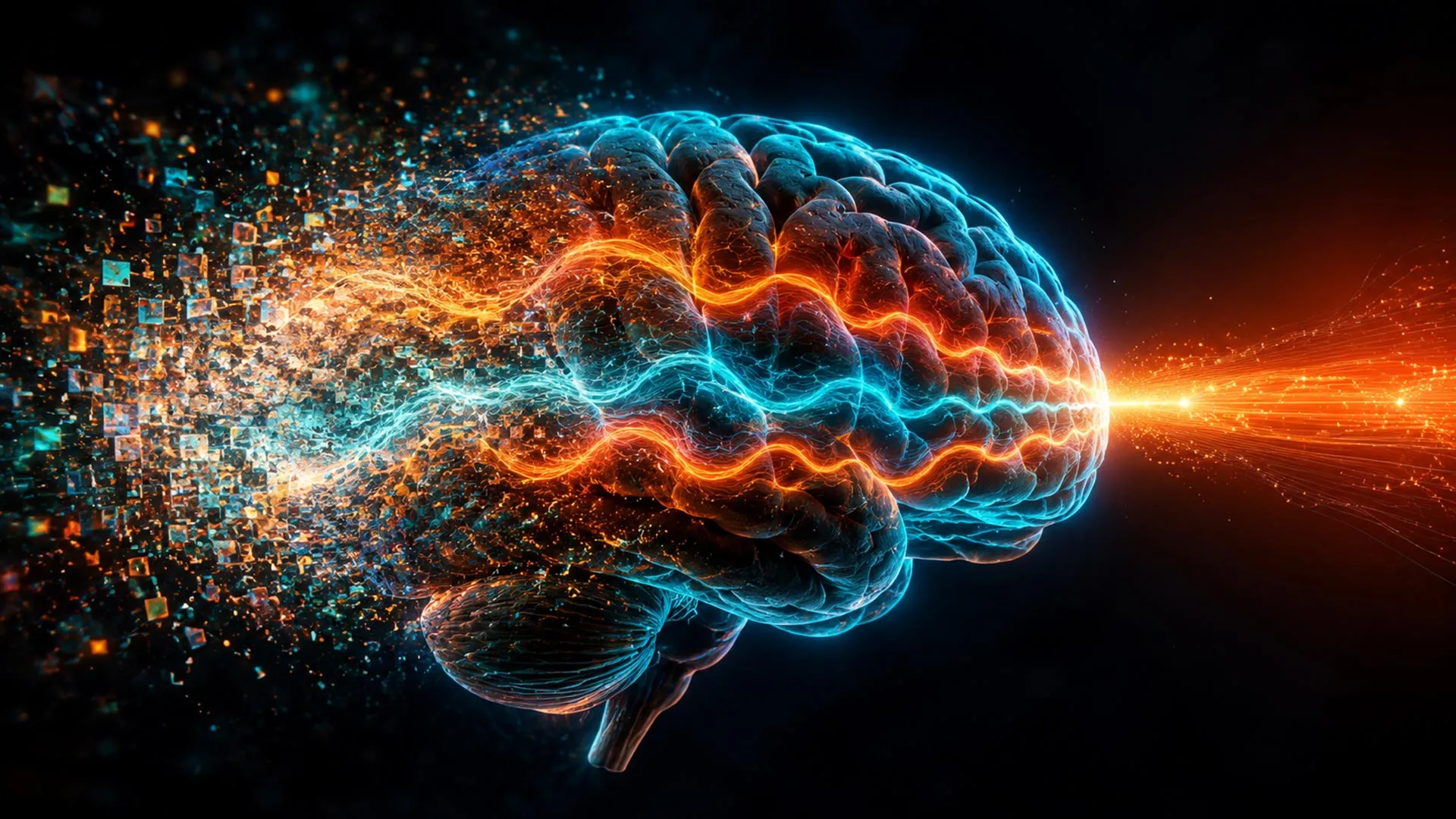
The intricate workings of the human brain, a system responsible for our conscious experience of reality, may be significantly influenced by rhythmic electrical patterns that traverse its surface. These phenomena, known as neural traveling waves, share a conceptual kinship with the dynamic movements observed on the surface of oceans, suggesting a fundamental organizational principle at play in vastly different biological and physical systems. Emerging from both internal neural activity and external sensory input, these brain waves are increasingly understood not merely as passive byproducts of neuronal firing, but as active agents that shape our attentional focus and guide our immediate actions.
A groundbreaking review, spearheaded by neuroscientists at the Salk Institute, proposes a compelling new perspective on the function of these traveling brain waves, positing them as a sophisticated computational engine, particularly within the visual cortex. This integrated physiological and computational research indicates that as these waves propagate through the complex circuitry of the brain, they facilitate the construction of internal mental models of the external environment. Such a mechanism would be instrumental in our capacity to interpret ongoing events, reconstruct past sensory information, and generate predictive insights into future occurrences. The comprehensive findings of this research were disseminated in the esteemed scientific journal Neuron on July 21, 2026.
The significance of traveling brain waves in understanding neural processing was underscored by early pioneering work. Dr. John Reynolds, a neuroscientist at the Salk Institute, was among the first to empirically document the presence of these waves in the visual systems of alert, behaving animals. His laboratory’s subsequent investigations revealed a direct correlation between the presence and characteristics of these traveling waves and the success of an animal in detecting a visual stimulus presented to it. This discovery offered a potential explanation for a common human experience: the frustration of searching for an object, such as misplaced keys, only to find it was in plain sight all along, implying that its presence in the visual field did not equate to its successful registration by the brain at that specific temporal juncture. The observation that traveling waves are not only present in awake animals but also directly influence visual perception ignited a fundamental inquiry into the underlying reasons for their generation within the brain’s architecture.
Dr. Reynolds, who served as senior and co-corresponding author on the review, articulated the paper’s contribution as establishing, for the first time, a unified theoretical structure that delineates the computational capabilities afforded by the brain’s intrinsic wave-generating circuitry. This proposed framework moves beyond viewing neural waves as mere background electrical noise. Instead, it posits that the neural connections responsible for generating these waves are dynamically adaptable, possessing the capacity to modify their signaling strength, a property known as synaptic plasticity. These modifications are not random; they are shaped by learned information derived from interactions with the environment.
The cumulative effect of an organism’s experiences—every visual input, auditory stimulus, olfactory sensation, and motor action—can leave an indelible mark on the neural pathways that generate these traveling waves. Over extended periods, these experiential modulations contribute to the refinement of the neural architecture, which in turn underpins the brain’s ability to construct a coherent internal representation of its surroundings. Dr. Reynolds drew an analogy between this biological process and the functionality of advanced artificial intelligence systems, such as large language models like ChatGPT. He explained that just as these AI models learn the statistical regularities inherent in language to generate contextually appropriate and well-formed text, the brain may be employing a functionally analogous mechanism. This suggests that the brain operates as a biological generative model, meticulously constructed from the ground up through the accumulation of experience.
At its core, the brain confronts a persistent challenge whenever sensory information arrives: discerning the most probable interpretation of the incoming data. The external world, while governed by predictable physical laws and inherent structures, presents an overwhelming degree of complexity. Objects occupy three-dimensional space, and the visual information projected onto the retina undergoes continuous flux due to ocular and bodily movements. These dynamic visual signals are further constrained by the fundamental principles of physics and the biological limitations of sensory organs. The novel framework presented in the review suggests that the brain learns to recognize these recurring patterns and encodes them within its intricate network of synaptic connections. Subsequently, these stored patterns can manifest as traveling waves, which then assist the brain in inferring the most likely causes of incoming sensory information, thereby assembling a comprehensive internal model of the world.
Within this conceptualization, traveling waves emerge as a crucial element in explaining how the brain transforms a ceaseless influx of complex sensory data into unified perceptions, accurate predictions, purposeful behaviors, and subjective experiences. A deeper understanding of this intricate process could bring researchers significantly closer to unraveling the mechanisms by which the brain navigates and makes sense of the dynamic and often chaotic environment we inhabit. The proposed functions for neural traveling waves within the visual cortex are multifaceted, encompassing the fine-tuning of perception on a moment-to-moment basis, the transformation of recent sensory input into enduring internal representations, the generation of short-term predictions about the surrounding environment, and the crucial task of preserving and replaying neural patterns associated with temporally unfolding events and memories. Collectively, these proposed roles highlight the central importance of traveling waves in the brain’s active interpretation of incoming information, rather than their being mere passive indicators of general neuronal activity.
The collaborative effort behind this significant research involved several distinguished scholars. Lyle Muller from UT Dallas and the Fields Institute, Alexandra Busch from the Fields Institute and Western University, and Zachary Davis from the University of Utah, were co-authors on this pivotal study. The research was generously supported by funding from multiple prestigious sources, including the National Institutes of Health (grants R01 EY028723, U01 NS131914, U01 NS139877, and EY014800), Research to Prevent Blindness, the Natural Sciences and Engineering Research Council of Canada, Western University, Compute Ontario, and the Digital Research Alliance of Canada. This multidisciplinary support underscores the broad interest and recognized importance of this line of inquiry in advancing our understanding of brain function.
About the Author












