Scientists have engineered minuscule robotic agents, operating at scales imperceptible to the naked eye, capable of directly interacting with and manipulating objects within the microbial realm. These newly developed nanobots, measuring approximately 50 times smaller in diameter than a human hair, represent a significant leap forward in achieving the long-sought objective of direct intervention at the microscopic level. This breakthrough opens up novel avenues for research and application, particularly in handling delicate biological materials suspended in aqueous environments, such as individual cells and bacteria, which have historically presented formidable challenges for precise control and movement. The latest advancements demonstrate not only the ability to capture and transport individual bacteria but also to release them with remarkable accuracy at predetermined destinations, marking a paradigm shift in our capacity to engineer at the nanoscale.
A fundamental hurdle in the development of such diminutive machinery lies in devising effective methods for propulsion and directional guidance. At Julius-Maximilians-Universität Würzburg (JMU), a dedicated research contingent, under the leadership of Professor Bert Hecht, has pioneered a sophisticated propulsion system leveraging the minute recoil generated by individual photons. These microscopic devices, colloquially referred to as microdrones, are outfitted with an array of up to four plasmonic nanoantennas. These specialized antennas possess the capability to absorb incident light of specific wavelengths and helical properties, subsequently re-emitting this absorbed energy in a directed manner. The redirection of each photon generates an infinitesimal but measurable force, a phenomenon analogous in principle to the reactive force experienced when a projectile is discharged from a firearm. Given the exceptionally low mass of these microdrones, these minuscule forces are amplified to produce considerable acceleration and velocity, enabling their movement through microscopic environments.
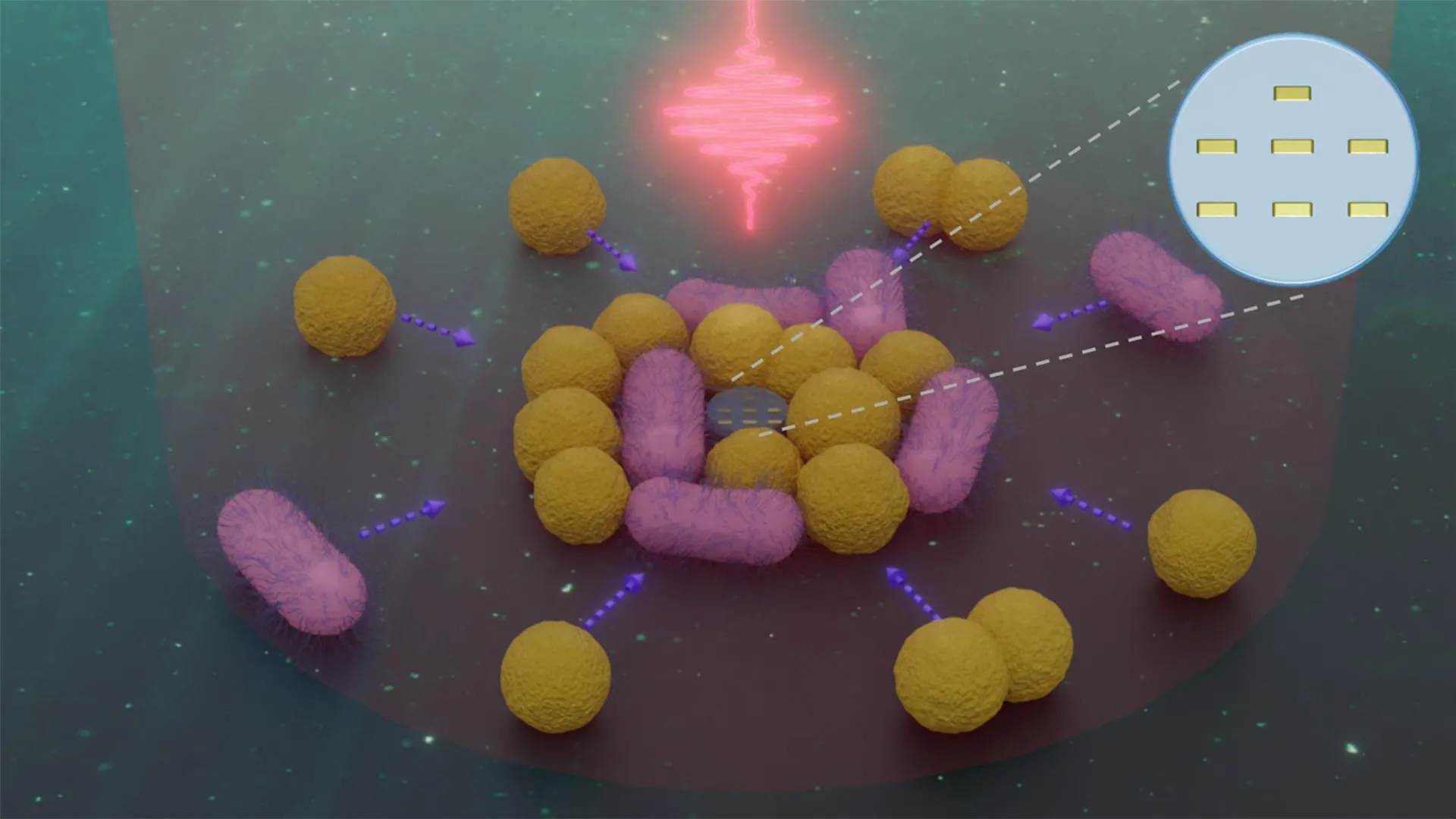
For their most recent endeavor, the research team has successfully miniaturized these light-driven robots to a size below one micrometer, further enhancing their applicability in ultra-fine manipulation tasks. A critical component of this miniaturization effort involved the simplification of the steering mechanism while preserving the core principle of photon recoil-based propulsion. The innovative control strategy employs nanoscale antenna wires integrated into the robot’s structure. These wires exhibit a natural inclination to align themselves with the polarization orientation of incoming light. By dynamically altering the polarization of the incident light, researchers can precisely dictate the orientation of the nanorobot. Concurrently, the persistent photon recoil force continues to drive the robot forward, thereby establishing a steering system that bears resemblance to the directional control mechanisms found in larger, macroscopic vehicles, offering intuitive and responsive navigation.
The practical implications of this technological advancement are profound, with the nanobots functioning effectively as "microscopic cleaning devices." Jin Qin, the lead experimental scientist on the project, elaborates on this function, stating, "In essence, we have built a light-driven nanorobot that can track down and collect bacteria." He further emphasizes the significance of the size reduction, noting, "By simplifying the design, we reached a size at which these robots can operate directly in the microbial world – almost like microscopic cleaning devices." Beyond their collection capabilities, these nanobots exhibit exceptional maneuverability, capable of executing sharp 90-degree turns with remarkable speed. This agility allows them to efficiently survey expansive areas of a sample in a systematic and organized fashion. Moreover, they possess the capacity to selectively capture, transport, and subsequently release substantial quantities of bacteria, demonstrating a high degree of control over their payload.
Under controlled laboratory settings, these attributes translate into a potent ability for the nanobots to "clean" microscopic environments. They can effectively gather bacteria from one location and precisely deposit them at designated sites. Professor Bert Hecht highlights the broader scientific impact of this work: "This is a striking example of how light can be used not only to observe the microscopic world, but also to actively shape it." He adds, "The idea of tiny robotic cleaners may sound futuristic, but we are already demonstrating the physical principles that make it possible." The operational integrity of the robots remains largely unimpeded even when laden with significant bacterial payloads, although a marginal reduction in speed is observed under such conditions. This sustained functionality while transporting substantial bacterial clusters underscores their potential for future applications across diverse fields, including microbiology, biomedical research, and the precise manipulation of materials at the nanoscale, paving the way for unprecedented advancements in scientific exploration and technological innovation.
About the Author