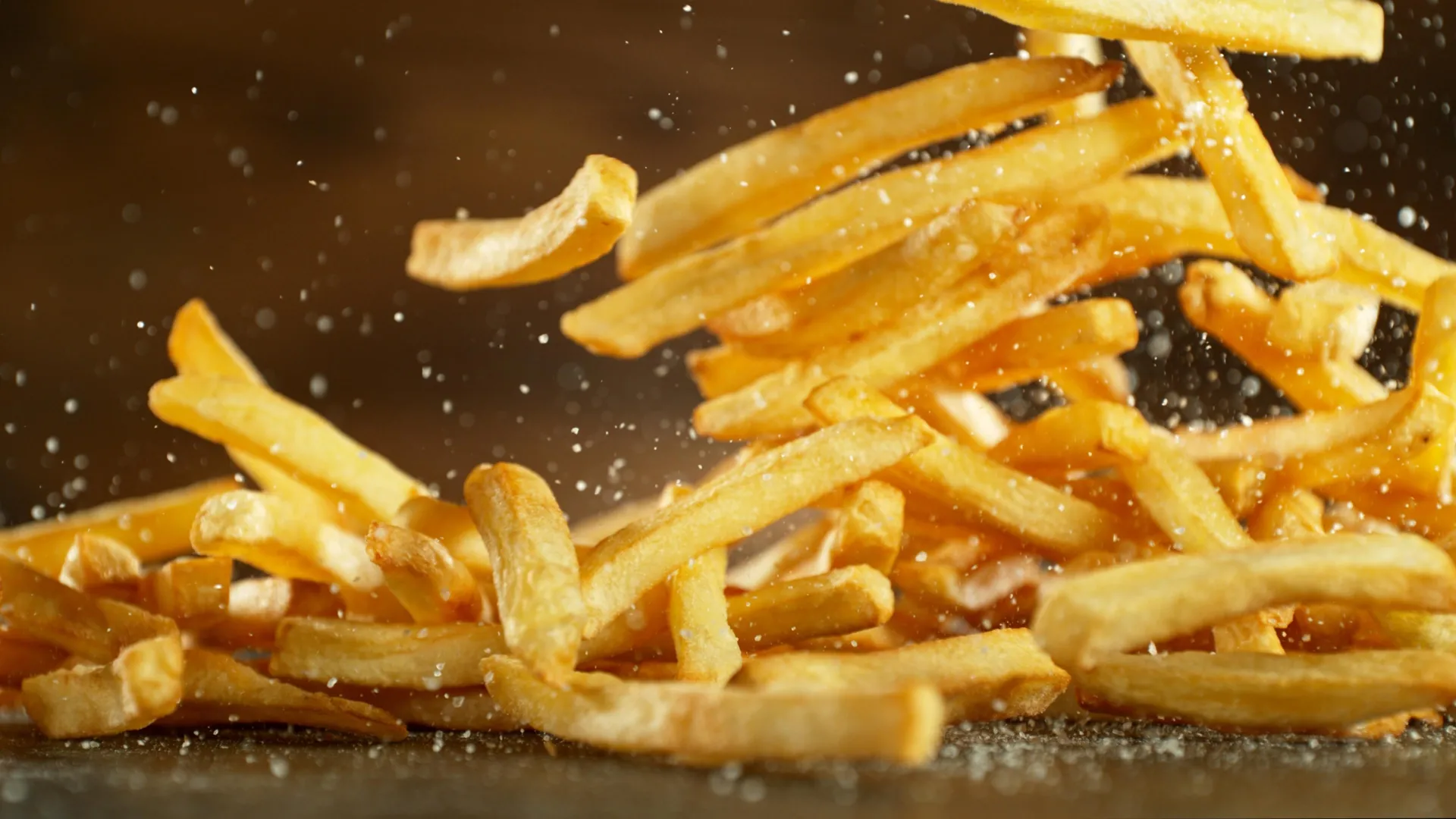
The allure of classic fried delicacies, epitomized by the universally adored French fry, lies in their irresistible textural contrast—a satisfying crunch yielding to a tender interior—and their rich, savory flavor profile. However, this culinary pleasure often comes at a significant caloric and lipid cost, as the cooking process inherently leads to substantial oil absorption. A growing body of evidence links regular consumption of high-fat foods to an increased risk of chronic health conditions, including obesity and hypertension, prompting a global search for healthier alternatives that do not compromise sensory appeal.
Researchers at the University of Illinois Urbana-Champaign have embarked on a pioneering exploration into the potential of microwave energy to revolutionize the frying process, aiming to significantly reduce oil uptake in popular fried products like French fries without sacrificing the cherished qualities that drive their popularity. Their preliminary findings indicate that a synergistic approach, integrating microwave technology with conventional frying methods, could not only accelerate cooking times but also curtail the amount of oil absorbed, all while preserving the signature crisp exterior and desirable mouthfeel that consumers expect.
At the forefront of this groundbreaking research is Professor Pawan Singh Takhar, a distinguished figure in food engineering within the Department of Food Science and Human Nutrition at the University of Illinois’ College of Agricultural, Consumer and Environmental Sciences. Professor Takhar articulated the core challenge: "Consumers are increasingly health-conscious, yet the primal appeal of familiar flavors, often enhanced by fat content, remains a powerful influence. My team’s focus is on developing frying methodologies that yield a reduced fat profile without a perceptible compromise in taste or texture."
Working alongside Yash Shah, a doctoral candidate in the Department of Food Science and Human Nutrition, Professor Takhar has documented their findings in a series of recent publications that delve into the intricate physical transformations occurring within French fries during microwave-assisted cooking.
In their initial study, the Illinois team collaborated with scientists at Washington State University, who had developed a specialized microwave fryer capable of operating at two distinct frequencies: 2.45 gigahertz, comparable to that found in standard household microwave ovens, and 5.8 gigahertz. The frequency of electromagnetic waves, measured in gigahertz, plays a critical role in determining how energy penetrates food and how rapidly water molecules within the food respond to the applied energy during the cooking cycle.
The experimental protocol involved carefully preparing potato strips, which were first rinsed and peeled before being cut into uniform lengths. These strips underwent a blanching process, a brief immersion in hot water or steam, designed to initiate softening of the potato tissue and prime the surface for the subsequent frying stage. Following blanching, the strips were salted and then subjected to frying in soybean oil maintained at a precise temperature of 180 degrees Celsius.
Throughout the frying process and in its immediate aftermath, the research team meticulously collected data on a range of critical parameters, including internal temperature, pressure dynamics, volumetric changes, textural characteristics, moisture content, and crucially, the amount of oil absorbed. This comprehensive data set provided invaluable insights into the complex interplay between water expulsion and oil ingress within the potato matrix during cooking.
Professor Takhar highlighted a fundamental hurdle in traditional frying: the persistent tendency for oil to migrate into food products both during and immediately following the cooking period. He explained the underlying physics: "Imagine the microscopic pores within a potato. Initially, these are saturated with water, leaving minimal space for oil. As the potato heats up, this water transforms into vapor and begins to escape. This escape creates void spaces, and a phenomenon known as negative pressure, akin to suction, can then draw oil into these newly formed cavities."
To illustrate this principle, Professor Takhar offered an analogy: "Consider a straw immersed in a beverage. If you expel air through the straw, you create positive pressure, pushing the liquid away. Conversely, if you draw air out, you create negative pressure, causing the liquid to be pulled upwards. Food materials are analogous to having numerous microscopic straws. When positive pressure prevails, oil is resisted. However, during periods of negative pressure, oil readily infiltrates the food."
The research revealed that a significant portion, as much as 90%, of oil absorption in conventional frying occurs when the food is subjected to negative internal pressure. This prolonged suction effect facilitates the movement of oil into the expanding pores. An optimized frying process, therefore, would strive to maintain positive internal pressure within the food for an extended duration, thereby minimizing the time spent under the oil-attracting negative pressure.
Microwave energy emerges as a potential solution to this challenge by facilitating more uniform heating throughout the food product, rather than relying solely on heat transfer from the surface inward. As water molecules within the potato absorb microwave energy, they exhibit increased kinetic activity, leading to accelerated vapor generation. This increased vapor production elevates the internal pressure within the food, creating a more formidable barrier against oil penetration.
"In a conventional oven, heat progresses from the exterior to the interior," Professor Takhar elaborated. "However, a microwave oven penetrates the material more broadly, effectively heating from within. The microwaves induce oscillations in water molecules, which intensifies vapor formation and consequently shifts the pressure profile towards the positive side. This enhanced internal pressure generated by microwaves is instrumental in mitigating oil absorption."
Beyond empirical laboratory tests, the research team employed sophisticated mathematical modeling to gain a deeper understanding of the frying process. These computational models allowed for the exploration of intricate variable interactions and the prediction of changes that might be difficult to quantify through direct experimental measurement alone. The researchers conducted comparative analyses of temperature, pressure, volume, texture, moisture content, and oil absorption under conventional frying conditions, as well as at the two microwave frequencies (2.45 GHz and 5.8 GHz).
Consistently across experiments and simulations, microwave frying demonstrated an accelerated rate of moisture expulsion from the potatoes. This led to a reduction in overall cooking time and a notable decrease in the quantity of oil absorbed by the fries. However, employing microwave energy as a standalone frying method did not yield the desired textural outcome; fries cooked solely with microwaves tended to be soft, lacking the characteristic crispness consumers associate with traditional fried foods.
"The limitation of using microwave frying in isolation is that it can result in a soggy product," Professor Takhar cautioned. "To achieve that desirable crisp texture and satisfying bite, conventional heating remains essential. Our proposal, therefore, is a hybrid approach that combines both methods within a single unit. Conventional heating is employed to develop the crisp exterior, while microwave heating efficiently removes moisture and inhibits excessive oil uptake."
The envisioned hybrid frying system would leverage conventional heating mechanisms to achieve surface browning and impart the desired crunch, while simultaneously utilizing microwave energy to expedite moisture removal and actively prevent undue oil ingress. This integrated approach holds the promise of enabling food manufacturers to produce French fries with a significantly reduced oil content, without compromising the flavor and texture that are integral to the appeal of fried foods. Furthermore, the potential for faster cooking times could translate into enhanced production efficiencies for commercial operations.
The researchers also noted the practical implications for industrial food production. Existing continuous frying equipment used in large-scale food processing facilities could potentially be retrofitted to incorporate microwave generators. Given the widespread availability and relatively modest cost of these components, such a system is likely to be economically viable for commercial implementation.
The scientific discourse on this innovative frying technique is documented in two key publications. The first, titled "The Effect of Conventional and Microwave Frying on the Quality Characteristics of French Fries," has been published in the Journal of Food Science. The second, "Predicting the quality changes during microwave frying of food biopolymers by solving the hybrid mixture theory-based unsaturated transport, and electromagnetics equations," appears in Current Research in Food Science. This research received vital funding from the USDA National Institute of Food and Agriculture, through awards 2020-67017-31194, ILLU-698-308, and ILLU-698-926.
About the Author