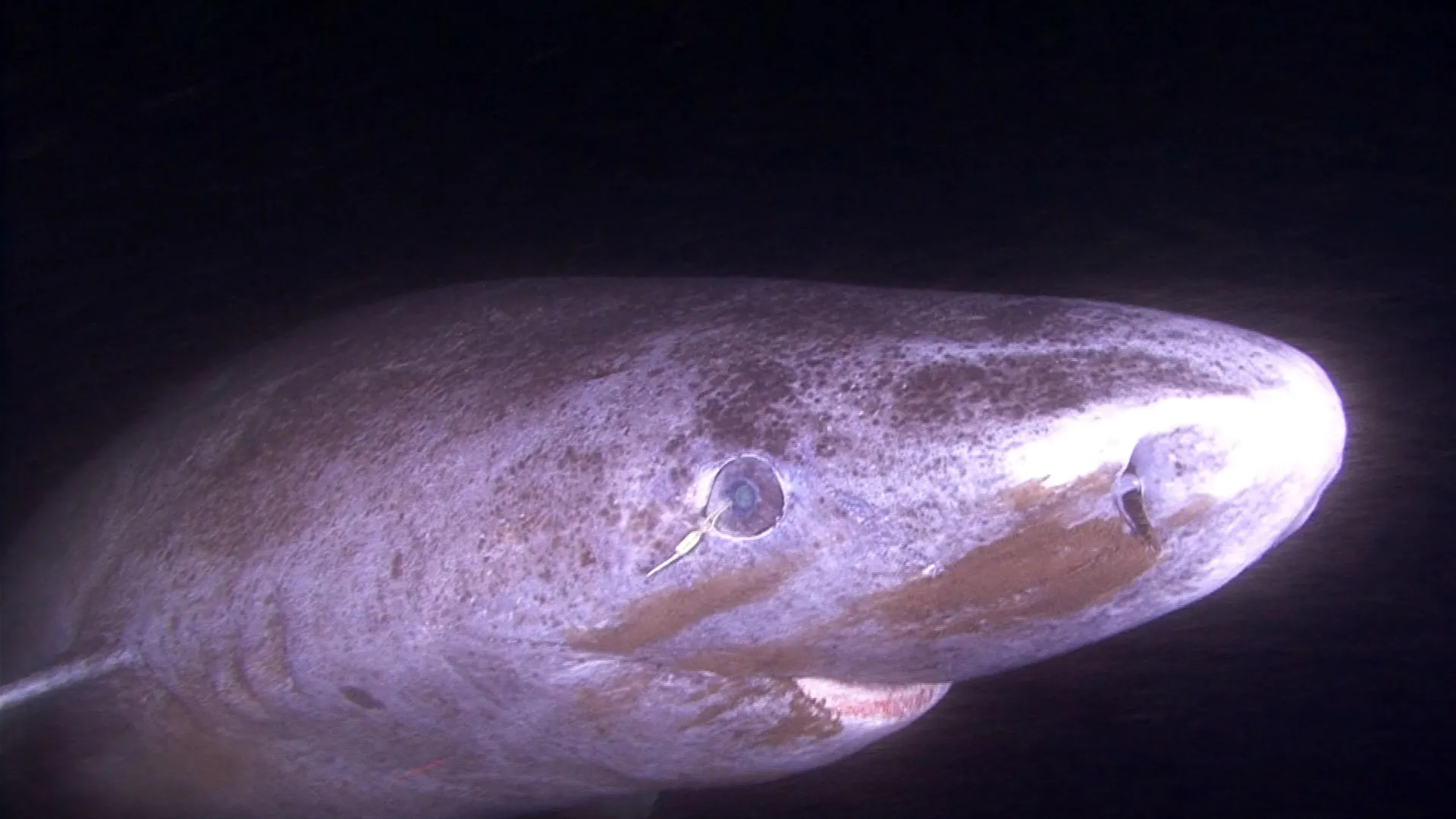
Researchers are delving into the extraordinary biology of the Greenland shark, a creature of the deep Arctic known for its unparalleled longevity, with recent investigations suggesting that its visual system possesses remarkable mechanisms for preserving sight over centuries. This species, capable of living for up to 400 years, has long puzzled scientists, not only due to its extended lifespan but also because of the peculiar appearance of its eyes, often clouded and frequently hosting visible parasites. These characteristics led to a prevailing assumption that Greenland sharks might be largely, if not entirely, visually impaired. However, groundbreaking new findings are challenging these long-held notions, offering a profound glimpse into cellular repair and adaptation in one of Earth’s most ancient living vertebrates.
The prevailing scientific understanding of aging in most organisms is intrinsically linked to cellular degradation, a process that inevitably impacts organ function. In the context of vision, this typically manifests as a decline in retinal health, leading to diminished visual acuity. The Greenland shark, however, appears to defy this universal biological trend. A collaborative research effort, spearheaded by Professor Dorota Skowronska-Krawczyk from the University of California, Irvine, alongside colleagues Walter Salzburger and Lily G. Fogg from the University of Basel, Switzerland, has unearthed compelling evidence suggesting a sophisticated DNA repair system at play within the shark’s ocular tissues. This intricate molecular machinery, according to the study published in the esteemed journal Nature Communications, appears to actively counteract the degenerative effects of time, thereby maintaining retinal integrity for extraordinarily extended periods.
The journey to this revelation began with Professor Skowronska-Krawczyk’s long-standing fascination with age-related ocular diseases. Her research into the molecular underpinnings of vision loss in humans drew her attention to a pivotal 2016 study published in Science by John Fleng Steffensen. This earlier work highlighted the common presence of eye parasites on Greenland sharks and the potential implications for their vision. While many might have concluded that such an organ, if compromised, would be evolutionary redundant, Skowronska-Krawczyk observed something different in video footage of the sharks: their eyes actively tracked light sources. This behavior, seemingly at odds with the assumption of blindness, ignited her curiosity and set the stage for a deeper investigation into their visual capabilities.
To conduct this detailed examination, a series of Greenland sharks were ethically captured between 2020 and 2024. These scientific expeditions, conducted near the University of Copenhagen’s Arctic Station situated on Disko Island, Greenland, provided invaluable specimens for the study. Collaborating with Professor Peter G. Bushnell of Indiana University South Bend and Dr. Richard W. Brill from the Virginia Institute of Marine Science, the research team carefully retrieved and preserved the sharks’ eyes. This meticulous preservation process, employing specialized fixative solutions, was crucial to ensure the integrity of the tissue for subsequent histological and molecular analyses.
The logistics of handling such large specimens presented unique challenges. Emily Tom, a doctoral candidate in Professor Skowronska-Krawczyk’s lab and a physician-scientist in training, recounted the memorable moment when a preserved Greenland shark eye, estimated to be from a 200-year-old individual, arrived. She described the sheer scale difference compared to the tiny eyeballs of laboratory mice, which are akin to papaya seeds, while the shark’s eye was roughly the size of a baseball. This necessitated a significant adaptation in laboratory techniques and protocols. Professor Skowronska-Krawczyk’s hands-on approach to mentorship and laboratory work was instrumental in navigating these complexities, fostering a collaborative and innovative research environment. Maintaining the delicate tissue required careful temperature control, as any significant warming could lead to deterioration, turning the lab into a carefully managed environment reminiscent of a bustling fish market due to the nature of the samples.
The core of the research involved detailed histological examinations and vision-specific analyses of the preserved eye tissues. The findings were striking: no evidence of retinal cell death was detected. This absence of cellular degeneration in such an ancient creature is a remarkable biological feat. Furthermore, the study identified that rhodopsin, a critical protein for vision in low-light conditions, remained functionally active within the shark’s retina. This protein exhibited a specific sensitivity to blue light, a crucial adaptation for navigating the dim, ethereal glow of the deep Arctic waters where sunlight penetration is minimal. This suggests that Greenland sharks are not merely surviving but are actively and effectively perceiving their environment, even in the absence of abundant light.
The implications of these findings extend far beyond the fascinating biology of a single species. Professor Skowronska-Krawczyk views this research as a potential Rosetta Stone for understanding age-related vision loss in humans. If the mechanisms that confer such remarkable visual longevity in Greenland sharks can be elucidated and potentially replicated, it could pave the way for novel therapeutic strategies to combat conditions like macular degeneration and glaucoma, which affect millions worldwide. The study also prompts broader scientific inquiries into the evolutionary pathways of vision and the fundamental principles of tissue maintenance over vast timescales. The question arises: can the protective mechanisms observed in these ancient sharks be harnessed or adapted for human health?
Despite the profound nature of these discoveries, the future of such pioneering research is not without its uncertainties. Professor Skowronska-Krawczyk voiced concerns regarding the fluctuating landscape of federal research funding, which can create apprehension about sustained support for long-term, ambitious scientific endeavors. However, she maintains an optimistic outlook, emphasizing a belief in the eventual triumph of scientific inquiry. The intrinsic reward of being at the vanguard of discovery, uncovering novel biological mechanisms and expanding the frontiers of knowledge, is a powerful motivator. Sharing these groundbreaking moments and the ensuing joy of discovery with her students, she notes, represents the most fulfilling aspect of her scientific career, underscoring the collaborative and inspiring nature of cutting-edge research.
About the Author