
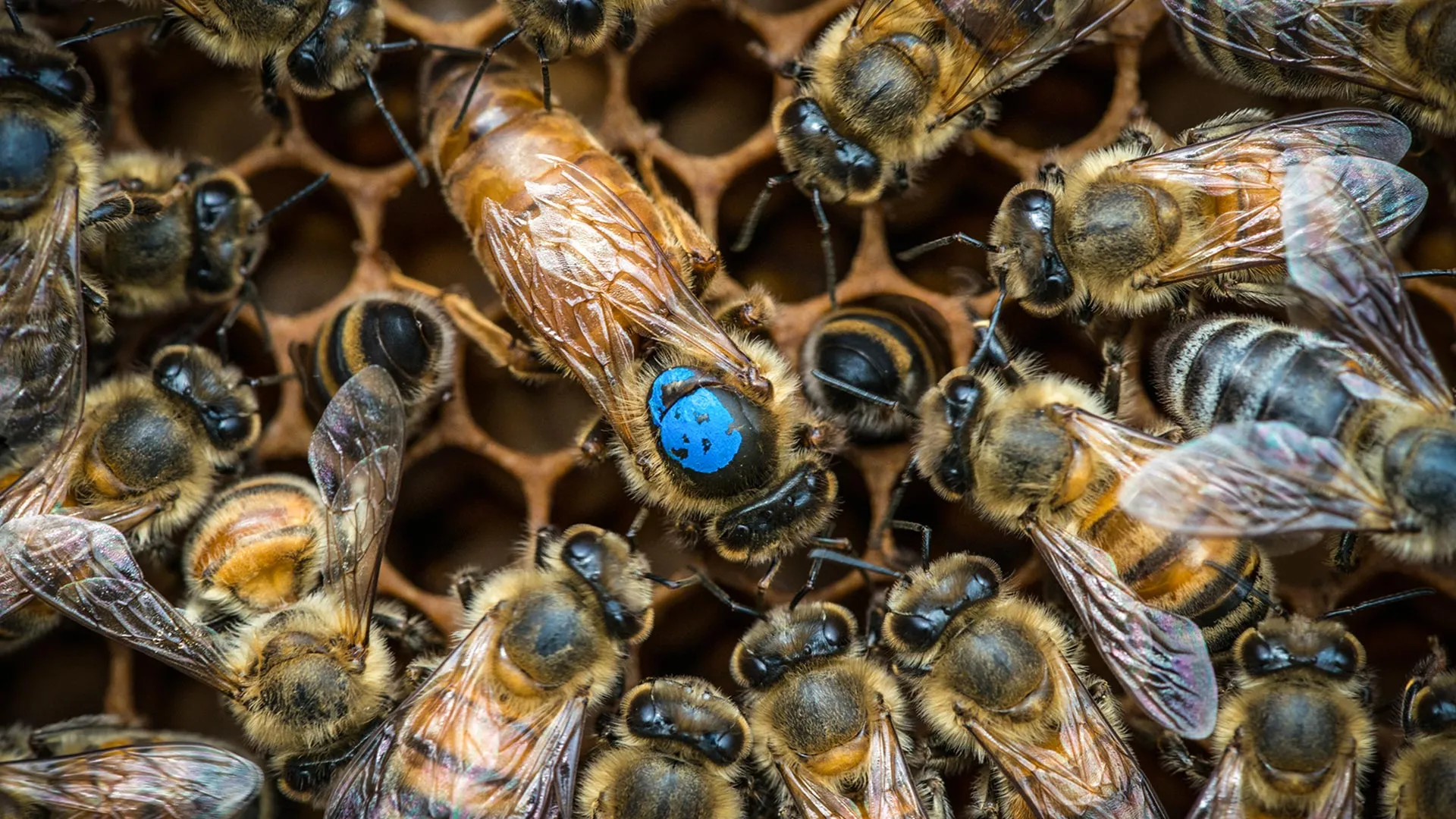
A groundbreaking scientific investigation has illuminated the intricate neural mechanisms governing task allocation within complex bee colonies, revealing how a specific gene’s influence on brain circuits can dictate a worker bee’s role. Researchers from Heinrich Heine University Düsseldorf (HHU), in collaboration with institutions in Cologne and Frankfurt/Main, have successfully demonstrated that by manipulating a particular gene and selectively dampening the activity of distinct neural pathways, they could precisely alter the behavioral repertoire of these essential social insects. This significant advancement, detailed in the esteemed journal Proceedings of the National Academy of Sciences (PNAS), offers profound new insights into the sophisticated, leaderless system of workforce organization that underpins the remarkable efficiency of a bee community.
The fundamental challenge of any thriving collective, whether human or insect, lies in the synchronized execution of diverse responsibilities. Unlike human societies, where communication and explicit delegation facilitate task assignment, a bee colony operates without a central command structure. Yet, the common honey bee (Apis mellifera) exhibits an astonishing degree of organizational prowess, ensuring that the myriad duties required for colony survival are met with precision. This division of labor is not static; it evolves dynamically with an individual bee’s age, forming a temporal progression of responsibilities that seamlessly transitions as the insect matures.
In their formative stages, young worker bees dedicate their efforts to the vital tasks of tending to the queen and nurturing the developing brood. As they age, their roles expand to encompass the construction and maintenance of the hive’s intricate architecture, alongside the critical duty of defending the colony against external threats. It is only in the twilight of their working lives that these bees venture beyond the hive’s protective walls to forage for sustenance, a task reserved for the most experienced members. This entire spectrum of age-dependent behavioral shifts is orchestrated by the complex interplay of approximately one million neurons residing within the bee’s brain. Until this recent research, the precise neurological pathways responsible for guiding this age-related transition between different roles remained largely enigmatic.
The genesis of this pivotal discovery can be traced to prior work conducted by a research team at HHU, spearheaded by Professor Dr. Martin Beye of the Institute of Evolutionary Genetics. Their focus was on a gene identified as "doublesex," and it was during their investigations into its function that an unexpected and significant behavioral anomaly was observed. When the expression of the doublesex gene was experimentally suppressed in older worker bees, these insects began to exhibit behaviors characteristic of much younger individuals, specifically resuming the care of the queen. This observation strongly suggested that the doublesex gene plays a crucial regulatory role in modulating age-related occupational behaviors within the colony.
The significance of this finding was amplified by the realization that the doublesex gene exerts its influence not broadly across the entire brain, but rather within specific, localized neural circuits. This specificity provided Professor Beye’s team, now joined by colleagues from the universities of Cologne and Frankfurt/Main, with a powerful tool to dissect how particular neural networks within the bee brain are instrumental in shaping complex social behaviors. Their subsequent experimental approach involved the precise inactivation of neurons directly associated with the doublesex gene’s activity.
To achieve this targeted silencing, the researchers ingeniously employed the doublesex gene itself to direct the production of a specialized protein designed to inhibit neural activity. The activation of this inhibitory protein was then precisely controlled by administering a specific dietary substance to the bees. This method allowed the scientists to selectively reduce neuronal firing only within the designated neural circuits, creating a localized "off switch" for specific brain functions.
The consequences of this targeted inhibition were striking and directly aligned with the researchers’ hypotheses. Following the suppression of these specific neural circuits, older worker bees invariably reverted to their earlier roles, resuming the care of the queen – a duty normally exclusive to their younger counterparts. Conversely, when these targeted circuits were left uninhibited, the bees displayed their typical, age-appropriate behaviors, seamlessly progressing through their expected duties. As Dr. Jana Seiler, the lead author of the PNAS study, eloquently stated, "The older worker bees then resumed caring for the queen, which only younger bees would do otherwise. When the circuits were not inhibited, the bees exhibited their normal, age-dependent behavior. In this way, we were able to control which tasks the worker bees performed." This experimental control powerfully demonstrated the direct link between the targeted neural circuits and specific behavioral outputs.
The implications of these findings extend to a broader understanding of how collective action is coordinated within bee colonies. The results strongly suggest that the organizational structure of the hive is fundamentally underpinned by a sophisticated neural architecture. The research indicates that when activity within certain brain regions is diminished, it can facilitate the engagement of alternative neural pathways, thereby triggering a different set of behavioral responses. This dynamic interplay between neural circuits appears to be the linchpin in determining whether a worker bee assumes the role of nursemaid to the queen, diligently contributes to hive construction and defense, or undertakes the critical task of foraging.
Professor Beye emphasized the broader significance of this research, concluding, "The ability to control the social behavior of bees offers us new opportunities to explore the fundamentals of innate behavioral diversity and social cooperation. The solution to the secret of how bees and other animals cooperate so well without a blueprint for work is likely hidden in the brain’s neural circuits." This research not only unravels a key aspect of bee social organization but also opens exciting avenues for exploring the evolutionary underpinnings of cooperation and behavioral plasticity in the animal kingdom, suggesting that the intricate wiring of the brain holds the fundamental answers to how complex societies function autonomously. The discovery underscores the power of genetic and neural investigation to decode behaviors that have long fascinated scientists and continues to highlight the profound intelligence and complexity inherent in even seemingly simple organisms.
About the Author












