
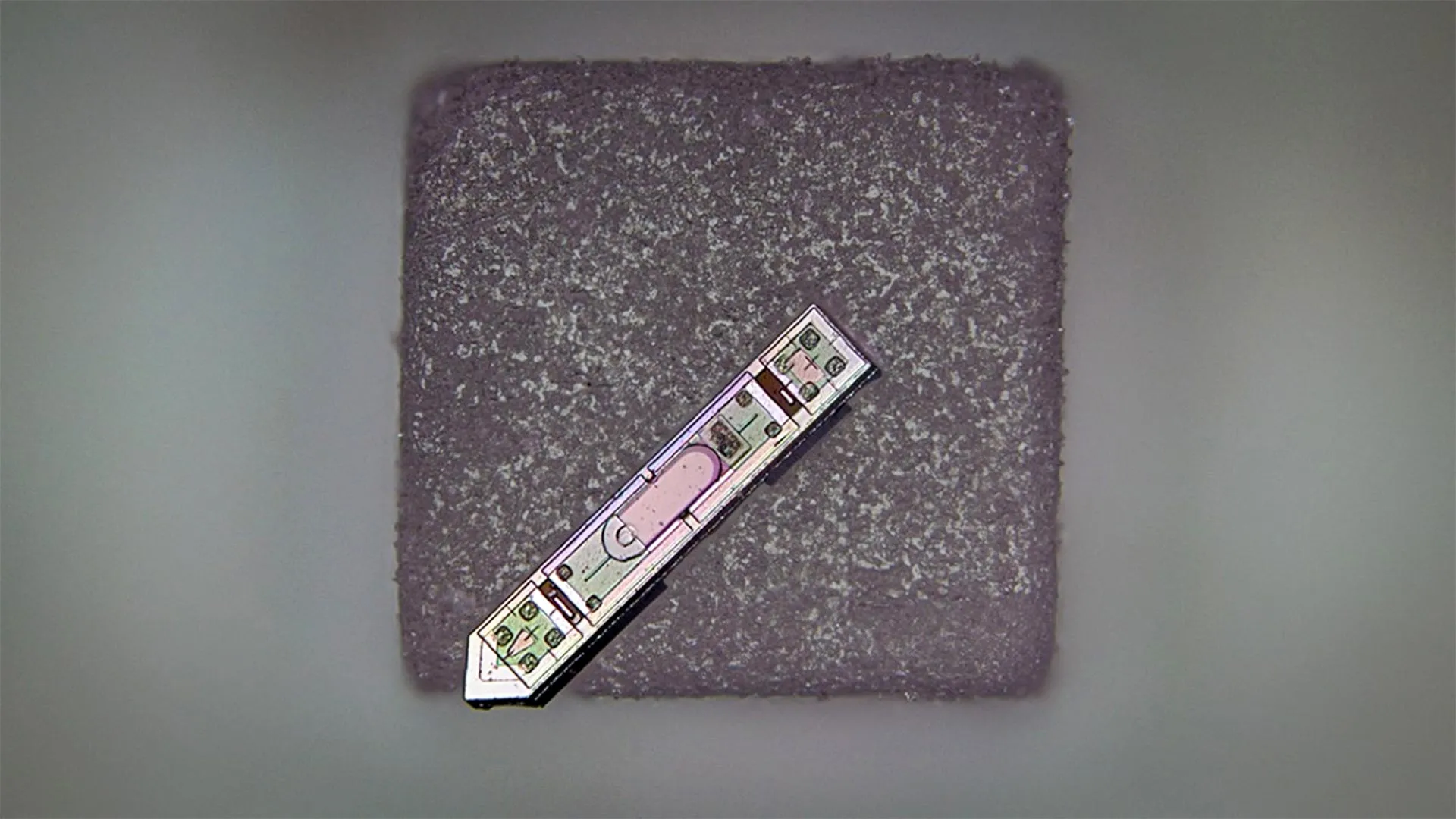
Researchers at Cornell University, in collaboration with international partners, have successfully engineered an extraordinarily diminutive neural implant, rivaling the size of a grain of salt, capable of reliably capturing and transmitting brain activity from living organisms for over a year. This significant technological leap, detailed in the esteemed journal Nature Electronics, underscores the burgeoning capabilities of microelectronic systems operating at the nanoscale, paving the way for novel paradigms in neural monitoring, sophisticated bio-integrated sensing, and a broad spectrum of biomedical and advanced technological applications.
The groundbreaking device, designated as a microscale optoelectronic tetherless electrode, or MOTE, represents the culmination of extensive research efforts led by Professor Alyosha Molnar of Cornell’s School of Electrical and Computer Engineering. Key contributions were also made by Sunwoo Lee, now an assistant professor at Nanyang Technological University, who initiated crucial aspects of this technology’s development during his tenure as a postdoctoral researcher in Professor Molnar’s laboratory. The project’s success hinges on a novel approach to data transmission, leveraging precisely modulated light signals to overcome the limitations inherent in traditional wired or bulkier wireless neural interfaces.
At the heart of the MOTE’s functionality lies its ingenious use of safe, penetrating laser beams – specifically, red and infrared wavelengths – which are employed to deliver power and facilitate communication through biological tissue without causing harm. The implant transmits recorded neural data by emitting minuscule pulses of infrared light, each uniquely encoded to represent the electrical signals detected from the brain. This elegant solution bypasses the need for external wires or bulky radio frequency transmitters, which can introduce noise, require significant power, and pose risks in delicate biological environments.
The core component responsible for this sophisticated interaction is a semiconductor diode fabricated from aluminum gallium arsenide. This meticulously engineered element performs a dual function: it absorbs incoming light to energize the entire system and simultaneously emits modulated light to relay the gathered information. Complementing this central diode are a low-noise amplifier and an optical encoder, both constructed using semiconductor fabrication techniques analogous to those employed in the production of contemporary microchips. This integration of advanced semiconductor technology ensures both miniaturization and high performance.
The physical dimensions of the MOTE are truly remarkable, measuring approximately 300 micrometers in length and 70 micrometers in width, making it one of the smallest neural implants ever developed that is capable of both measuring and wirelessly reporting brain activity. Professor Molnar highlighted this achievement, stating that, to the best of the research team’s knowledge, this represents the smallest neural implant that can detect electrical brain activity and transmit it wirelessly. The communication protocol employed is pulse position modulation, a technique also utilized in high-speed optical communications, such as those used for satellite transmissions. This method allows for highly efficient data transfer with minimal power expenditure, a critical factor for long-term implantation and operation within a living subject.
The implications of this technological advancement extend far beyond fundamental neuroscience research. The unique materials utilized in the MOTE’s construction hold the potential to enable researchers to record brain activity during magnetic resonance imaging (MRI) scans, a feat largely unattainable with existing neural implants due to electromagnetic interference. This capability could unlock unprecedented insights into brain function under various physiological and pathological conditions. Furthermore, the MOTE’s design principles are amenable to adaptation for monitoring neural signals in other regions of the body, including the spinal cord, offering new avenues for understanding and treating neurological disorders affecting motor control and sensation.
Looking toward the future, this technology could be integrated with forthcoming innovations, such as optoelectronic components embedded within artificial skull plates. Such advancements could lead to sophisticated brain-computer interfaces that are minimally invasive, highly effective, and capable of providing continuous, long-term monitoring and intervention. The ability to implant such a tiny, long-lasting, and wireless device opens up a vast landscape of possibilities for both therapeutic and diagnostic applications, potentially revolutionizing the way we study the brain and treat neurological conditions. The research team’s focus on biocompatibility and minimal power consumption further positions the MOTE as a foundational technology for the next generation of bio-integrated electronics. The successful demonstration of over a year of continuous data transmission from a living animal signifies a critical milestone, validating the robustness and reliability of the MOTE’s design and fabrication. This enduring performance is crucial for applications requiring long-term observation of chronic conditions or the effects of therapeutic interventions. The team’s meticulous attention to detail in addressing potential biofouling and immune response at the microscopic level also contributes to the implant’s extended operational lifespan. The miniaturization achieved with the MOTE also minimizes the physical disruption to neural tissue, a critical consideration for animal welfare and the accurate representation of natural brain activity. This reduced invasiveness is paramount for studies aiming to understand subtle neural processes or the long-term effects of interventions. The optical communication method employed by the MOTE offers inherent advantages over radio frequency transmission, including a lower risk of electromagnetic interference with other medical devices and potentially greater security against unauthorized access to sensitive neural data. This is a significant consideration as such implants become more integrated into healthcare systems. The scalability of the fabrication process for the MOTE suggests that this technology could eventually be produced cost-effectively, facilitating its wider adoption in research and clinical settings. The modularity of the design also allows for future iterations to incorporate additional sensing modalities or functionalities, further enhancing its versatility. For instance, future versions might integrate temperature sensors, neurotransmitter detectors, or even micro-stimulators for closed-loop neuromodulation therapies. The successful development of the MOTE represents a paradigm shift from cumbersome, short-lived neural probes to discreet, enduring, and high-fidelity monitoring systems. This transition is essential for advancing our understanding of complex neurological processes that unfold over extended periods, such as learning, memory consolidation, and the progression of neurodegenerative diseases. The ability to unobtrusively record neural activity in freely behaving animals without wires or bulky head-mounted equipment is a significant enhancement for behavioral neuroscience studies, allowing for more naturalistic observation and the reduction of artifacts associated with tethered systems. The long-term wireless data transmission also simplifies experimental setups and reduces the burden on researchers, enabling more extensive and longitudinal studies. The potential for this technology to be applied to human subjects, following rigorous safety and efficacy testing, opens up exciting possibilities for treating conditions like epilepsy, Parkinson’s disease, and depression with unprecedented precision and minimal invasiveness. The ability to continuously monitor neural activity could also lead to earlier and more accurate diagnosis of neurological disorders. The scientific community is keenly observing the progress of the MOTE technology, recognizing its profound potential to accelerate discoveries in neuroscience and neuroengineering. The successful translation of this research from laboratory proof-of-concept to a functional, long-term implant marks a pivotal moment in the quest to decipher the complexities of the brain and develop innovative solutions for neurological health.
About the Author












