As individuals progress into their later years, maintaining physical strength and mobility becomes increasingly crucial for sustaining independence and overall quality of life. A common area of concern for many, particularly those over the age of sixty, involves the upper arms, where changes in muscle mass, fat distribution, and skin elasticity can lead to a perceived loss of definition. While the desire for toned arms often stems from aesthetic preferences—such as feeling more confident in sleeveless attire or preparing for a vacation—the benefits of targeted upper body strengthening extend far beyond superficial appearance, impacting functional capacity, metabolic health, and injury prevention. Fortunately, achieving robust upper body strength and improved arm contour doesn’t necessarily require complex gym machinery; a series of thoughtfully designed, home-based exercises can prove remarkably effective, often engaging stabilizing muscles more comprehensively than fixed-path equipment.
The physiological landscape of the human body undergoes significant transformations with age. A primary factor contributing to changes in upper arm appearance and strength is sarcopenia, the progressive and generalized loss of skeletal muscle mass and strength. This natural process typically accelerates after the age of 30, with a more pronounced decline observed after 60. Concurrently, shifts in hormonal balance, such as reduced levels of growth hormone, testosterone (in men), and estrogen (in women post-menopause), can influence fat storage patterns and muscle protein synthesis. These combined effects often lead to a reduction in lean muscle tissue and an increase in adipose tissue, particularly around the triceps area, contributing to the perception of "flabby" arms. Furthermore, the skin’s natural elasticity diminishes over time due to decreased collagen and elastin production, which can exacerbate the appearance of loose skin.
It is important to clarify that "spot reduction" of fat—the idea that exercising a specific body part will burn fat exclusively from that area—is a myth. Fat loss is a systemic process influenced by overall caloric expenditure and diet. However, strengthening and toning the underlying muscles in the upper arms and surrounding areas can dramatically improve their appearance by increasing muscle volume and firmness, thereby providing a more sculpted foundation. Beyond aesthetics, the development of upper body strength is a cornerstone of healthy aging. It significantly enhances the ability to perform daily activities with ease, such as lifting groceries, reaching overhead to retrieve items, opening jars, pushing doors, or even simply getting up from a seated position. Stronger upper bodies also contribute to better posture, improved bone density, reduced risk of falls, and enhanced metabolic health, which includes better blood sugar regulation.
Melissa Leach, a Certified Yoga Instructor and Strength & Conditioning Coach at Yoga-Go, emphasizes the holistic advantages of developing upper body strength. "Building upper-body strength goes far beyond aesthetic reasons," Leach explains. "It’s often an indicator of overall health and functional capacity, and developing it through regular training can help improve muscle mass, support joint stability, enhance metabolic health, and make everyday tasks easier and safer to perform." For seniors, the accessibility and adaptability of home-based workouts are particularly appealing. These exercises can be performed with minimal equipment—small dumbbells, wearable wrist weights, or even just body weight—making them convenient and less intimidating than a gym environment. Leach advises beginning with body weight or very light resistance and gradually increasing the challenge as form and strength improve. This gradual progression is key to preventing injury and fostering sustainable progress.
Here are five highly effective, daily exercises that can be integrated into a home fitness routine, designed to build comprehensive upper body strength and improve arm definition:
1. Arm Circles
This foundational movement is excellent for enhancing shoulder mobility and endurance, targeting the deltoids (shoulder muscles) and the rotator cuff stabilizers. To perform arm circles effectively, stand tall with your feet shoulder-width apart, engaging your core slightly to maintain a stable torso. Extend your arms straight out to your sides, parallel to the floor, ensuring your palms face down. Begin by making small, controlled circular motions with your arms, either forward or backward. The key is to keep your shoulders relaxed, consciously avoiding any shrugging toward your ears. The focus should be on smooth, deliberate rotations rather than rapid, momentum-driven swings. Start with smaller circles and gradually increase the diameter as your shoulders warm up and gain comfort. This exercise can be performed for 30-60 seconds in each direction, completing 2-3 sets. Adding light wrist weights or holding very small dumbbells (1-2 pounds) can increase the intensity, but prioritize impeccable form over added resistance, especially when starting.
2. Single-Arm Lat Pull-Downs
While often associated with large gym machines, the single-arm lat pull-down can be effectively simulated at home using light weights or a resistance band, providing significant benefits for the latissimus dorsi (back muscles) and biceps. To execute this, stand or sit tall, holding a light dumbbell or resistance band handle in one hand, with the arm extended overhead. Imagine a vertical line extending from your shoulder to your hip. Keeping your elbow close to your body and your core engaged, slowly pull your elbow downwards towards your hip, feeling the contraction in the side of your back and your bicep. Your hand should come down towards your shoulder or chest level. Emphasize a controlled, squeezing motion throughout the movement, focusing on the engagement of the muscles along the side of your back rather than relying on momentum. Return the arm slowly to the starting overhead position. Perform 10-15 repetitions on one side before switching to the other, completing 2-3 sets per arm. This exercise is vital for improving posture and strengthening the muscles that support the spine, contributing to a more upright stance.
3. Side-Body Reach Pulses
This dynamic exercise is exceptional for strengthening the obliques (side abdominal muscles), intercostals, and the entire side body chain, which plays a crucial role in core stability and rotational movements. While not directly targeting the upper arm muscles, it builds a strong foundation for all upper body movements and contributes to a lean physique. Stand with your feet hip-width apart, ensuring both feet are firmly planted on the floor. Extend one arm overhead, reaching towards the ceiling, while keeping the other arm relaxed by your side. With a slight bend in your knees, gently pulse sideways, reaching further with the extended arm. The movement should be small, controlled, and originate from your core, creating a sensation of length from your hip all the way through your fingertips. Avoid bending forward or backward; the motion is purely lateral. Perform 15-20 small pulses on one side, then switch to the other, completing 2-3 sets per side. This exercise improves flexibility in the torso and strengthens the often-neglected side abdominal muscles, which are key for balance and injury prevention.
4. Steering Wheels
The "Steering Wheels" exercise is a fantastic way to engage the shoulders, specifically the anterior and medial deltoids, as well as the biceps and forearms, without heavy weights. It also implicitly activates the core for stabilization. Stand tall with a straight spine and your core gently pulled in. Extend both arms forward at shoulder height, bending your elbows slightly so your forearms are parallel to the floor, as if you’re holding a steering wheel. Your palms can face each other or down. Now, slowly rotate your hands and forearms as if turning a steering wheel, making full circular motions. The further your arms are extended from your body, the greater the leverage and, consequently, the harder your shoulders will have to work. Maintain a slow, deliberate pace to maximize muscle activation and minimize momentum. Perform 10-15 rotations in one direction, then reverse for another 10-15 rotations, completing 2-3 sets. This exercise is particularly effective for improving shoulder strength and endurance, which are critical for daily tasks requiring arm extension and rotation.
5. Bicep Curl to Shoulder Press
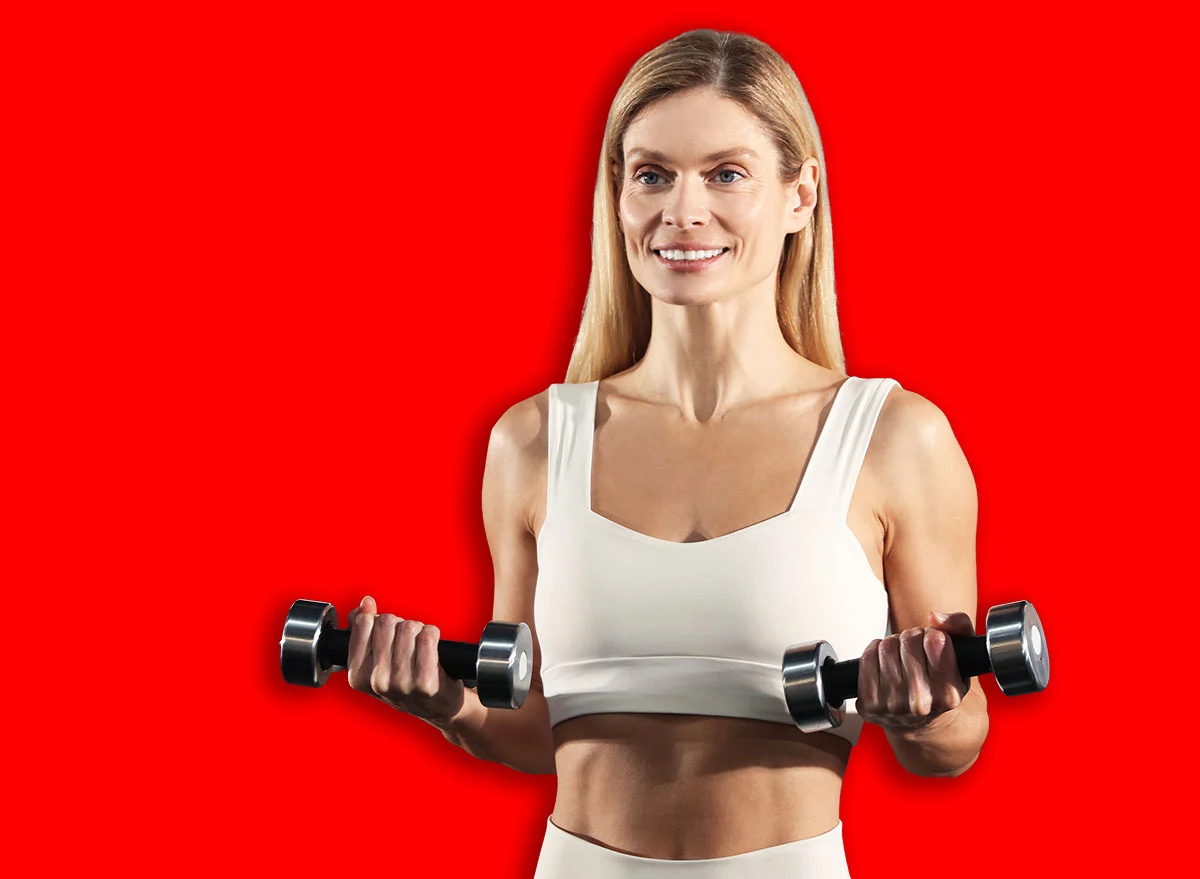
This compound exercise is a highly efficient way to work multiple major muscle groups in the upper body, combining the benefits of a bicep curl with a shoulder press. It targets the biceps, deltoids, and triceps (during the eccentric phase of the press), while also demanding significant core stability. Begin by standing with feet hip-width apart, holding a light dumbbell in each hand, palms facing forward, arms extended down by your sides. First, perform a bicep curl: slowly lift the dumbbells towards your shoulders, contracting your biceps. Once the curl is complete, rotate your wrists so your palms face forward, and smoothly press the dumbbells overhead into a shoulder press, fully extending your arms without locking your elbows. Avoid rushing through this transition. As you lower the dumbbells, reverse the motion: bring them down to shoulder height, rotate your wrists back to face your body, and then slowly lower them back to the starting position for the bicep curl. Throughout the entire movement, keep your ribs pulled in and your core engaged to protect your lower back and ensure the work remains in your arms and shoulders. Perform 8-12 repetitions for 2-3 sets. This exercise is a powerful builder of functional strength, mimicking movements often performed in daily life.
Integrating these five exercises into a consistent daily or near-daily routine, even for short durations, can yield remarkable improvements in upper arm strength, definition, and overall functional capacity for individuals over sixty. Consistency is paramount, as is the principle of progressive overload—gradually increasing the challenge over time by adding more repetitions, sets, or a slightly heavier weight. Always prioritize proper form over the amount of weight lifted, and remember to listen to your body, adjusting the intensity as needed. It is also advisable to consult with a healthcare professional or a certified fitness expert before embarking on any new exercise regimen, especially if you have pre-existing health conditions. By embracing these accessible and effective routines, seniors can actively defy the common narrative of age-related decline, empowering themselves with renewed strength, vitality, and confidence in their upper bodies.
About the Author