The natural progression of human aging often brings with it subtle yet significant physiological shifts, particularly concerning muscle mass and strength. Many individuals observe a gradual decline in the firmness and power of their upper limbs as they advance through their middle years and beyond. This phenomenon is not merely an anecdotal observation but a well-documented biological process known as sarcopenia, which describes the age-associated loss of skeletal muscle mass, quality, and strength. While the precise onset and rate can vary, scientific literature indicates that muscle atrophy typically begins accelerating around the fifth decade of life, with adults potentially losing approximately one percent of their total muscle mass annually without consistent engagement in resistance training. Such a reduction in physical capacity can profoundly impact everyday functionality, making seemingly simple tasks—like pushing open a heavy door, carrying groceries from the car, or reaching for items on a high shelf—progressively more challenging.
However, the narrative surrounding age-related decline in muscular strength is not one of inevitability. Contemporary understanding of exercise physiology emphatically demonstrates that muscle mass and strength can be preserved, and even significantly rebuilt, regardless of chronological age. The key lies in consistent, appropriate resistance training. Counter to a common misconception, achieving greater strength and definition in the upper body does not inherently demand access to heavy free weights or complex gym machinery. A growing body of expert opinion, supported by practical application, highlights the immense efficacy of simple, standing bodyweight exercises. These movements leverage an individual’s own mass for resistance, emphasizing controlled execution and sustained muscular engagement, offering a highly accessible and joint-friendly pathway to improved upper arm conditioning for adults navigating the second half of life.
James Bickerstaff, a certified personal trainer affiliated with OriGym, underscores the distinct advantages of incorporating standing bodyweight regimens. He notes that these exercises offer a versatile method to fortify the upper body without placing undue stress on sensitive joints, a crucial consideration for an aging population. Beyond targeting specific muscle groups such as the triceps and deltoids, these dynamic movements inherently foster improvements in balance, coordination, and overall postural stability. This holistic benefit is particularly vital for maintaining independence and reducing the risk of falls in later life.
Sarcopenia’s impact extends beyond mere aesthetics or the ability to lift objects. It is intimately linked to broader health outcomes, including metabolic health, bone density, and even cognitive function. As muscle mass diminishes, the body’s metabolic rate can slow, increasing the propensity for fat accumulation and raising the risk of conditions like type 2 diabetes. Furthermore, muscles play a crucial role in supporting bone structure; their weakening can exacerbate bone loss, contributing to osteoporosis and increasing fracture vulnerability. Regular resistance training acts as a powerful countermeasure, stimulating muscle protein synthesis, strengthening connective tissues, and even signaling bone-building cells, thus providing comprehensive physiological benefits. The good news is that muscle retains its adaptability well into advanced age, meaning that initiating a strength program, even if one has been sedentary for years, can yield substantial and measurable improvements.
The adoption of standing bodyweight exercises presents a particularly attractive solution for older adults due to their inherent accessibility and low barrier to entry. They require no specialized equipment, can be performed in virtually any space, and can be easily modified to suit varying fitness levels. The emphasis on slow, controlled movements and time under tension, rather than heavy loads, provides a safe yet effective stimulus for muscle growth and endurance. This approach also naturally integrates core stability and balance, as standing positions demand continuous engagement of stabilizing muscles throughout the torso and lower body. This multi-faceted benefit translates directly into enhanced functional fitness, making daily activities easier and safer.
Let’s delve into five highly effective standing exercises recommended for fostering robust, defined upper arms and improved overall upper body function:
1. Standing Wall Presses
This foundational exercise serves as an excellent entry point for individuals new to resistance training or those seeking a joint-gentle alternative to traditional push-ups. Standing wall presses engage the chest, shoulders, and the triceps muscles located at the back of the upper arm, all without placing direct pressure on the wrists or elbows often associated with floor-based variations. The movement directly translates to real-world tasks requiring pushing strength, such as opening doors or maneuvering heavy objects.
- Execution: Begin by standing approximately two to three feet away from a sturdy wall, facing it directly. Place your palms flat against the wall, slightly wider than shoulder-width apart, with your hands at chest height. Engage your core and keep your body in a straight line from head to heels. Slowly bend your elbows, allowing your chest to move towards the wall in a controlled manner, as if performing a standing push-up. Maintain a straight back and avoid arching. Once your nose or chest is close to the wall, press strongly through your palms, extending your elbows to return to the starting position. Focus on squeezing your chest and triceps during the upward phase.
- Modifications: To increase difficulty, step further away from the wall. To decrease difficulty, stand closer to the wall or reduce the depth of the press.
- Common Mistakes: Allowing hips to sag or arching the back, not keeping the neck in line with the spine, rushing the movement.
2. Standing Arm Rotations
While seemingly simple, standing arm rotations are remarkably effective for placing the shoulder musculature and upper arms under continuous, low-impact tension. This exercise primarily targets all three heads of the deltoid muscle (front, side, and rear shoulder) and contributes to the overall endurance and definition of the upper arms without the need for external weights. It also promotes improved circulation and shoulder mobility.
- Execution: Stand tall with your feet shoulder-width apart, arms extended straight out to your sides, parallel to the floor, forming a "T" shape with your body. Keep your shoulders relaxed and down, away from your ears, and your core gently engaged. Begin making small, controlled circles with your arms, first moving them forward for a set number of repetitions. The circles should originate from your shoulders, not just your wrists or elbows. After completing the forward circles, reverse the direction, performing the same number of repetitions backward. Focus on maintaining continuous tension in your shoulders and upper arms throughout the movement.
- Modifications: Adjust the size of the circles – smaller circles for less intensity, larger for more. Vary the speed, moving slower to emphasize time under tension.
- Common Mistakes: Shrugging shoulders, using momentum instead of muscle control, allowing arms to drop below shoulder height.
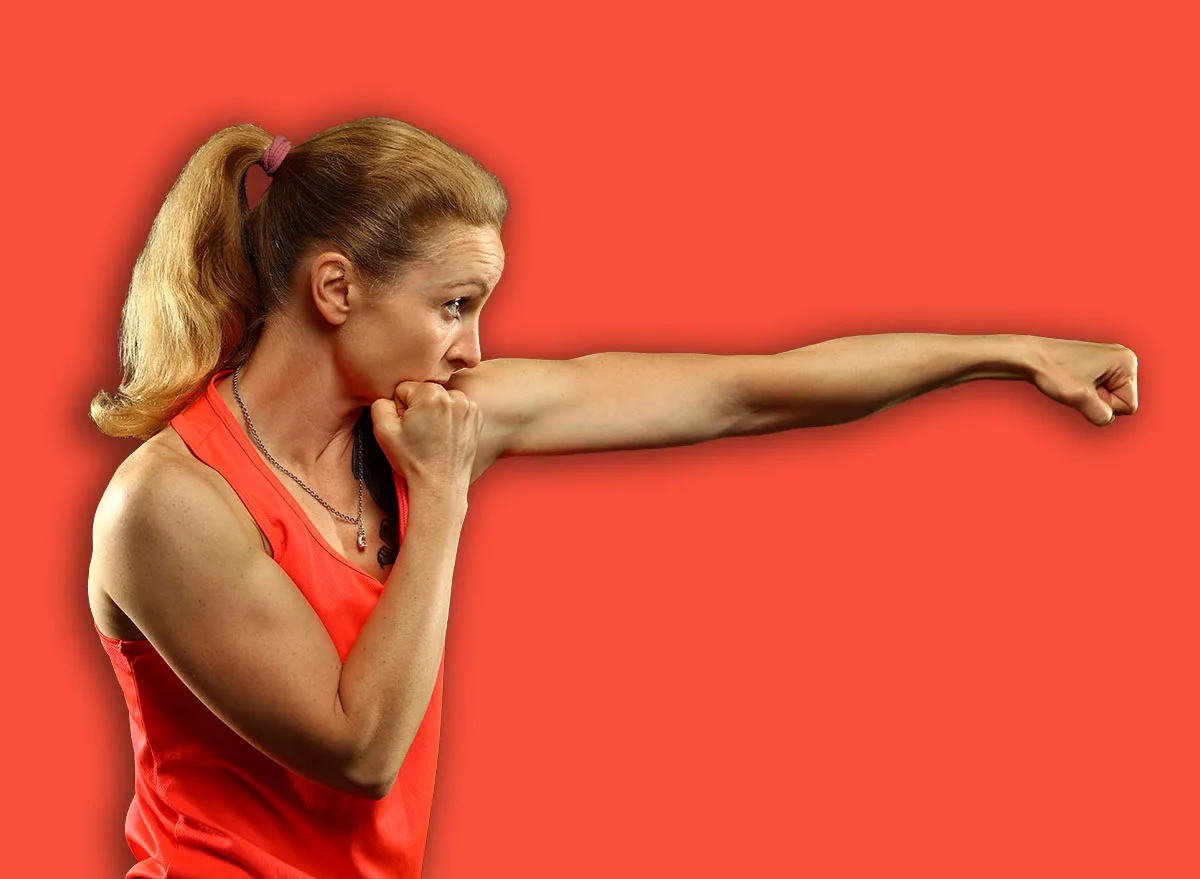
3. Standing Punches
This dynamic exercise combines elements of upper-arm strengthening with light cardiovascular activity, making it excellent for building muscular endurance, promoting overall body coordination, and enhancing upper arm tone. Standing punches engage the shoulders, biceps, and triceps in a continuous, rhythmic fashion, while also activating the core for stability.
- Execution: Stand with your feet shoulder-width apart, knees slightly bent, and your core engaged. Hold your hands up in a guard position, fists loosely clenched near your chin. Extend one arm forward in a controlled punching motion, rotating your fist slightly so your palm faces down at the end of the punch. Fully extend your arm but avoid locking the elbow. Immediately retract the arm back to the starting guard position with equal control. Alternate arms, performing continuous punches in a fluid motion. Maintain a stable torso and avoid excessive swaying.
- Modifications: Increase the speed for a greater cardio effect, or slow down the punches to focus purely on muscular contraction and control. Add a slight rotation of the torso for increased core engagement.
- Common Mistakes: Over-extending and locking elbows, losing core engagement, allowing shoulders to creep up towards the ears.
4. Standing Reverse Arm Raises
Often, individuals focus heavily on the front of their shoulders and arms, neglecting the posterior chain muscles. Standing reverse arm raises specifically target the rear deltoids and the muscles of the upper back, such as the rhomboids and trapezius. Strengthening these often-overlooked muscle groups is critically important for maintaining good posture, counteracting the forward-slump posture common with desk work or age, and contributing to balanced shoulder health and overall arm strength.
- Execution: Stand with your feet hip-width apart, knees slightly bent, and hinge forward slightly at your hips, maintaining a flat back. Let your arms hang straight down towards the floor, palms facing each other or slightly behind you. Engage your core. Keeping a slight bend in your elbows, slowly raise your arms out to the sides and slightly behind you, as if trying to squeeze a pencil between your shoulder blades. Your arms should form a "Y" shape with your body. Focus on feeling the contraction in your upper back and the back of your shoulders. Control the movement as you slowly lower your arms back to the starting position.
- Modifications: Adjust the degree of forward hinge; a greater hinge increases the challenge. Perform one arm at a time to focus on individual muscle engagement.
- Common Mistakes: Rounding the back, shrugging shoulders, using momentum to swing the arms up, lifting the arms too high without engaging the back muscles.
5. Standing Overhead Reach
The standing overhead reach is an indispensable exercise for cultivating triceps strength, improving shoulder stability, and enhancing overall shoulder flexibility – all vital components for functional movement in daily life, such as reaching for objects on high shelves. This movement effectively places the triceps under tension while simultaneously promoting a healthy range of motion in the shoulder joint.
- Execution: Stand tall with your feet shoulder-width apart and your core gently engaged. Extend one arm straight overhead, palm facing forward or inward. Keep your elbow close to your head. Slowly bend your elbow, lowering your hand behind your head as far as comfortably possible, ensuring your upper arm remains pointing upwards. Feel the stretch in your triceps. Then, powerfully extend your arm back to the starting overhead position, focusing on squeezing the triceps at the top. Maintain a stable torso throughout the movement, avoiding arching your back. Complete all repetitions on one side before switching to the other.
- Modifications: If reaching fully overhead is challenging, reduce the range of motion. Perform the movement with both arms simultaneously for increased stability demand, or hold a light household object (e.g., a water bottle) for minimal added resistance.
- Common Mistakes: Arching the lower back excessively, allowing the elbow to flare out to the side, rushing the movement, using shoulder muscles more than triceps.
Integrating these standing bodyweight exercises into a regular fitness routine offers a profound opportunity to counteract the effects of sarcopenia and maintain a high quality of life. Consistency is paramount; aiming for two to three sessions per week, with 10-15 repetitions per exercise across 2-3 sets, can yield significant results over time. Beyond exercise, a holistic approach that includes adequate protein intake to support muscle repair and growth, sufficient hydration, and restorative sleep will amplify the benefits. It is always advisable to consult with a healthcare professional or a qualified fitness expert before embarking on any new exercise program, especially if you have underlying health conditions. By embracing these accessible, effective movements, individuals can cultivate enduring upper body strength, enhance their functional independence, and enjoy a more vigorous and capable life at any age.
About the Author