Maintaining physical strength is a cornerstone of healthy aging, directly influencing an individual’s independence, quality of life, and ability to perform daily tasks. As people progress beyond their sixth decade, they often encounter a natural decline in muscle mass and strength, a condition scientifically termed sarcopenia. This age-related muscular atrophy can significantly impede functional capabilities, making routine actions like lifting groceries, reaching for items on a high shelf, or even rising from a seated position increasingly challenging. While many traditional strength-building exercises, such as standard push-ups, are highly effective, they can present considerable barriers for older adults due to the significant demands they place on joint stability, wrist flexibility, and overall body control. Fortunately, accessible and adaptable alternatives exist, with chair-based exercises emerging as a particularly valuable strategy for cultivating robust upper-body strength and enhancing overall physical resilience.
The inherent stability provided by a sturdy chair transforms complex movements into safer, more controlled, and highly effective training opportunities. This approach allows individuals to concentrate on activating specific muscle groups without the added challenge of maintaining balance or supporting their full body weight in potentially awkward positions. A certified strength and conditioning specialist often recommends incorporating such supported workouts for clients aiming to develop pressing, pulling, and stabilizing capabilities with greater precision and confidence. The familiarity of the setup, coupled with the ease of modifying movements, makes chair exercises an ideal pathway to activating the muscles across the arms, shoulders, chest, and upper back. This balanced approach is crucial, as it not only strengthens the muscles responsible for pushing but also integrates vital pulling movements, which are often overlooked yet essential for maintaining good posture, shoulder health, and preventing imbalances.
Before embarking on any new exercise regimen, particularly for individuals over 60, it is always advisable to consult with a healthcare provider or a qualified fitness professional. This ensures that the chosen exercises are appropriate for individual health conditions and fitness levels. When engaging in strength training, the paramount focus should always be on impeccable form and controlled movements rather than on lifting excessively heavy weights. Progressive overload, the principle of gradually increasing resistance or repetitions over time, is fundamental for continued muscular adaptation, but it must be implemented cautiously. Consistency, typically two to three sessions per week, combined with adequate warm-up and cool-down periods, will yield the most beneficial and sustainable results.
The following four chair-based exercises are designed to offer a comprehensive upper-body workout, systematically targeting various muscle groups crucial for functional strength and mobility. For these exercises, a stable chair is essential, and incorporating a resistance band and light dumbbells (if available) will allow for progressive resistance.
1. Triceps-Focused Chair Dips: Enhancing Pushing Power for Daily Function
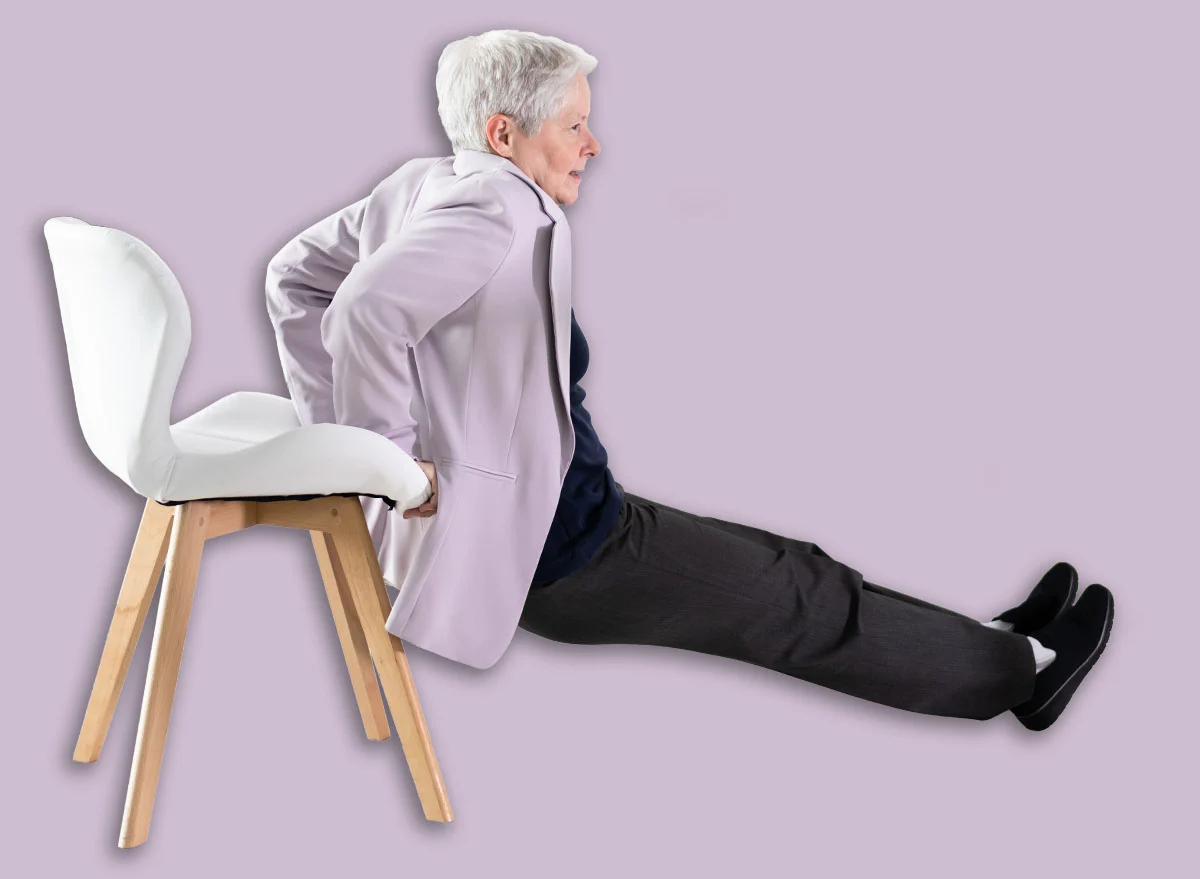
The ability to push oneself up from a chair, propel away from a surface, or safely lower to the floor relies heavily on the strength of the triceps muscles located at the back of the upper arm. Chair dips specifically isolate and fortify this pushing capacity in a controlled environment. By utilizing the support of a chair, individuals can manage the depth of the movement, ensuring that the exercise remains within a comfortable and pain-free range of motion. The primary objective is to engage the triceps effectively throughout the movement, prioritizing muscle activation over the extent of the dip. A partial dip executed with precision and control invariably offers greater benefits than a deeper movement that strains the shoulder joints or compromises form.
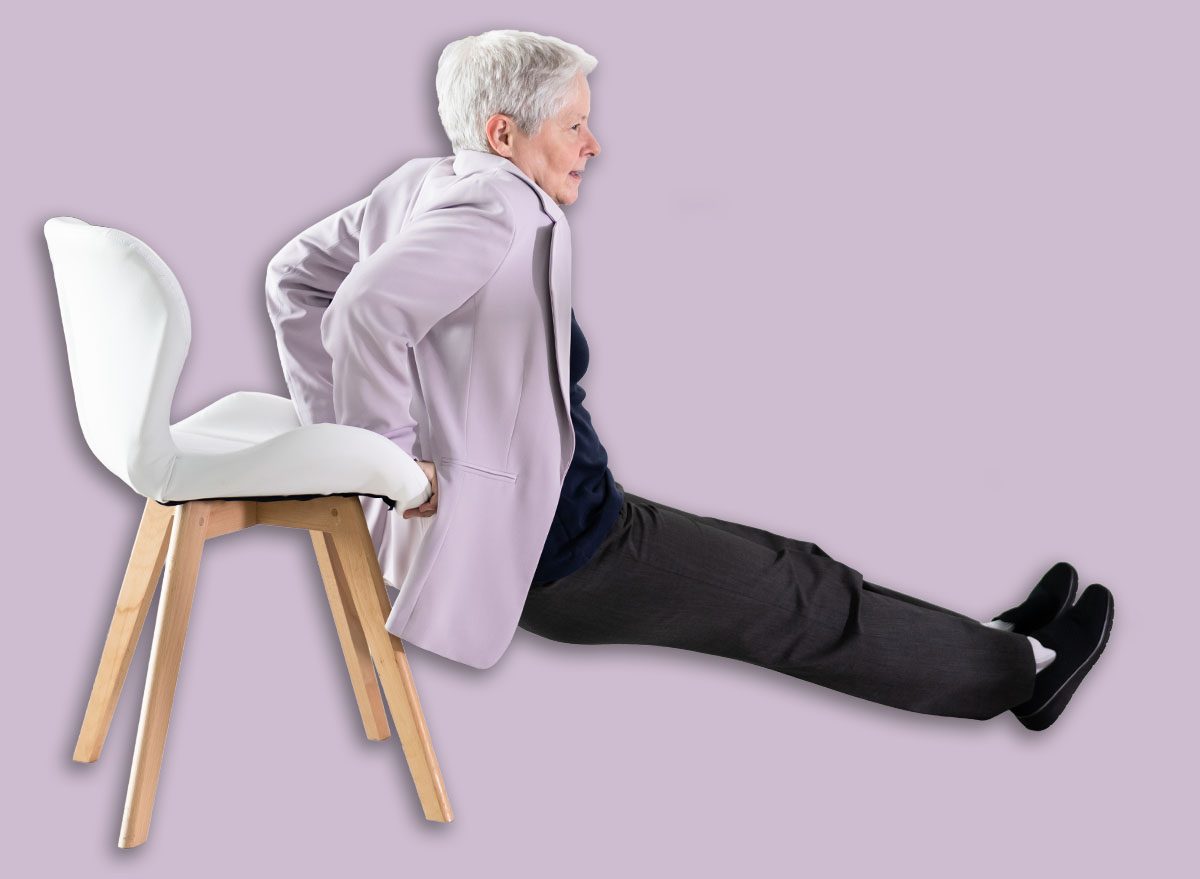
- Muscles Engaged: Primarily targets the triceps, with secondary activation of the shoulders (deltoids), chest (pectorals), and upper back stabilizers.
- Execution: Position yourself at the edge of a sturdy chair, gripping the seat with hands placed shoulder-width apart, fingers pointing forward or slightly outward. Extend your legs forward, either with bent knees for reduced difficulty or straightened legs for increased challenge. Slowly lower your body by bending your elbows, keeping them pointed directly backward and close to your torso. Descend only as far as comfortable, ensuring no strain on the shoulders. Push back up to the starting position using your triceps.
- Set and Repetitions: Aim for 2 to 3 sets, performing 6 to 10 repetitions per set.
- Adaptations: To simplify, perform a smaller range of motion or keep knees bent closer to the chair. To increase challenge, extend legs further or perform the movement at a slower, more deliberate pace.
- Key Technique Point: Focus on maintaining a straight back and preventing the shoulders from shrugging up towards the ears. The movement should be driven by the triceps, not momentum.
2. Seated Overhead Press: Cultivating Vertical Strength and Shoulder Mobility
Developing strength in overhead movements is paramount for tasks such as reaching into high cabinets, lifting objects above the head, or even properly storing items. The seated shoulder press offers an excellent foundation for building this vertical strength, as the seated position eliminates the need for additional core and lower-body stabilization, allowing for a concentrated focus on shoulder mechanics and proper form. For individuals who may lack confidence or experience discomfort when reaching overhead, this supported variation provides a secure platform to develop the necessary power and range of motion. Initiating with minimal resistance, maintaining proper spinal alignment, and executing the press with a deliberate, even tempo are critical for optimal results.
- Muscles Engaged: Primarily targets the anterior and medial deltoids (shoulders), triceps, upper back, and core stabilizers.
- Execution: Sit upright in a chair with your back supported, feet flat on the floor. Hold a light dumbbell in each hand, resting them at shoulder height with palms facing forward or inwards. Engage your core and keep your rib cage gently pulled down to prevent excessive arching of the lower back. Smoothly press the weights directly overhead until your arms are fully extended but not locked. Control the descent back to the starting position.
- Set and Repetitions: Perform 2 to 3 sets of 8 to 12 repetitions.
- Adaptations: For a reduced challenge, use lighter dumbbells or a resistance band looped under your feet and pressed overhead. To increase difficulty, consider a single-arm press, which also engages core stabilizers more intensely.
- Key Technique Point: Ensure your back remains against the chair or maintain a neutral spine throughout the movement, avoiding any excessive arching as the weights go overhead. The movement should be controlled, not jerky.
3. Seated Resistance Band Row: Reinforcing Posterior Chain and Postural Integrity
While pressing movements are frequently emphasized, the development of pulling strength is equally, if not more, vital for maintaining balanced upper-body strength, improving posture, and mitigating the forward-slumped posture often associated with aging. The seated resistance band row effectively targets the muscles of the upper back, contributing significantly to enhanced shoulder support and overall spinal health. By anchoring a resistance band in front of the body or around the feet, individuals can engage in a controlled pulling motion that emphasizes the contraction of the back muscles. The focus should be on initiating the pull with the shoulder blades, drawing the elbows backward, and consciously squeezing the shoulder blades together at the peak of the contraction, rather than simply yanking with the hands and biceps.
- Muscles Engaged: Primarily targets the upper back (rhomboids, trapezius), latissimus dorsi (lats), rear deltoids, and biceps.
- Execution: Sit tall in a chair with feet flat on the floor. Loop a resistance band around your feet or anchor it to a sturdy object directly in front of you at chest height. Hold the ends of the band with both hands, palms facing each other. Keep your back straight and shoulders relaxed. Initiate the movement by pulling your elbows backward, bringing your hands towards your torso, and squeezing your shoulder blades together. Control the release as the band extends forward.
- Set and Repetitions: Complete 2 to 3 sets of 10 to 15 repetitions.
- Adaptations: Utilize a lighter resistance band for easier execution or a heavier band for increased challenge. Incorporating a brief pause at the peak of the contraction can intensify muscle engagement. A single-arm variation can also be used to address muscular imbalances.
- Key Technique Point: Avoid shrugging your shoulders towards your ears. The primary action should originate from the retraction of your shoulder blades, drawing your elbows back and down.
4. Seated Resistance Band Pull-Apart: Optimizing Shoulder Health and Rotator Cuff Stability
As a finishing exercise or a standalone movement focused on shoulder integrity, the seated resistance band pull-apart offers precise and targeted work for the often-neglected posterior shoulder muscles and the rotator cuff. These muscles play a critical role in stabilizing the shoulder joint, improving overall posture, and facilitating smooth, pain-free movement during activities such as pressing, reaching, and carrying. The key to this exercise is to use a resistance band light enough to allow for a fluid and controlled movement from start to finish. Any sensation of the shoulders creeping upwards towards the ears indicates excessive tension or incorrect form, necessitating a reduction in resistance or a reset of the starting position.
- Muscles Engaged: Primarily targets the rear deltoids, upper back musculature (rhomboids, trapezius), and the rotator cuff muscles.
- Execution: Sit comfortably in a chair with good posture. Hold a light resistance band with both hands, arms extended straight out in front of you at shoulder height, palms facing down. The band should have some tension. Slowly and deliberately pull the band apart by retracting your shoulder blades and moving your arms outwards, as if trying to touch your shoulder blades together. Maintain the band at shoulder height and avoid shrugging. Control the return to the starting position.
- Set and Repetitions: Perform 2 to 3 sets of 12 to 15 repetitions.
- Adaptations: Adjust the band’s resistance level. Experiment with palms-up or diagonal pull-aparts to target slightly different angles of the posterior shoulder.
- Key Technique Point: The movement should be smooth and deliberate, focusing on the contraction of the muscles between the shoulder blades and the back of the shoulders. Avoid using momentum or allowing the shoulders to elevate.
Rebuilding and maintaining upper-body strength after 60 is an attainable and profoundly beneficial goal. By incorporating these chair-supported exercises into a regular fitness routine, individuals can experience significant improvements in functional strength, mobility, and overall quality of life. The emphasis on controlled movements, proper form, and progressive adaptation ensures a safe and effective path to enhanced physical well-being. Consistent engagement, perhaps three to four times weekly, whether as a dedicated session or integrated into a broader exercise program, will progressively strengthen pressing, pulling, and reaching capabilities, empowering greater independence and vitality in everyday activities. Always prioritize listening to your body, making each repetition purposeful, and gradually increasing the challenge as your strength and confidence grow.
About the Author