As individuals advance into their sixties and beyond, maintaining robust lower limb strength becomes a cornerstone of preserving autonomy and quality of life. The physiological phenomenon known as sarcopenia, characterized by the progressive loss of skeletal muscle mass and strength with age, significantly impacts mobility, balance, and the capacity to perform daily tasks. While traditional exercises like squats are undeniably effective for developing lower body musculature, they may present balance challenges or exacerbate joint discomfort for some older adults. This underscores the necessity for adaptable, supportive, and comprehensive fitness regimens. Chair-assisted exercises offer a compelling solution, providing stability and control that empower seniors to build strength safely and efficiently, often targeting muscle groups in a more integrated manner than isolated movements.
The importance of strong legs extends far beyond aesthetic appeal; it directly correlates with fundamental aspects of independent living. From the simple act of rising from a seated position to navigating stairs or walking confidently on varied terrains, resilient lower body muscles are indispensable. Research consistently demonstrates that engaging in regular strength training can mitigate the effects of sarcopenia, enhance bone density, improve metabolic health, and significantly reduce the risk of falls, which are a leading cause of injury among the elderly. By offering a stable anchor point, a chair transforms into a versatile piece of exercise equipment, enabling a wider range of motion with reduced perceived effort and heightened safety, making strength training accessible to a broader demographic of older adults.
A holistic approach to lower body conditioning is crucial, moving beyond merely one or two movement patterns. While foundational movements like sitting and standing are paramount, integrating exercises that address various muscle groups—including the quadriceps, hamstrings, glutes, and hip abductors—ensures comprehensive development. This multifaceted strategy not only builds raw strength but also enhances coordination, proprioception (the body’s sense of self-movement and position), and overall functional fitness. For fitness professionals working with older populations, observing consistent improvements in control, stability, and confidence during these chair-supported movements serves as a strong indicator of progress, translating into greater ease and security in everyday activities.
For optimal benefits, these chair-based exercises should be incorporated into a routine two to four times weekly. The emphasis should always be on controlled, purposeful movements, treating each repetition as a deliberate practice session aimed at fortifying the muscles for real-world application. Ensure the chosen chair is sturdy and stable, preferably without wheels, to provide reliable support. The following five exercises are designed to offer a well-rounded lower body workout, focusing on key muscle groups essential for maintaining independence and mobility.
1. Chair-Assisted Sit-to-Stand (Box Squat Variation)
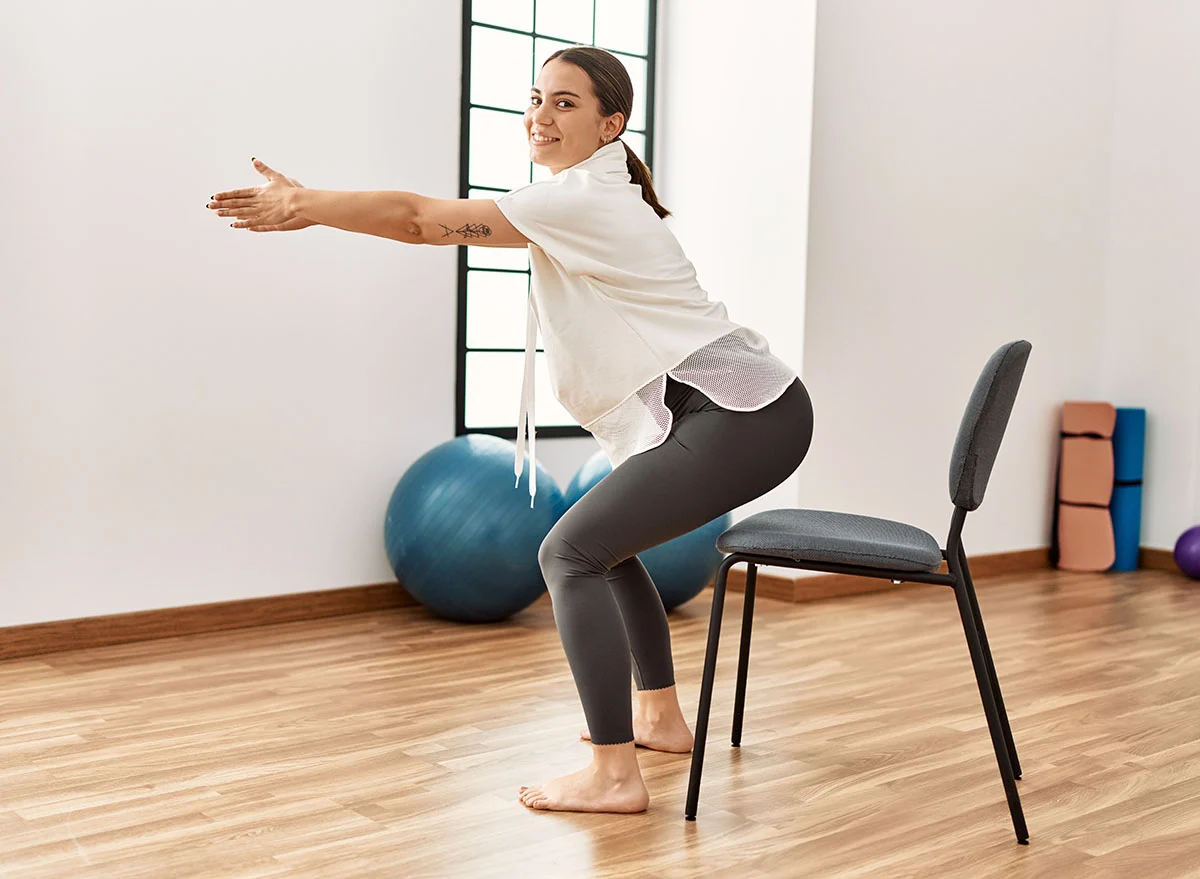
This exercise directly mimics one of the most fundamental daily movements: transitioning from sitting to standing. It is a cornerstone for building functional strength in the lower body, particularly engaging the major muscle groups of the thighs and buttocks. By using a chair as a clear target and support, individuals can practice the movement with precise depth and control, fostering confidence in an essential motor skill.
- Muscles Engaged: Quadriceps (front of thighs), Gluteal muscles (buttocks), Hamstrings (back of thighs), and Core stabilizers.
- Functional Benefits: Directly improves the ability to get up from chairs, sofas, and toilets, enhancing independence in the home environment.
- Execution: Begin by sitting on the edge of a stable chair, feet flat on the floor, shoulder-width apart. Lean slightly forward from the hips, engaging your core, and push through your heels to stand up fully. Lightly tap the chair with your glutes as you descend, maintaining tension in your muscles, before pressing back up without fully relaxing into the seat.
- Key Considerations: Avoid "plopping" down onto the chair. The movement should be slow and controlled both upwards and downwards. Keep your chest lifted and your gaze forward.
- Progression/Variations: To increase difficulty, use a lower chair, perform a brief pause at the bottom of the movement, or slow down the tempo. To make it easier, use a higher chair or lightly push off your thighs with your hands.
- Recommended Sets and Reps: Aim for 3 sets of 10 to 15 repetitions, resting for 45 to 60 seconds between sets.
2. Chair-Supported Reverse Lunge
Single-leg strength is paramount for balance and stability, particularly during activities like walking or climbing stairs. The reverse lunge is an excellent way to cultivate this strength, and performing it with chair support significantly reduces the balance challenge, allowing for greater focus on muscle engagement. Stepping backward tends to be less strenuous on the knees compared to a forward lunge, making it a preferable option for many older adults.

- Muscles Engaged: Quadriceps, Glutes, Hamstrings, Calves, and Core stabilizers.
- Functional Benefits: Improves balance, strengthens muscles used in walking and stair climbing, and enhances hip and knee stability.
- Execution: Stand tall beside a sturdy chair, holding onto its back or armrest for balance. Step one leg backward, lowering your hips until both knees are bent at approximately 90-degree angles. Ensure your front knee remains aligned over your ankle and your rear knee hovers just above the floor. Push through the heel of your front foot to return to the starting position.
- Key Considerations: Use the chair for stability, not to pull yourself up. Maintain an upright torso and keep your front heel firmly planted throughout the movement.
- Progression/Variations: Adjust the range of motion by taking a smaller step backward if needed. For added challenge, perform the exercise without chair support once balance improves, or hold light dumbbells.
- Recommended Sets and Reps: Complete 3 sets of 6 to 10 repetitions per side, resting for 45 to 60 seconds between sets.
3. Seated Leg Extension
Targeting the quadriceps muscles directly, this exercise is instrumental in bolstering knee support and enhancing the power needed for actions like standing and ascending stairs. While typically performed on a machine, a seated variation using a chair effectively isolates these crucial thigh muscles without requiring specialized equipment.
- Muscles Engaged: Quadriceps (specifically rectus femoris, vastus lateralis, vastus medialis, vastus intermedius), and Hip Flexors.
- Functional Benefits: Strengthens the muscles that stabilize and extend the knee, making stair climbing, standing up, and walking easier and more secure.
- Execution: Sit upright in a chair with your feet flat on the floor. Extend one leg straight out in front of you until it is parallel to the floor, actively squeezing your quadriceps at the top of the movement. Hold this peak contraction for a brief moment before slowly lowering your foot back to the starting position.
- Key Considerations: Focus on a controlled lift and a slow, deliberate lowering phase to maximize muscle engagement. Avoid swinging your leg or using momentum.
- Progression/Variations: Incorporate a resistance band around your ankles for increased challenge. Perform short-range extensions if full extension causes discomfort, or introduce a pause at the top.
- Recommended Sets and Reps: Perform 3 sets of 10 to 12 repetitions per side, with a rest period of 30 to 45 seconds between sets.
4. Seated Band Hamstring Curl
Often overshadowed by quadriceps work, the hamstrings are vital for knee flexion, hip stability, and contributing propulsive power to one’s stride. This seated band curl offers a direct and effective method to target these posterior thigh muscles, which can be underdeveloped in routines heavily focused on squatting.
- Muscles Engaged: Hamstrings (biceps femoris, semitendinosus, semimembranosus), and to a lesser extent, Calves and Glutes.
- Functional Benefits: Enhances knee flexion, supports hip extension, and improves the power and efficiency of walking and running.
- Execution: Sit comfortably in a chair, looping a resistance band around one ankle and securing the other end around the chair leg or the opposite foot. Keeping your thigh still, bend your knee and pull your heel backward towards the chair, contracting your hamstring. Control the band’s tension as you slowly allow your foot to return to the starting position.
- Key Considerations: Isolate the movement to the knee joint, ensuring your thigh remains relatively stationary. The pull should be smooth, and the return controlled.
- Progression/Variations: Adjust the band’s resistance (lighter or heavier band). Experiment with shorter ranges of motion if full flexion is challenging, or introduce a slower tempo for increased time under tension.
- Recommended Sets and Reps: Aim for 3 sets of 10 to 15 repetitions per side, resting for 30 to 45 seconds between sets.
5. Seated Band Hip Abduction
The muscles on the outer aspect of the hips, primarily the gluteus medius and minimus, are critical for stabilizing the pelvis, maintaining balance during single-leg stance, and controlling knee alignment. Strengthening these muscles through seated hip abductions can significantly enhance overall lower body stability and reduce fall risk.
- Muscles Engaged: Gluteus Medius, Gluteus Minimus, Tensor Fasciae Latae (TFL), and Core stabilizers.
- Functional Benefits: Improves lateral stability, crucial for walking, changing direction, and preventing inward collapse of the knees. Directly contributes to better balance.
- Execution: Sit upright in a chair with a resistance band looped around your thighs, just above your knees. Keep your feet planted flat on the floor, hip-width apart. Press your knees outward against the band, feeling the contraction in your outer hips. Hold briefly, then slowly and with control, return your knees to the starting position, resisting the band’s pull.
- Key Considerations: Avoid rocking your torso or using momentum. The movement should be initiated and controlled by the outer hip muscles. Maintain a stable posture throughout.
- Progression/Variations: Use a band with higher resistance. Incorporate a pause at the point of maximum abduction, or perform the exercise with a slower tempo to increase muscle activation.
- Recommended Sets and Reps: Complete 3 sets of 12 to 15 repetitions, resting for 30 to 45 seconds between sets.
Integrating These Chair Exercises into a Comprehensive Routine
To maximize the benefits of these exercises, consider performing them as a lower-body circuit. Begin by completing one set of each exercise consecutively, moving from one to the next with minimal rest. Once all five exercises have been performed once, take a longer rest period of 60 to 90 seconds. Then, repeat this entire circuit for a total of two to three rounds. This approach ensures a thorough workout for all major lower body muscle groups, promoting both strength and muscular endurance.
Consistency is key when it comes to any fitness regimen, especially for muscle restoration in older adults. Adhering to this routine regularly will yield cumulative improvements in strength, balance, and functional capacity. Remember that restoring and building leg muscle after the age of 60 is most effective when the training stimulus addresses the legs from multiple angles and planes of motion. The chair-assisted box squats lay a solid foundation for fundamental movement, while supported lunges introduce crucial single-leg strength and balance. The targeted seated exercises, particularly with resistance bands, fill in critical gaps by strengthening specific muscles like the hamstrings and outer hips, which are vital for overall stability and ease of movement throughout the day. By embracing such a comprehensive and adaptable program, older adults can proactively counter the effects of aging, enhance their physical capabilities, and maintain a vibrant, independent lifestyle. Always consult with a healthcare professional or physical therapist before starting any new exercise program, especially if you have underlying health conditions.
About the Author