As women navigate the complexities of aging, particularly after reaching their sixth decade, the maintenance of physical strength emerges as a critical determinant of prolonged independence and overall quality of life. The natural physiological process of sarcopenia, or age-related muscle loss, accelerates significantly during and after menopause, often leading to a substantial reduction in muscular power and endurance. This decline, while often overlooked or underestimated, profoundly impacts the ability to perform everyday activities, from rising effortlessly from a chair to carrying groceries, and critically influences fall risk and long-term health outcomes. Fortunately, a targeted and accessible approach to strength training, focused on standing exercises that minimize joint stress and maximize functional benefits, offers a powerful antidote to these age-related changes, enabling women to reclaim and rebuild their physical capabilities.
The journey through the decades often brings a subtle but relentless erosion of muscular mass and function. By the age of 60, many women may have experienced a reduction of 15 to 20 percent in the muscle mass they possessed in their prime 40s. This isn’t merely an aesthetic concern; it manifests as tangible difficulties in fundamental movements that were once automatic. Simple actions like transitioning from a seated position to standing, ascending a flight of stairs, or even recovering from a fall, become increasingly challenging without a clear understanding of the underlying cause. Expert guidance, forged over decades in the fitness industry, highlights that this muscular depletion, particularly in the lower body, shoulders, chest, and back, is a primary driver of reduced autonomy. Professionals in personal training, such as the co-founder of TRAINFITNESS, a renowned institution for fitness education, underscore the transformative potential of consistent, low-impact strength regimens. These programs can effectively reverse years of strength degradation, often exceeding participants’ initial expectations for recovery and improvement.

Several key physiological areas warrant focused attention when addressing strength preservation in women over 60. The most pronounced issue frequently observed is the dwindling muscle mass in the legs and glutes. These powerful muscle groups are foundational for mobility, balance, and the execution of daily tasks. Their weakening contributes directly to difficulties with ambulation, transfers, and general stability. Concurrently, upper body strength often lags, partly due to historical societal trends that discouraged women from engaging in heavy lifting throughout their younger years. Consequently, by their sixties, many women find that the musculature of their shoulders, chest, and back has never been adequately challenged. This deficit becomes apparent in activities such as managing shopping bags, opening stubborn containers, or lifting grandchildren, where previously effortless movements now demand considerable effort.
Beyond these major muscle groups, grip strength stands out as a remarkably insightful indicator of overall health and longevity in older adults. A diminished hand grip has been consistently linked to a shorter life expectancy, an increased incidence of falls, and a greater reliance on assistance for daily living. Data suggests that women over 60 often experience a decline of 30 percent or more in grip strength compared to their thirties, a reduction that is rarely addressed proactively. Lastly, bone mineral density, while not directly a measure of muscular strength, is intimately connected to it. Muscles exert force on bones, and this mechanical loading is a crucial stimulus for maintaining bone density. When muscles are underutilized and weak, they fail to provide the necessary stimulus, leading to a concurrent weakening of the skeletal structure and an elevated risk of osteoporosis and fractures. The common thread for addressing all these interconnected issues—muscle loss, functional decline, reduced grip, and bone density—is regular, meaningful resistance training.
Recognizing the unique considerations of an older demographic, a well-designed strength program judiciously avoids certain types of exercises. High-impact movements, such as jumping, while effective for strength building in younger populations, can impose excessive stress on joints that have undergone decades of wear and tear. Knees, hips, and ankles, unaccustomed to such forces for many years, face a significantly elevated risk of injury from sudden, high-impact activities—a risk often understated in general fitness advice. Similarly, exercises performed on the floor present their own set of challenges. The act of transitioning to and from the floor can itself be arduous, consuming a significant portion of an individual’s energy and focus. For many women, particularly those with pre-existing knee or hip conditions, or a pervasive apprehension about their ability to return to a standing position, floor work can be a substantial deterrent, leading to avoidance of beneficial exercises altogether.
This is precisely where the advantages of standing, seated, or wall-supported strength exercises become paramount. These modalities bypass the difficulties associated with impact and floor transitions, offering a safe, joint-friendly, and highly adaptable pathway to strength development. Such exercises can be seamlessly integrated into daily life, requiring no specialized gym attire or equipment beyond potentially some light resistance. They can be performed in the comfort of one’s home, perhaps in a kitchen corner, without the need for a mat or constant changes in body position. This inherent accessibility not only minimizes physical barriers but also addresses a crucial psychological component. Standing strength work feels more akin to "normal life," reducing the intimidation factor often associated with traditional gym environments. This natural integration fosters greater adherence, and in the context of sustained physical improvement, consistent effort consistently outperforms sporadic bursts of intense activity, particularly for this age group.
A foundational strength regimen for women over 60 can effectively target major muscle groups through four carefully selected standing movements. These exercises are designed for safety, efficacy, and progressive challenge.
-
Assisted Squat with Isometric Hold: This exercise powerfully engages the largest muscles of the lower body – the quadriceps, hamstrings, and glutes – in a movement pattern directly mirroring the functional act of standing up. By adding a deliberate pause at the bottom of the movement, the muscles are forced to work harder to maintain position, significantly enhancing strength beyond a simple sit-to-stand. To perform, stand in front of a sturdy chair with feet hip-width apart. Slowly lower your hips as if to sit, maintaining an upright chest, until your glutes lightly touch the chair or hover just above it. Hold this bottom position for 2-4 seconds, engaging your core and glutes, before pressing through your heels to return to a standing position. Avoid collapsing onto the chair or letting your knees track inward. The focus should be on controlled descent and ascent, with the hold creating deep muscular engagement.
-
Vertical Plane Push-Off with Controlled Return: This movement systematically builds strength in the chest, shoulders, arms, and the intrinsic core muscles essential for maintaining an erect posture. Performing the lowering phase slowly, known as eccentric training, dramatically increases the muscular challenge without necessitating additional weight, making it a remarkably safe and effective method for progressing upper body strength. Position yourself facing a wall, standing an arm’s length away with hands placed shoulder-width apart at chest height on the wall. Lean into the wall, bending your elbows and keeping your body in a straight line from head to heels, as if performing a standing push-up. Slowly, over a count of 3-4 seconds, push back to the starting position. Ensure your elbows move slightly outward and your core remains braced throughout. Avoid arching your lower back or shrugging your shoulders towards your ears.
-
Anchored Horizontal Pull (Doorway Row): Targeting the muscles between the shoulder blades and the upper back, this exercise directly counteracts the common forward-slump posture often developed with age. It also builds vital pulling strength crucial for tasks such as opening heavy doors, lifting objects, and managing groceries. A sturdy doorway provides a stable, built-in anchor without requiring any specialized equipment. Stand within a doorway, holding onto the doorframe on either side with an overhand grip, arms extended. Lean back slightly, engaging your core, then pull your chest towards the doorway, squeezing your shoulder blades together. Control the return to the starting position. Adjust your foot position to increase or decrease the difficulty; leaning further back increases the challenge. Remember to keep your shoulders depressed and retracted, avoiding any shrugging.
-
Overhead Press with Light Resistance (Water Bottles): This movement specifically strengthens the shoulders and upper back, areas that frequently exhibit significant weakness in women over 60. Developing overhead strength is instrumental in preventing shoulder rounding and the forward-head posture commonly associated with aging. Begin standing with good posture, feet hip-width apart, holding a water bottle (or light dumbbell) in each hand at shoulder height, palms facing forward. Engage your core and glutes to stabilize your pelvis and protect your lower back. Press the weights directly overhead until your arms are fully extended but not locked. Slowly lower the weights back to the starting position. Ensure the movement is controlled and avoid using momentum or arching your back excessively. Squeezing your glutes throughout the movement provides critical lumbar support.
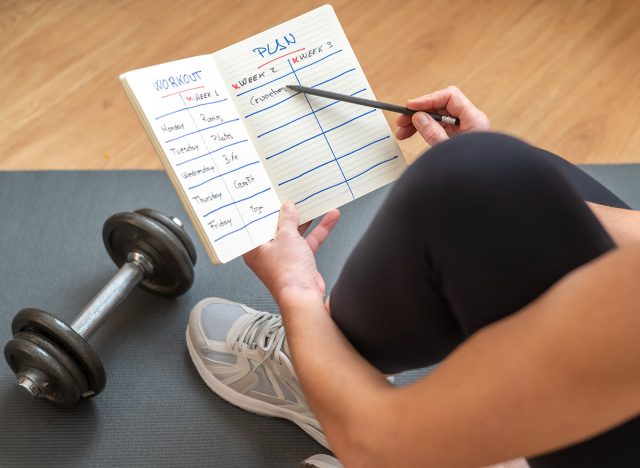
Implementing this regimen effectively requires a structured approach to frequency and progression. A realistic starting point involves performing all four exercises in a single session, twice per week. Each exercise should consist of 2 sets of 10 to 12 repetitions, with a rest period of 45 to 60 seconds between sets. This entire workout can typically be completed within 15 to 20 minutes. Allowing two full days between strength sessions is crucial for muscle recovery and rebuilding, as this is the period during which actual strength gains occur. After the initial month, consider adding a third set to each exercise. As strength improves over two months, the principle of progressive overload becomes vital: increase the challenge by adding more resistance (e.g., heavier water bottles), extending the isometric hold in the squat, or further slowing the eccentric phase of the wall push-up. Continuous adaptation is key to sustained muscular development. For a holistic fitness approach, integrate brisk walks on non-strength training days to build an aerobic base. A pattern of two strength sessions and four walks per week constitutes an excellent regimen for women over 60, demanding approximately three hours of dedicated exercise time weekly.
The benefits of consistent engagement with this strength program unfold in a series of noticeable transformations. Within the initial two weeks, many women report an immediate sense of improved stability and greater ease when standing up and sitting down. This early improvement is largely attributed to neural adaptation, where the brain effectively "relearns" how to recruit and coordinate muscles that may have been underutilized. By the four-to-six-week mark, the impact becomes more tangible, with everyday tasks feeling meaningfully less strenuous. The burden of carrying shopping bags diminishes, climbing stairs becomes less daunting, and navigating soft chairs or low car seats ceases to be an awkward struggle.
As the program progresses into the eight-to-twelve-week range, the strength enhancements become objectively measurable. It is common for participants to achieve 30 to 50 percent more repetitions on the same exercises than when they began. While upper body development may lag slightly behind the lower body, visible changes in arm and shoulder definition and function are typically apparent within three months. Reaching the six-month milestone with consistent effort often translates to a remarkable functional age reduction; in terms of strength, individuals may feel a decade younger. This profound physical revitalization directly contributes to increased energy levels, reduced fatigue, and the promise of many more years of active, independent living. Investing in accessible strength training is not merely about exercise; it is an investment in a vibrant, self-sufficient future.
About the Author