Accessible Chair Exercises for Seniors: Rebuilding Lower Back Strength and Enhancing Mobility Post-60

The pervasive issue of lower back discomfort stands as a primary concern for a substantial segment of the population aged 60 and above, frequently diminishing their overall quality of life and independence. Many individuals in this demographic often resign themselves to the belief that such pain is an inevitable consequence of aging, an unchangeable aspect of their later years. However, contemporary fitness expertise suggests a more optimistic outlook: targeted, accessible interventions can profoundly alter this trajectory, restoring strength and alleviating chronic pain.
According to seasoned fitness professionals, including those with decades of experience in personal training and leadership roles in fitness education, the root cause of much age-related lower back weakness is not irreversible damage but rather a functional decline. Over decades, particularly with increasingly sedentary lifestyles, the intricate network of muscles supporting the spine can effectively "forget" how to activate properly. Key contributors to this phenomenon include dormant gluteal muscles, chronically tight hip flexors, and disengaged deep abdominal stabilizers. When these primary support structures falter, the lumbar muscles are compelled to undertake an excessive burden, performing tasks for which they are not optimally designed. This compensatory effort leads to overstrain and weakness, manifesting as persistent aches and diminished functional capacity.
A significant psychological factor often exacerbates this physical decline: the "fear-avoidance" cycle. Following an acute episode of back pain, individuals instinctively begin to restrict movements that they associate with the onset of discomfort. This understandable, yet counterproductive, reaction leads to further deconditioning, progressive loss of range of motion, and, ultimately, a more vulnerable and weaker back. Breaking this cycle requires gentle, consistent movement that rebuilds confidence alongside physical strength.

In addressing this complex challenge, a simple, everyday piece of furniture—the chair—emerges as a surprisingly potent tool, often surpassing the efficacy of specialized gym equipment for older adults seeking to rejuvenate their lumbar strength. Unlike many gym machines, which tend to isolate specific muscles, chair-based exercises promote integrated, functional movement patterns. True lower back resilience stems from its ability to stabilize the torso while the limbs perform dynamic actions, mirroring the demands of daily life. Activities such as lifting a grocery bag, reaching for an item on a high shelf, or rising from a seated position all require the lower back to act as a stable anchor, coordinating with the hips, glutes, and core. Chair exercises are uniquely suited to train these synergistic muscle activations.
Beyond their functional superiority, chair exercises offer unparalleled accessibility and a lower barrier to entry. They eliminate the need for gym memberships, travel, or waiting for equipment. The familiar setting of one’s home fosters a sense of comfort and reduces intimidation, making it easier to commit to a regular routine. Furthermore, the inherent support of a chair allows for precise control over the range of motion and intensity, enabling individuals to start at a level appropriate for their current capabilities and gradually progress, a flexibility often lacking in fixed-plane gym apparatus.
Here are four foundational chair-based exercises recommended for strengthening the lower back and enhancing overall functional mobility:
1. Seated Pelvic Tilts

- Primary Goal: This exercise focuses on gently mobilizing the lumbar spine and reactivating the deep core muscles crucial for spinal stability. It serves as an excellent warm-up, re-establishing the mind-muscle connection with the lower back.
- Muscles Engaged: Deep core stabilizers (transversus abdominis, multifidus), lower back extensors and flexors.
- Execution Guide: Begin by sitting tall on the edge of a sturdy chair, with feet flat on the floor and knees bent at approximately 90 degrees. Place hands lightly on your thighs. Gently tilt your pelvis forward, allowing a slight arch in your lower back, as if pointing your tailbone backward. Then, slowly tilt your pelvis backward, rounding your lower back slightly and tucking your tailbone under. Focus on the subtle movement within your lumbar region, coordinating with your breath.
- Common Pitfalls & Refinements: Avoid large, exaggerated movements; the goal is gentle articulation. If your back feels very stiff, begin with extremely small, almost imperceptible tilts and gradually increase the range over several weeks. Consistency is more important than amplitude.
2. Seated Hip Hinge
- Primary Goal: This movement teaches the body to bend forward primarily from the hips while maintaining a neutral, protected lower back—a fundamental pattern for safe lifting and bending in daily activities.
- Muscles Engaged: Glutes, hamstrings, lower back muscles (isometrically maintaining neutral spine).
- Execution Guide: Sit at the edge of your chair, feet hip-width apart and firmly planted. Place your hands on your knees or thighs. Keeping your back naturally straight and your chest lifted, slowly hinge forward from your hips, allowing your torso to lean forward. Imagine a string pulling your tailbone backward and your head forward. Feel a gentle stretch in your hamstrings. Pause briefly, then use your glutes and hamstrings to return to an upright seated position without rounding your back.
- Common Pitfalls & Refinements: The most common error is rounding the lower back instead of hinging at the hips. Keep your gaze forward and maintain the natural curve of your spine. If you struggle, reduce the forward lean until you can maintain proper form.
3. Sit-to-Stand
- Primary Goal: Considered a benchmark for functional independence, this exercise strengthens the entire posterior chain (glutes, hamstrings, and lower back) in a highly practical, real-world movement pattern.
- Muscles Engaged: Glutes, quadriceps, hamstrings, lower back stabilizers.
- Execution Guide: Position yourself on the edge of a stable chair, feet flat on the floor, hip-width apart, and slightly behind your knees. Lean your torso forward slightly, shifting your weight over your feet. Push through your heels and glutes to stand up completely, reaching full extension. Control the movement as you slowly lower yourself back down to the chair, gently tapping the seat before rising again, or fully sitting if preferred initially.
- Common Pitfalls & Refinements: Avoid "flopping" into the chair or using momentum to stand up. Control is key. If standing from a standard chair is too challenging, use a higher chair or place a firm cushion on the seat to reduce the depth. As strength improves, remove the cushion or use a lower chair.
4. Standing Hip Extension with Chair Support
- Primary Goal: This exercise specifically targets and activates the gluteal muscles, which are often underactive. Strengthening the glutes is paramount as they should share the load of hip movements, thereby reducing the burden on the lower back.
- Muscles Engaged: Glutes (gluteus maximus, medius), lower back (stabilizing).
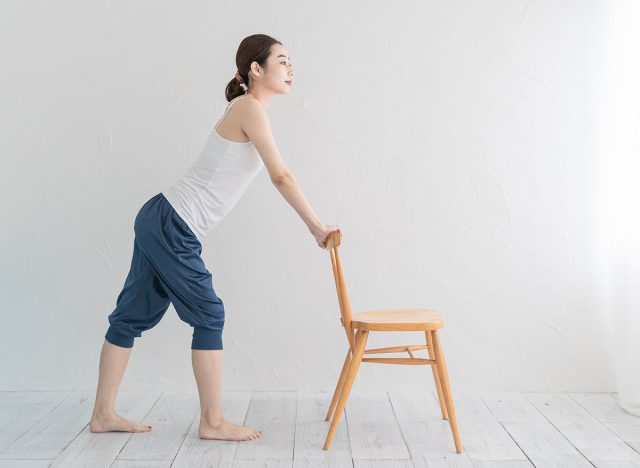
- Execution Guide: Stand behind your sturdy chair, holding onto the backrest for balance and support. Shift your weight slightly onto one leg. Keeping your standing leg slightly bent and your torso stable (avoiding arching your lower back), slowly extend the other leg straight backward, squeezing the glute on that side. Only lift the leg as high as you can without tilting your pelvis or arching your back. Return the leg to the starting position with control. Complete reps on one side before switching.
- Common Pitfalls & Refinements: The primary mistake is arching the lower back to lift the leg higher. The movement should originate from the hip and glute, not the spine. Keep the movement small and focused on glute contraction. Initially, perform a gentle lift; as you progress, consider holding the top position for a count of 1-2 seconds to enhance muscle activation.
Optimizing Your Exercise Environment
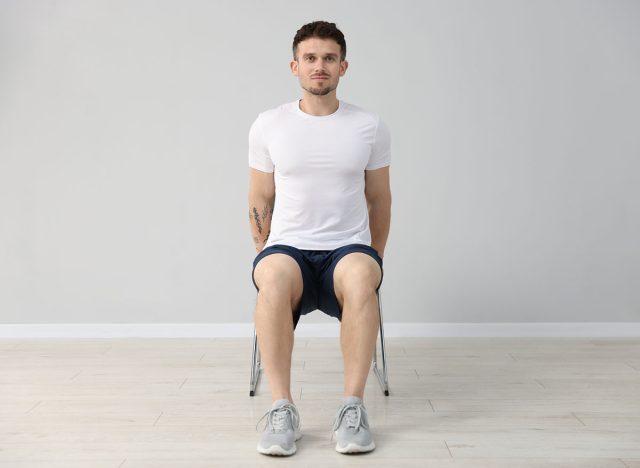
The choice of chair is critical for safety and effectiveness. Opt for a robust dining chair—one that is stable, does not have wheels, and will not flex or wobble under your weight. The seat should be firm and flat, allowing you to sit with your feet flat on the floor and your knees bent at approximately a 90-degree angle. For individuals concerned about balance, positioning the chair against a wall can prevent backward tipping. Additionally, having a second chair or a stable counter in front of you can provide extra support for the standing exercises. If the sit-to-stand exercise proves difficult due to chair height, a firm cushion can be added to the seat, or a naturally higher chair can be utilized. Remember, gradual progression is key; begin with what feels comfortable and build up over time. Even the seated exercises alone can yield significant benefits within the first few weeks.
Integrating the Regimen into Your Routine
Consistency is the cornerstone of progress. A sensible starting point is three to four days per week. Daily practice is also acceptable given the low-impact nature of these exercises. Aim for two sets of the recommended repetitions for each of the four exercises. This typically translates to a manageable 10 to 12-minute session, including brief rests between sets, easily fitting into a morning routine or after a leisurely walk.
After approximately two weeks, consider adding a third set to the Seated Pelvic Tilts and the Standing Hip Extension. After roughly one month, further enhance the Standing Hip Extension by holding each repetition at the peak of the movement for two seconds. This isometric hold intensifies glute activation and fosters strength gains more rapidly than merely increasing repetitions.
Anticipating Results and Long-Term Benefits
The transformative effects of this consistent regimen often become apparent sooner than many anticipate. Within two weeks, most individuals report a noticeable ease in everyday tasks. Bending to tie shoelaces, retrieving dropped items, or rising from a low sofa become less awkward and require less conscious effort. By the four-week mark, the persistent, nagging lower back ache that many older adults endure typically begins to subside. While not always a complete eradication of pain, the reduction is usually significant enough to improve overall comfort throughout the day. Walks and other forms of light physical activity may also feel more effortless, as the back is no longer compensating for underactive glutes.
After six weeks, a profound sense of increased back strength is commonly experienced. Family members or friends might even observe improvements in posture or overall movement quality. Objective measures, such as the sit-to-stand test, often reveal strength gains in the range of 30 to 50 percent—a substantial improvement in a critical functional movement pattern. It is vital to recognize, however, that this program is not a finite six-week solution but an ongoing investment. Maintaining a strong, resilient lower back throughout life requires continued dedication to these foundational movements a few times each week.
Essential Medical Consultation and Warning Signs

While these exercises are generally safe and beneficial, it is crucial to prioritize personal health and safety. Individuals with specific medical conditions should seek professional medical advice before commencing any new exercise program. This includes anyone who has undergone recent back surgery, received a diagnosis of a disc problem, spinal stenosis, osteoporosis, or sustained a fracture in the past year. In such cases, certain exercises may require modification, and personalized guidance from a general practitioner or physiotherapist is invaluable.
Furthermore, any individual experiencing pain that radiates down a leg, particularly extending past the knee, should consult a doctor prior to starting. This type of discomfort can indicate a nerve-related issue rather than purely muscular weakness, necessitating a thorough medical assessment before any exercise regimen is initiated.
There are also critical warning signs that warrant immediate cessation of exercise and prompt medical attention:
- Sharp, acute pain that differs from a steady muscular burn.
- Pain that persists for more than a few hours after an exercise session.
- Any pain or numbness that spreads down a limb.
- Sudden or unexplained loss of bladder or bowel control, which is rare but indicates a serious medical emergency.
For all other individuals, the guiding principle should be to start gently, progress gradually, and immediately stop any movement that elicits sharp pain. The aim is to cultivate a steady, controlled muscular effort, fostering strength and stability for a healthier, more active life beyond 60.
Related posts:

Related News