
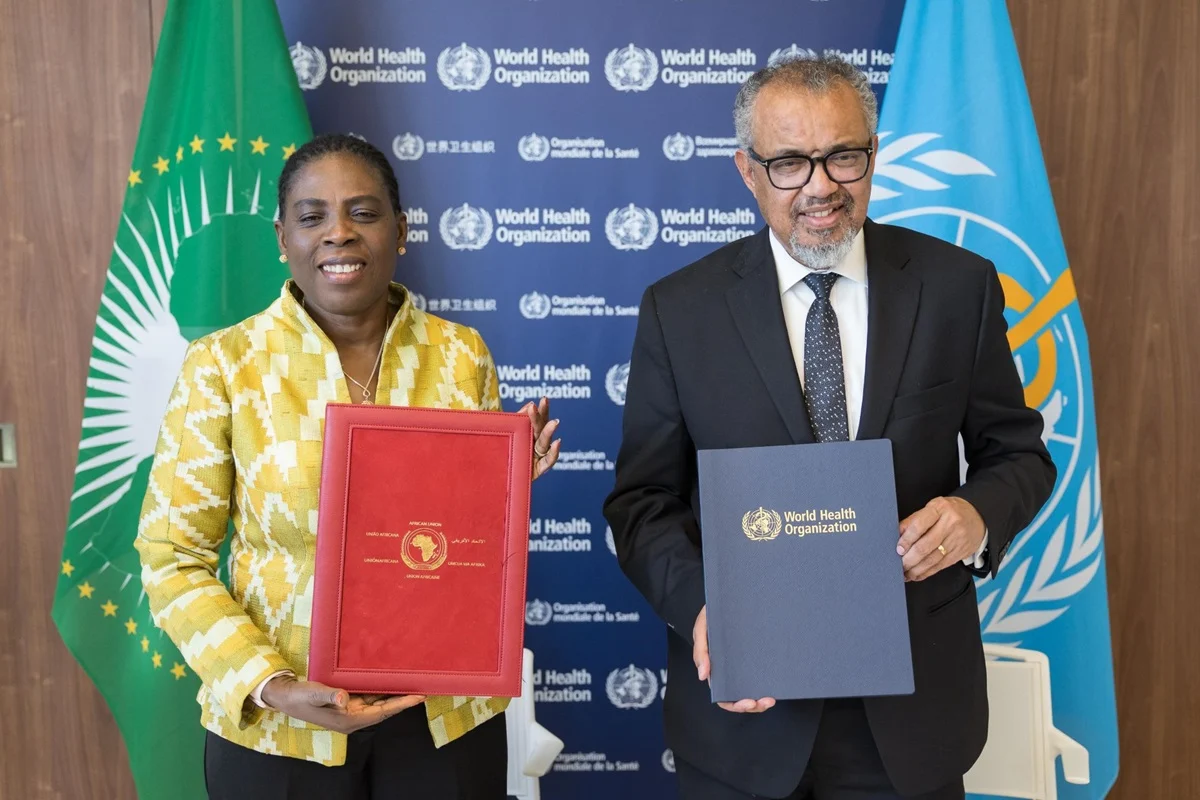
Geneva, Switzerland – A renewed commitment to advancing public health across the African continent was formally cemented recently as the African Union (AU) Commission and the World Health Organization (WHO) inked an updated Memorandum of Understanding (MoU). This pivotal agreement, signed on the fringes of the 78th World Health Assembly in Geneva, signifies a critical step in solidifying an already established strategic alliance, aiming to fortify health systems, expand universal health coverage, and bolster health security amidst a challenging global financial environment. The collaborative framework underscores a shared dedication to fostering sustainable development and ensuring robust health outcomes for all populations within Africa.
The timing of this enhanced pact carries profound significance, emerging as the global health landscape navigates a period marked by considerable fiscal pressures and dwindling international aid. This context makes the pursuit of greater health self-reliance and regional autonomy more imperative than ever for African nations. Both organizations acknowledge the necessity of proactive measures to counteract the potential adverse effects of reduced external funding on vital health programs and infrastructure development across the continent. The updated MoU is therefore a direct response to these evolving challenges, seeking to build resilience and long-term sustainability.
Representing the African Union, Her Excellency Ambassador Amma Adomaa Twum-Amoah, Commissioner for Health, Humanitarian Affairs, and Social Development, affixed her signature to the document on behalf of His Excellency Mahmoud Ali Youssouf, Chairperson of the African Union Commission. Dr. Tedros Adhanom Ghebreyesus, the Director-General of the World Health Organization, signed for the global health body. This formal act marks a significant milestone, particularly for the progress of primary health care initiatives and the broader objective of achieving comprehensive health coverage throughout Africa. The symbolism of the signing event highlights the elevated focus both organizations place on these foundational health tenets.
Commissioner Twum-Amoah articulated the profound importance of this strategic alignment, emphasizing the African Union’s pivotal role in shaping the continent’s health trajectory. She highlighted that this agreement inaugurates a fresh chapter in the collaborative history between the AU and WHO. By intensifying their cooperative efforts, she stated, the organizations could more effectively address the diverse health requirements of African populations, ensuring that no individual or community is overlooked. The Commissioner reaffirmed the AU’s high regard for WHO’s indispensable leadership in global health affairs, expressing eagerness for a deeper partnership to realize their collective aspirations. Her vision extended beyond merely surviving budgetary constraints, advocating instead for a strategic shift towards planning for genuine health autonomy – a future where Africa commands its health destiny rather than being dependent on external support. This concept of health sovereignty forms a cornerstone of the AU’s long-term strategy, reflecting a desire for self-determination and sustainable internal capacity.
Dr. Tedros echoed these sentiments, stressing that the renewed accord arrives at a crucial juncture when reductions in bilateral aid threaten the well-being of millions across Africa. He affirmed the WHO’s unwavering resolve to translate this alliance into tangible, positive outcomes for the continent’s inhabitants. Furthermore, he articulated WHO’s commitment to assisting African nations in transitioning away from an era characterized by reliance on foreign aid towards a more sustainable model of self-sufficiency. The Director-General expressed pride in standing alongside the African Union in championing and advancing the critical health priorities specific to the continent. This declaration underscores a shared understanding of the urgency and strategic importance of fostering independent health capabilities.
The foundation for this updated agreement rests upon a prior Memorandum of Understanding established in 2019. The current iteration builds upon that earlier framework, introducing refinements and enhancements designed to streamline collaboration across all relevant entities within the African Union structure. This evolution ensures a more cohesive and coordinated approach to addressing Africa’s health priorities, setting the stage for more impactful cooperation between the WHO and the AU. It further reiterates the WHO’s crucial technical and normative guidance role in both global and regional health governance, reaffirming its dedication to supporting the AU and its various institutions in achieving the health-related targets outlined within the Sustainable Development Goals (SDGs). This continuity and refinement demonstrate a maturing partnership focused on greater efficacy.
A key factor underpinning the significance of this renewed collaboration is the African Union’s increasingly prominent voice within global health governance dialogues. This influence has been notably amplified by its recent admission into the G20, a forum of the world’s major economies. The AU’s presence at such high-level international tables provides a powerful platform to advocate for African health priorities and perspectives on a global scale. The WHO’s continued engagement and support for the AU in this context highlight its recognition of the AU as a vital political and strategic partner, complementing WHO’s established role as a reliable technical and operational collaborator in regional health initiatives. This synergy of political advocacy and technical expertise is crucial for driving continental health agendas forward.
The pursuit of Universal Health Coverage (UHC) stands as a central pillar of this renewed partnership. For the African continent, UHC means ensuring that all individuals and communities have access to the quality health services they need, without suffering financial hardship. This encompasses a full spectrum of essential health services, from health promotion and disease prevention to treatment, rehabilitation, and palliative care. Achieving UHC in Africa presents unique challenges, including fragile health infrastructure, acute shortages of skilled health workers, vast geographical disparities in access, and persistent funding gaps. The collaboration between the AU and WHO will focus on strengthening primary health care (PHC) as the bedrock of UHC, recognizing that robust, accessible PHC services are essential for equitable health outcomes and for reaching remote and vulnerable populations. This involves investing in community health workers, essential medicines, and basic health facilities.
Beyond UHC, the agreement places a strong emphasis on enhancing health security across Africa. The continent has historically borne a disproportionate burden of epidemics and pandemics, from Ebola and HIV/AIDS to the recent COVID-19 crisis. These outbreaks underscore the urgent need for resilient health systems capable of detecting, preventing, and responding to health emergencies swiftly and effectively. The AU-WHO partnership aims to bolster continental capacities in areas such as disease surveillance, laboratory diagnostics, emergency preparedness and response, and cross-border collaboration. By working together, the organizations seek to strengthen the implementation of the International Health Regulations (IHR) and build a more robust regional health architecture that can safeguard populations against future health threats. This proactive approach to health security is vital for maintaining stability and protecting economic development.
Furthermore, the renewed MoU directly contributes to the achievement of health-related Sustainable Development Goals (SDGs) in Africa. The SDGs, adopted by all United Nations Member States in 2015, provide a shared blueprint for peace and prosperity for people and the planet. Several of these goals are intricately linked to health, including SDG 3 (Good Health and Well-being). The partnership will channel efforts towards critical areas such as reducing maternal and child mortality, combating communicable diseases like HIV/AIDS, tuberculosis, and malaria, addressing the growing burden of non-communicable diseases, and ensuring access to essential medicines and vaccines. By aligning their strategies, the AU and WHO aim to accelerate progress towards these ambitious global targets, recognizing that improvements in health are fundamental to broader socio-economic development.
The operationalization of this expanded partnership will involve detailed collaborative frameworks across various programmatic areas. While specific five key areas are outlined in the memorandum, the overarching intention is to translate shared visions into concrete actions. This will likely encompass joint planning for health workforce development, facilitating knowledge exchange and best practices in disease control, coordinating health data collection and analysis to inform policy, harmonizing regulatory standards for medicines and health products, and mobilizing resources for critical health interventions. The collaboration is designed to foster greater coherence in health policies and programs implemented by AU member states, leveraging WHO’s technical expertise and the AU’s political convening power to drive meaningful change at both continental and national levels.
Ultimately, this renewed MoU represents a significant impetus for regional and multilateral cooperation aimed at addressing Africa’s most pressing health challenges. It embodies a collective determination to move beyond short-term fixes and towards sustainable, continent-led solutions. By fostering regional resilience and promoting collective action, the partnership is poised to deliver meaningful and lasting improvements in health outcomes across Africa. The commitment enshrined in this agreement underscores a shared vision of a continent where robust health systems empower communities, protect lives, and contribute to overall prosperity, leaving no one behind in the journey towards a healthier future.
About the Author












