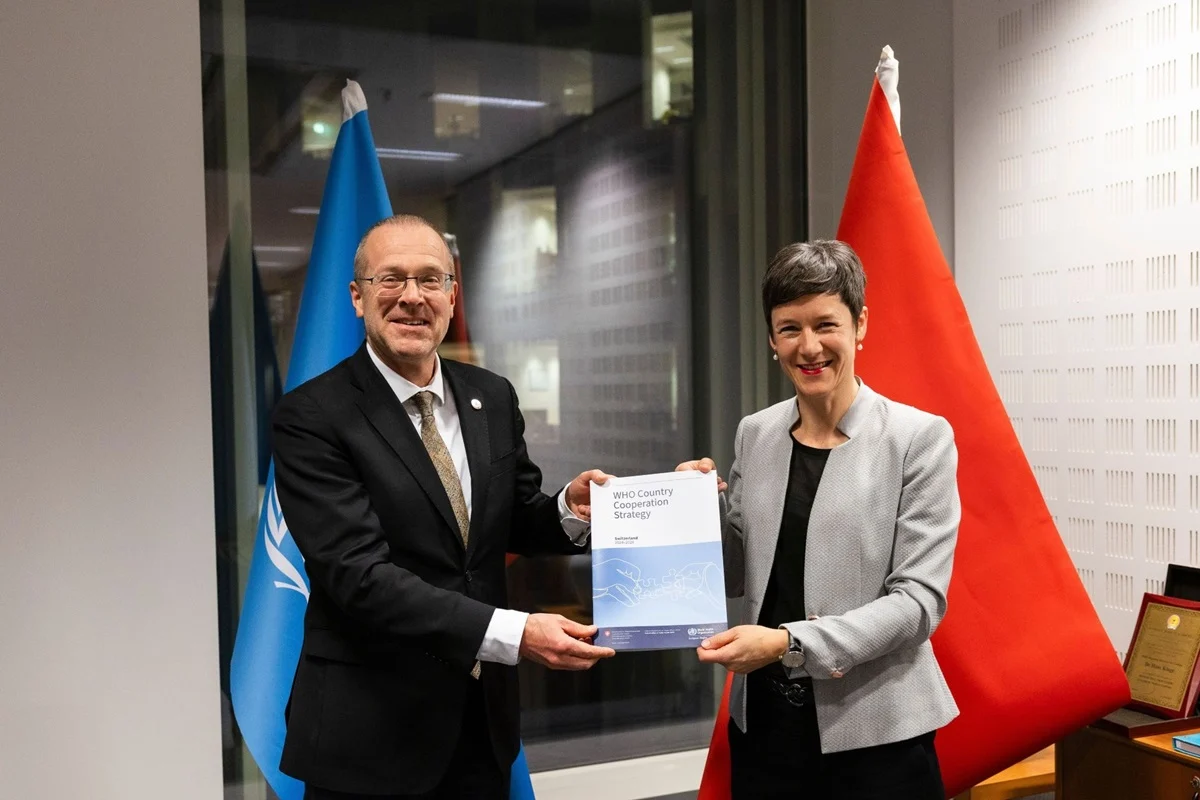
Copenhagen, Denmark – A pivotal moment in international public health collaboration was formally marked on March 4, 2025, as Switzerland and the World Health Organization (WHO) officially renewed their comprehensive cooperation strategy, charting a course for joint action from 2024 through 2028. This significant agreement, formalized at the WHO Regional Office for Europe in Copenhagen, underscores a deep-seated commitment to global health security, equitable health outcomes, and resilient health systems worldwide. The extended framework is poised to amplify efforts against pressing health challenges, building upon a decade of pioneering partnership between the Swiss Confederation and the leading global health authority.
The roots of this robust alliance trace back to 2013, when Switzerland distinguished itself as the inaugural high-income nation within the WHO European Region to implement a dedicated country cooperation strategy with the organization. This innovative approach signaled a profound commitment beyond standard member state contributions, establishing a bespoke mechanism for strategic alignment and operational synergy. Switzerland’s initiative set a precedent, demonstrating how developed economies could forge more integrated, outcome-oriented partnerships with the WHO, moving beyond purely transactional relationships to embrace a shared vision for health system strengthening and global public good. The initial strategy provided a structured framework for collaborative endeavors, focusing on areas of mutual interest and leveraging Swiss expertise and resources to support WHO’s mandate across the European continent and globally.
The decision to update and extend this critical framework was jointly taken in 2022, a period marked by profound global reflection on health vulnerabilities exposed by the COVID-19 pandemic. The intervening years since the initial strategy’s inception witnessed an escalation in complex health emergencies, the persistent threat of antimicrobial resistance, the accelerating impact of climate change on health, and widening health inequalities. These evolving challenges necessitated a re-evaluation of priorities and a recalibration of strategic approaches. The collaborative decision to renew the strategy reflected a shared understanding that the landscape of global health had fundamentally shifted, requiring an adaptive, forward-looking blueprint for collective action. This proactive stance by both parties aimed to ensure that their partnership remained agile and responsive to emerging threats while continuing to address long-standing health disparities.
The formalization ceremony in Copenhagen brought together key figures from both entities, including Dr. Hans Henri P. Kluge, WHO Regional Director for Europe, and Barbara Schedler, Ambassador for Global Health at the Swiss Federal Office of Public Health. Their presence underscored the high-level commitment to this enduring collaboration. The setting at the European Regional Office emphasized the regional dimension of the partnership, acknowledging Switzerland’s integral role within the European health landscape while simultaneously highlighting its contributions to broader global health initiatives. The renewed strategy is not merely an administrative extension but a strategically enhanced document, designed to optimize the impact of joint efforts over the next five years.
At its core, a country cooperation strategy outlines the specific objectives and modalities through which a member state and the WHO work together. For a high-income country like Switzerland, this extends beyond financial contributions to encompass technical expertise, policy alignment, capacity building, and diplomatic support. The renewed strategy is expected to delineate several key pillars of cooperation, reflecting both the WHO’s global priorities and Switzerland’s particular strengths and values in international cooperation. While the specific details of these pillars are elaborated in the official strategy document, general areas of heightened focus are anticipated to include:
Firstly, Strengthening Health Security and Pandemic Preparedness. The experience of recent global health crises has unequivocally demonstrated the critical need for robust systems to prevent, detect, and respond to health emergencies. Switzerland’s partnership with the WHO in establishing and bolstering initiatives like the Global BioHub System is a testament to this commitment. The Global BioHub System, headquartered in Spiez, Switzerland, is an innovative platform designed to facilitate the rapid and safe sharing of novel pathogens and biological materials among member states. This critical infrastructure enables scientists worldwide to develop new diagnostics, therapeutics, and vaccines more quickly, thereby accelerating global response capabilities to emerging infectious diseases. The renewed strategy will likely further integrate Switzerland’s technical and logistical support for such vital mechanisms, ensuring more agile and coordinated international responses to future outbreaks.

Secondly, Advancing Universal Health Coverage (UHC) and Primary Healthcare. Switzerland, with its well-developed health system, brings valuable insights and experience in health financing, service delivery, and equitable access to care. The partnership will likely focus on sharing best practices, supporting evidence-based policymaking, and assisting countries, particularly within the European Region, in strengthening their primary healthcare foundations as the cornerstone of UHC. This involves promoting integrated care models, investing in health workforce development, and ensuring that essential health services are accessible to all, irrespective of socio-economic status.
Thirdly, Fostering Innovation, Research, and Digital Health. Switzerland’s reputation as a hub for scientific research, technological innovation, and pharmaceutical development makes it an invaluable partner in advancing health solutions. The renewed strategy will likely leverage Swiss expertise in areas such as medical research, biotechnology, and digital health transformation. This could involve collaborative research projects, supporting the development and equitable deployment of new health technologies, and exploring how digital tools can enhance health service delivery, surveillance, and public health communication. The focus on innovation is not merely about technological advancement but also about finding novel approaches to address persistent health challenges effectively and sustainably.
Fourthly, Addressing the Health Impacts of Climate Change and Environmental Determinants of Health. Recognizing the escalating threat that environmental degradation and climate change pose to human health, this partnership will likely intensify efforts to build climate-resilient health systems, monitor environmental health risks, and advocate for policies that protect planetary health. Switzerland’s strong environmental policies and scientific contributions in this domain offer a unique opportunity to lead by example and support WHO’s global agenda on climate and health.
Switzerland’s role in this partnership transcends its geographical location or economic standing. As a host country to numerous international organizations, including the WHO headquarters in Geneva, Switzerland embodies a profound commitment to multilateralism and global governance. Its diplomatic traditions of neutrality and humanitarian engagement provide a unique platform for fostering dialogue and consensus on complex global health issues. The Swiss Federal Office of Public Health, through its Ambassador for Global Health, plays a crucial role in translating national health policies into international action and ensuring a coherent, impactful engagement with the WHO. This sustained partnership reflects Switzerland’s understanding that national health security is intrinsically linked to global health security, making international collaboration an imperative rather than an option.
The implications of this renewed cooperation are far-reaching. For the WHO, a strengthened partnership with a high-income, influential member state like Switzerland provides critical resources, technical expertise, and political backing necessary to fulfill its ambitious global health agenda. It serves as a model for other nations, demonstrating the tangible benefits of strategic, long-term collaboration. For Switzerland, the strategy offers a structured avenue to contribute meaningfully to global health outcomes, enhance its international standing, and protect its own population from cross-border health threats. It allows Switzerland to leverage its investment in global health for maximum impact, aligning its national health priorities with international objectives.
As the world navigates a landscape of increasingly interconnected health challenges, the stability and strategic foresight offered by partnerships like that between Switzerland and the WHO become ever more critical. The 2024-2028 cooperation strategy represents more than just a renewed agreement; it signifies an enduring commitment to a healthier future for all, underpinned by shared values, mutual respect, and a collective determination to build more resilient, equitable, and secure health systems globally. The collaboration formalized in Copenhagen is a beacon of sustained international solidarity, vital for overcoming the complex health hurdles of the 21st century.
About the Author