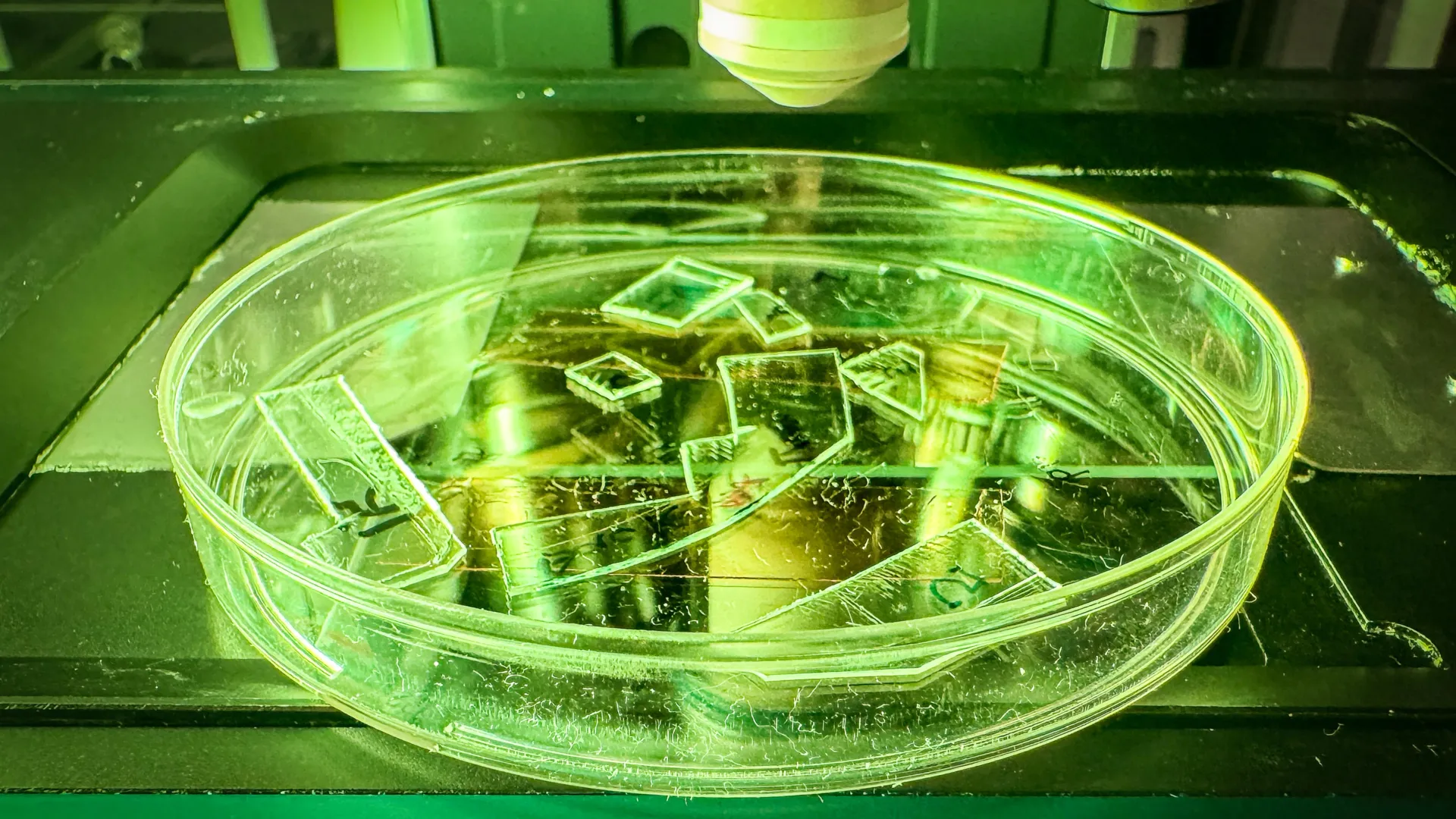
A groundbreaking development in materials science has yielded a novel plastic film engineered with a microscopic topography capable of physically disintegrating viruses upon their initial encounter with the surface. This innovative material, designed for practical implementation, holds significant promise for mitigating the transmission of infectious agents, particularly from high-touch surfaces commonly found in public and medical environments. The research, which moves beyond traditional chemical disinfection methods, introduces a purely mechanical approach to viral inactivation, offering a sustainable and scalable solution for enhanced public health safety.
The core of this innovation lies in the film’s sophisticated surface architecture, which is fabricated from an acrylic polymer and adorned with an array of meticulously arranged nanopillars. These infinitesimally small structural elements, measured in nanometers, function as miniature traps, physically engaging with viral particles. Upon contact, the nanopillars exert a stretching force on the virus’s outer membrane or capsid, deforming it to a critical point where its structural integrity is compromised, rendering it incapable of initiating an infection. This method of mechanical disruption, as detailed in a recent publication in the journal Advanced Science, has demonstrated superior efficacy compared to earlier surface designs that sought to puncture or abrade viral structures.
Laboratory investigations have provided compelling evidence of the film’s potent antiviral capabilities. In rigorous testing scenarios, the material was challenged with the human parainfluenza virus 3 (hPIV-3), a common respiratory pathogen responsible for severe illnesses like bronchiolitis and pneumonia in infants and young children. The results were remarkably swift and decisive; within a mere hour of exposure, approximately 94% of the viral particles that came into contact with the nanopillar-enhanced surface were either completely dismantled or sustained damage so profound that their infectivity was entirely nullified. This high rate of inactivation underscores the material’s potential to drastically reduce viral load on treated surfaces.
The development of this antiviral film was guided by a commitment to practicality and scalability. Researchers specifically selected readily available and cost-effective materials, facilitating widespread adoption and manufacturing. Lead author Samson Mah, a PhD candidate at RMIT University, highlighted the team’s strategic focus on accessible components and manufacturing processes. He further explained that as nanofabrication technologies continue to advance, the findings from this study offer a clear roadmap for optimizing nanopattern designs to achieve maximum viral inactivation. The envisioning of everyday applications is ambitious, with projections for surfaces such as smartphone screens, computer keyboards, and hospital furnishings to be coated with this protective film, actively neutralizing viruses without the need for chemical sanitizers. Crucially, the manufacturing methodology employed allows for adaptation to existing industrial processes, such as roll-to-roll production, enabling the large-scale output of these antiviral plastic films using conventional factory equipment.
A significant revelation from the research pertains to the critical role of nanopillar spacing in determining the material’s antiviral effectiveness. The study meticulously analyzed the impact of various spatial arrangements of these nanostructures, discovering that their proximity to one another was a far more influential factor than their individual height. Mah elaborated on this key finding, explaining that a denser configuration of nanopillars allows for a greater number of these structures to simultaneously engage with a single virus particle. This collective force, applied across a larger surface area of the virus, effectively stretches its outer layer beyond its elastic limit, leading to catastrophic failure. Conversely, wider spacing between the nanopillars reduces the force exerted on each individual virus, diminishing its ability to be effectively disrupted.
This investigation builds upon prior advancements in creating physically disruptive nanoscale surfaces, such as those based on nanospike silicon. However, the current research broadens this understanding by demonstrating that both sharp, pointed features and more blunt, pillar-like structures can achieve viral inactivation when strategically positioned. The paramount design principle emerging from these findings is unequivocally the density of nanostructures. The closer these nanoscale features are arranged, the more potent their antiviral effect becomes. Empirical data from the study pinpointed an optimal spacing of approximately 60 nanometers between nanopillars as yielding the highest level of viral destruction. Deviations from this ideal, with spacing increasing to 100 nanometers, led to a noticeable decline in efficacy, and at 200 nanometers, the antiviral effect was almost entirely abrogated.
Looking ahead, the research team is focused on expanding the scope of their investigations and transitioning towards practical, real-world applications. Thus far, the efficacy of the nanopillar film has been primarily assessed against enveloped viruses like hPIV-3, which possess a lipid bilayer outer membrane that is relatively susceptible to mechanical shearing. The next crucial phase involves evaluating the material’s performance against a broader spectrum of viruses, including smaller, non-enveloped viruses. These pathogens, lacking the protective lipid envelope, present a more formidable challenge due to their inherently more robust outer protein shells. Understanding how the nanopillar surfaces interact with these different viral structures will be vital in determining the universal applicability of this technology. Furthermore, scientists intend to explore the film’s effectiveness on curved surfaces, as surface curvature can alter the effective spacing and arrangement of nanopillars, potentially influencing their mechanical interaction with viruses.
Distinguished Professor Elena Ivanova, a co-author of the study, expressed the team’s enthusiasm for moving beyond laboratory experiments and toward tangible applications. She articulated a strong conviction that this nanostructured surface texturing represents a highly promising candidate for integration into everyday consumer products and essential infrastructure. The research group is actively seeking partnerships with industrial entities to collaboratively refine the manufacturing processes and accelerate the deployment of this innovative antiviral technology on a large scale. The ultimate goal is to create ubiquitous surfaces that passively contribute to public health by continuously neutralizing viral threats upon contact, thereby offering a significant new layer of defense against the spread of infectious diseases.
About the Author