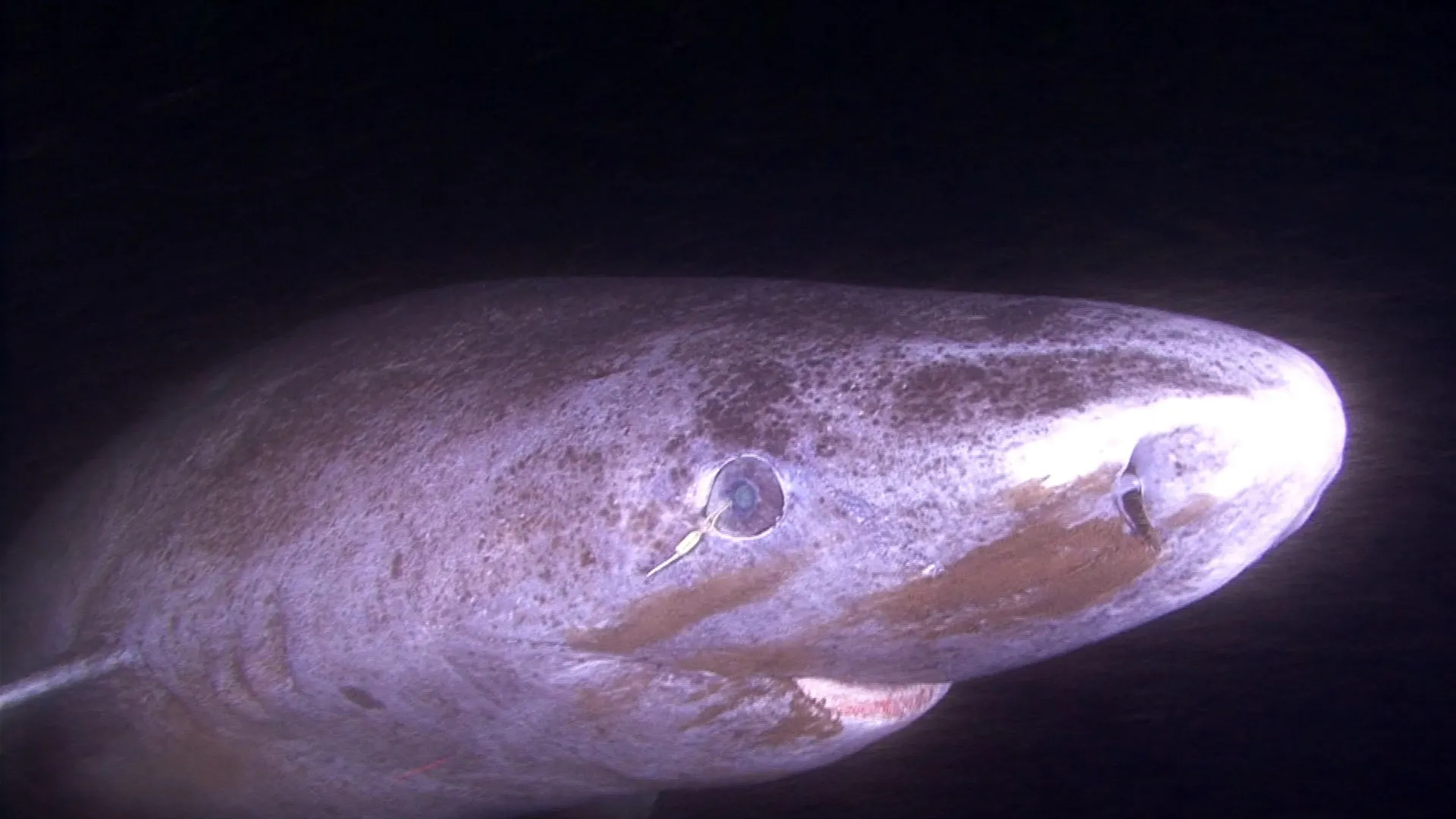
In the abyssal depths of the Arctic and North Atlantic oceans, where sunlight barely penetrates and temperatures hover near freezing, a creature of profound biological mystery silently navigates its ancient domain. Somniosus microcephalus, commonly known as the Greenland shark, holds the astonishing distinction of being the longest-living vertebrate known to science, with some individuals estimated to have survived for up to four centuries. This remarkable longevity, unfolding across generations of human history, has long captivated marine biologists, prompting intense curiosity about how its physiology endures such extraordinary spans of time. A recent groundbreaking study, spearheaded by researchers from the University of California, Irvine, and published in the esteemed journal Nature Communications, has now cast new light on one of the most enigmatic aspects of this deep-sea marvel: its seemingly ageless eyes, challenging long-held assumptions about its visual capabilities and offering unprecedented clues into the mechanisms of extreme biological resilience.
For decades, the Greenland shark’s ocular system presented a puzzling paradox. Its physical appearance—thick, gray body, a relatively small head terminating in a rounded snout, and notably cloudy, often opaque eyes—suggested a creature ill-equipped for detailed visual perception. Further compounding this perception was the frequent presence of parasitic copepods, specifically Ommatokoita elongata, which are commonly observed attached directly to the shark’s corneas, appearing to obscure vision and potentially cause permanent damage. Coupled with the perpetually dim, murky environment of its deep-ocean habitat, scientists had largely theorized that the Greenland shark might be functionally blind, relying instead on other sensory inputs, such as olfaction and mechanoreception, to navigate and hunt in its light-starved world. This hypothesis, though logical, now stands dramatically challenged by the latest findings.
The catalyst for this scientific re-evaluation emerged from an astute observation made by Dorota Skowronska-Krawczyk, an associate professor of physiology and biophysics at the University of California, Irvine, whose primary research focuses on the molecular intricacies of age-related eye diseases. Her initial interest in the Greenland shark was piqued after reviewing a 2016 research paper by John Fleng Steffensen, a marine biology professor at the University of Copenhagen, which detailed aspects of the shark’s extreme longevity. While acknowledging the widespread presence of ocular parasites noted in Steffensen’s work, Skowronska-Krawczyk found herself questioning the premise of functional blindness. "Evolutionarily speaking," she posited, reflecting on her initial thoughts, "an organism doesn’t typically retain an organ that serves no purpose." Her subsequent analysis of extensive video footage of these elusive sharks revealed a compelling detail: the animals were demonstrably moving their eyeballs, subtly but consistently tracking ambient light sources. This behavioral evidence served as a powerful impetus, propelling her team into a deeper investigation of the Greenland shark’s visual apparatus.
The research journey was an exercise in interdisciplinary collaboration and meticulous scientific endeavor. Acquiring specimens of a deep-sea apex predator like the Greenland shark presents formidable logistical challenges. Between 2020 and 2024, a series of scientific expeditions utilized long lines to carefully catch sharks near the University of Copenhagen’s Arctic Station, located on Disko Island, Greenland. Following their capture, the eyes of these ancient creatures were expertly dissected by a team including Professor Steffensen, alongside Peter G. Bushnell of Indiana University South Bend and Richard W. Brill from the Virginia Institute of Marine Science. The delicate ocular tissues were then carefully preserved in a fixative solution, a critical step to maintain their cellular integrity during the lengthy transit to Skowronska-Krawczyk’s laboratory in California.
The arrival of these centuries-old biological samples marked a pivotal moment for the Irvine team, particularly for Emily Tom, a UC Irvine Ph.D. student and physician-scientist in training. She vividly recounted the moment a package arrived containing one such specimen: "I opened the box, and there was this enormous, 200-year-old eyeball, resting on dry ice, seemingly staring right back at me." The scale of the task was immediately apparent. Unlike the minuscule mouse eyeballs typically used in their lab, these were roughly the size of a baseball, demanding a significant re-calibration of their analytical techniques. The entire process, from careful defrosting to the subsequent histological and vision-specific analyses, required utmost precision. Maintaining a consistently low temperature was paramount; any significant warming could lead to tissue degradation, jeopardizing invaluable data. The lab, Tom recalled with a chuckle, temporarily took on the distinct aroma of a fish market, a testament to the raw, untamed nature of their research material.
The meticulous analysis of these preserved ocular tissues yielded truly astonishing results, fundamentally reshaping our understanding of deep-sea vision and extreme longevity. Contrary to prior expectations, the researchers found absolutely no discernible evidence of widespread cellular degeneration or death within the Greenland shark’s retina. This finding alone was monumental, suggesting a level of cellular maintenance and repair far surpassing what is typically observed in vertebrates, especially in organs that are under constant environmental stress and subject to the ravages of time.
Further investigation uncovered that rhodopsin, the light-sensitive protein crucial for vision in low-light conditions, remained remarkably active and functionally robust within the shark’s retinal cells. More significantly, the team discovered that this rhodopsin was specifically tuned to detect blue light. This adaptation is profoundly intelligent in an evolutionary context, as blue wavelengths of light penetrate deepest into the water column, making it the predominant—and often only—spectrum available for vision in the deep ocean. This specialized tuning would enable the Greenland shark to effectively perceive faint blue light cues, aiding in navigation, identifying bioluminescent prey, or even detecting subtle reflections from other organisms in its perpetual twilight zone habitat.
The collective implications of these findings are profound and multi-layered. For Skowronska-Krawczyk, whose work focuses on the pathogenesis of age-related eye conditions, the Greenland shark offers a living blueprint for understanding how visual systems can resist the relentless march of time. The absence of retinal cell death, coupled with the persistent activity of key photopigments, strongly suggests the presence of highly efficient and robust DNA repair mechanisms within these cells. Such mechanisms would be vital for counteracting accumulated genetic damage, a primary driver of cellular aging and senescence in most organisms. Unraveling these specific repair pathways could provide revolutionary insights into preventing or even reversing age-related vision loss in humans, offering new avenues for treating debilitating conditions such as macular degeneration, glaucoma, and diabetic retinopathy.
Beyond ophthalmology, the study’s revelations resonate across the broader fields of gerontology and evolutionary biology. The Greenland shark’s capacity to maintain tissue functionality over centuries challenges fundamental assumptions about the limits of biological aging. It prompts deeper questions about how certain species manage to circumvent the typical age-associated decline in cellular performance and structural integrity. Could the cellular machinery responsible for the shark’s ocular resilience be indicative of broader anti-aging strategies at play throughout its entire body? Understanding these protective mechanisms could inform our pursuit of enhanced human healthspan, extending not just lifespan but the quality of life into advanced years.
Moreover, the research enriches our understanding of sensory evolution in extreme environments. The retention of a sophisticated, albeit specialized, visual system in an environment thought to render sight largely superfluous underscores the powerful selective pressures that shape organismal development. It suggests that even in near-total darkness, subtle visual cues may offer a crucial survival advantage, perhaps for discerning faint bioluminescent signals from deep-sea organisms, detecting the silhouettes of potential prey, or navigating complex underwater topography.
Despite the monumental nature of these discoveries, the scientific journey is not without its challenges. Skowronska-Krawczyk acknowledges concerns regarding the stability of federal research funding, which is critical for sustaining such long-term, resource-intensive investigations. Yet, her resolve remains unwavering, fueled by the intrinsic thrill of discovery. "What I love about my work," she affirmed, "is being at the forefront, the first in the world to witness new results, uncover novel mechanisms, rules, and discoveries." This pioneering spirit, coupled with the profound joy of sharing these breakthroughs with her students, continues to drive the pursuit of knowledge, promising further revelations from the ageless gaze of the Greenland shark, a sentinel of the deep holding keys to some of life’s most enduring mysteries.
About the Author