
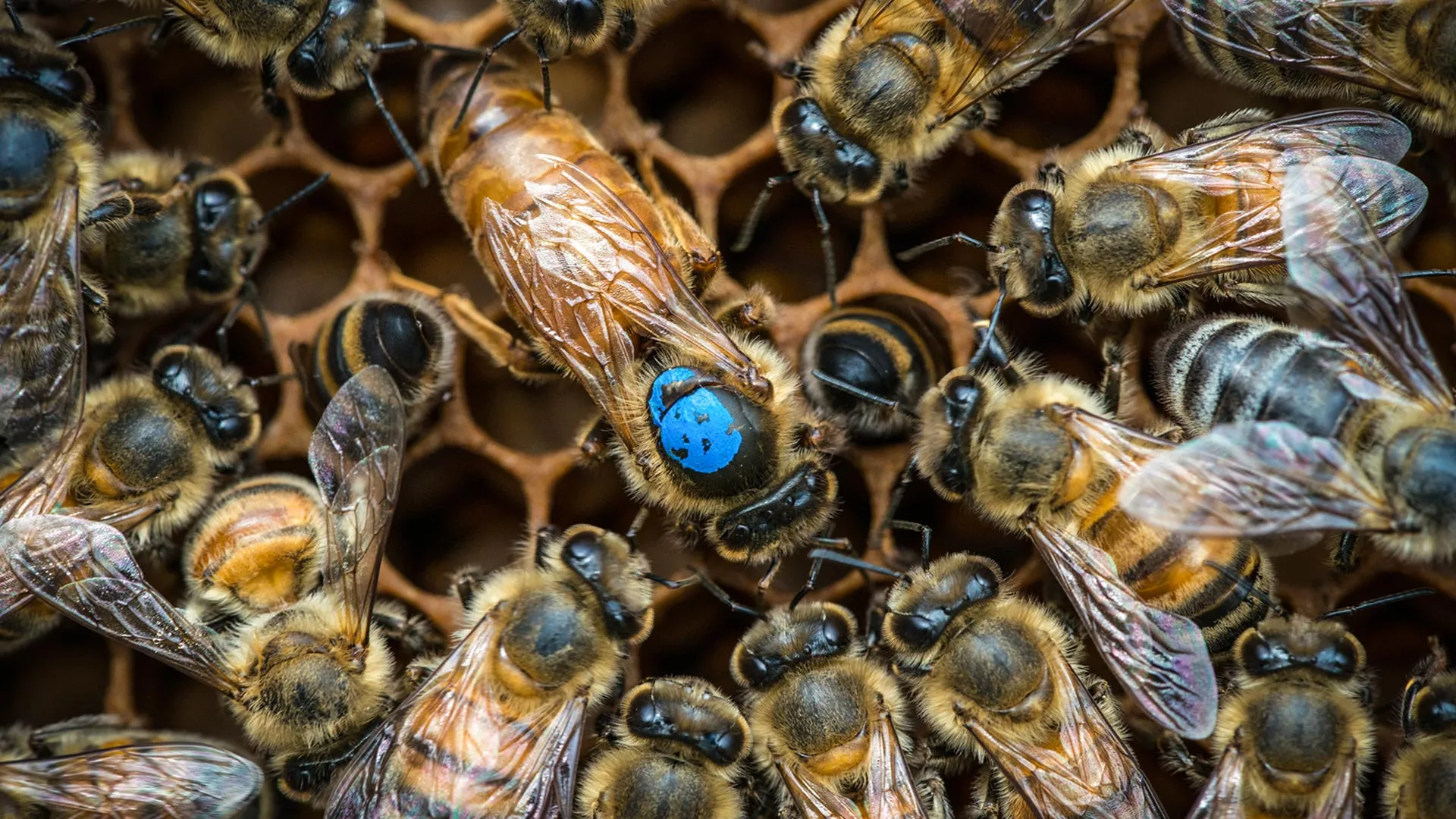
Researchers have pinpointed specific neural pathways within the honeybee brain that govern the allocation of labor among worker bees, revealing a sophisticated internal mechanism that orchestrates colony functions without explicit direction. This groundbreaking discovery, a collaborative effort involving scientists from Heinrich Heine University Düsseldorf (HHU), the University of Cologne, and Goethe University Frankfurt, demonstrates that manipulating a key gene can significantly alter bee behavior by selectively modulating activity in particular brain circuits. The findings shed light on the intricate biological underpinnings of how a highly organized society, like a bee colony, manages its diverse responsibilities efficiently, a process that has long fascinated biologists.
The remarkable coordination observed in bee colonies, where tasks are performed with precision and timeliness, stands in stark contrast to human organizational models. Unlike human communities, which rely on communication, discussion, and deliberate assignment of duties, a bee colony operates as a decentralized system. There is no central authority figure dictating who does what. Instead, honeybees ( Apis mellifera ) exhibit a natural division of labor that evolves dynamically throughout their lifespan, ensuring the colony’s survival and prosperity. This age-dependent progression of responsibilities is a cornerstone of their social structure.
Typically, a worker bee’s role shifts as it matures. In their early stages, young bees are primarily engaged in nursing duties, attending to the queen and tending to developing brood. As they age, their responsibilities expand to include hive maintenance, construction, and defense against external threats. Only in the final phase of their lives do these bees transition to foraging, venturing outside the hive to collect nectar and pollen. This seamless transition between roles is a marvel of biological engineering, and until now, the precise neural mechanisms driving this age-related behavioral shift remained largely elusive.
The current research builds upon foundational work conducted by a team at HHU, led by Professor Dr. Martin Beye of the Institute of Evolutionary Genetics. Their prior investigations into a gene known as doublesex yielded an unexpected and pivotal observation. When the expression of this gene was suppressed in older worker bees, the insects inexplicably reverted to performing tasks typically undertaken by much younger bees, specifically caring for the queen. This surprising finding strongly suggested that the doublesex gene plays a critical role in regulating age-related work behaviors within the colony.
The significance of this discovery lies in the fact that the doublesex gene’s influence is not uniform throughout the entire brain; rather, it is active within specific neural circuits. This localization provided Professor Beye’s team, in conjunction with their colleagues from Cologne and Frankfurt, a precise avenue to explore how discrete regions of the bee brain exert control over complex social behaviors. By targeting these specific neural pathways, they could begin to unravel the intricate relationship between genetic expression, neural activity, and behavioral output.
To investigate this further, the researchers employed an innovative technique to selectively inhibit neural circuits associated with the doublesex gene. Their methodology involved engineering the doublesex gene to produce a protein capable of dampening neural activity. The crucial step was to then trigger the activation of this inhibitory protein by administering a specific dietary substance to the bees. This approach allowed for the targeted reduction of neuronal activity solely within the designated brain circuits, without affecting other neural functions.
Following the successful inhibition of these targeted circuits, a striking behavioral change was observed. Older worker bees, which would normally be engaged in hive maintenance or defense, began to exhibit behaviors characteristic of much younger bees, such as tending to the queen. Conversely, when these specific circuits were not inhibited, the bees displayed their normal, age-appropriate behaviors, seamlessly progressing through their typical life stages of tasks. This experimental manipulation allowed the scientists to effectively control the specific tasks performed by individual worker bees, providing direct evidence for the neural basis of task allocation.
Dr. Jana Seiler, the lead author of the study published in the prestigious journal Proceedings of the National Academy of Sciences (PNAS), elaborated on these findings, stating, "The older worker bees then resumed caring for the queen, which only younger bees would do otherwise. When the circuits were not inhibited, the bees exhibited their normal, age-dependent behavior. In this way, we were able to control which tasks the worker bees performed." This statement underscores the precision and controllability achieved in the experiment, offering a clear demonstration of how specific neural pathways dictate behavioral repertoires.
The implications of these results are far-reaching, suggesting that the complex organization of labor within a bee colony is fundamentally rooted in its neural architecture. The study proposes a model where the reduction of activity in certain brain areas may allow for the activation of alternative neural circuits, thereby triggering a distinct set of behaviors. This dynamic interplay between neural pathways appears to be the driving force behind the colony’s ability to adapt and allocate its workforce effectively to meet changing demands.
These findings provide compelling, albeit early, evidence that sophisticated communication and interaction between different neural circuits are instrumental in determining a worker bee’s role. Whether a bee is engaged in nursing the queen, constructing or guarding the hive, or embarking on foraging expeditions, these fundamental decisions are likely orchestrated by the intricate signaling within its brain. The research opens up new avenues for understanding not only insect social behavior but also the broader principles of neural control over complex, cooperative actions in the animal kingdom.
Professor Beye concluded by emphasizing the broader significance of their work, stating, "The ability to control the social behavior of bees offers us new opportunities to explore the fundamentals of innate behavioral diversity and social cooperation. The solution to the secret of how bees and other animals cooperate so well without a blueprint for work is likely hidden in the brain’s neural circuits." This perspective highlights the potential of studying bee societies as a model system for understanding universal biological principles of cooperation and the evolutionary development of complex social structures. The intricate network of neural circuits within the bee brain holds the key to deciphering the evolutionary success of highly organized animal societies.
About the Author












