
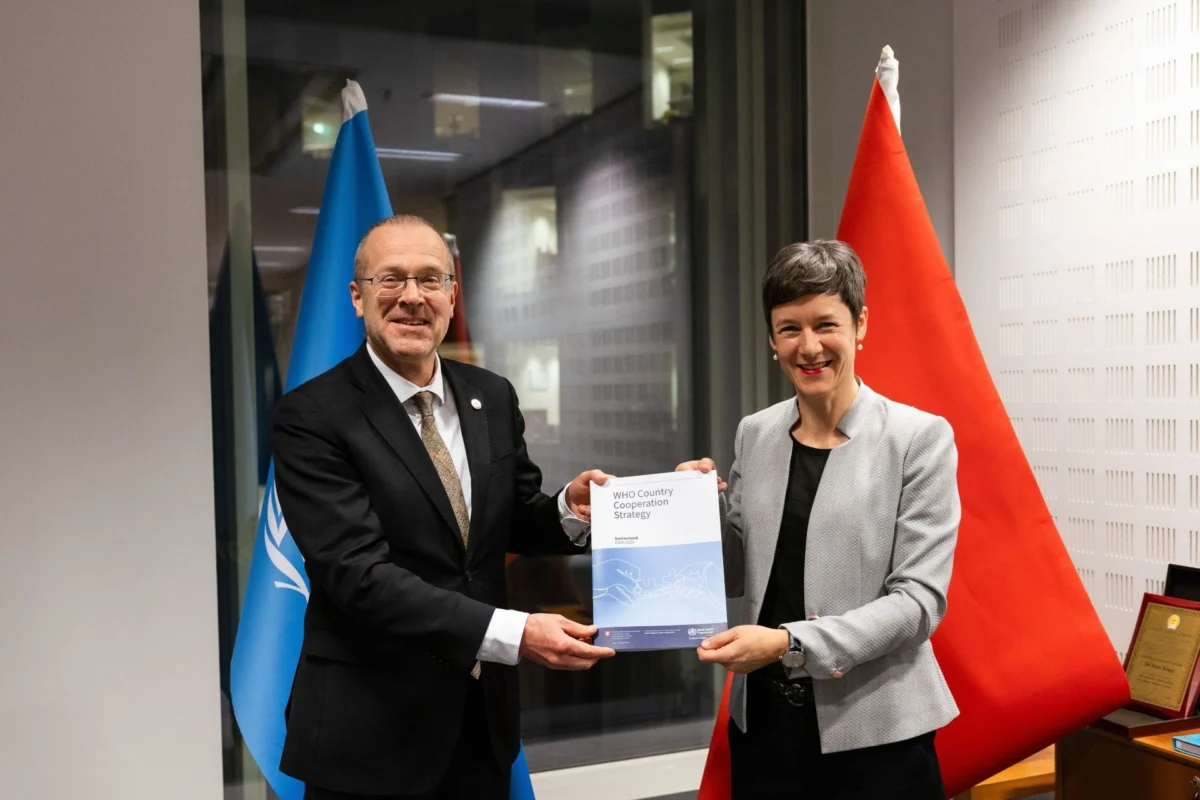
In a significant affirmation of enduring international collaboration, the World Health Organization (WHO) and the Swiss Confederation have formalized the extension of their strategic partnership, outlining a comprehensive framework for cooperation spanning the years 2024 to 2028. This renewed accord, officially signed on March 4, 2025, at the WHO Regional Office for Europe in Copenhagen, Denmark, underscores a mutual commitment to addressing pressing global health challenges and bolstering health systems worldwide. The ceremony brought together high-level representatives, including Dr. Henri P. Kluge, WHO Regional Director for Europe, and Barbara Schedler, Switzerland’s Ambassador for Global Health at the Federal Office of Public Health, marking a pivotal moment in their shared endeavor.
This latest agreement builds upon a foundational partnership that began over a decade ago, establishing Switzerland as a trailblazer among high-income nations within the WHO European Region. In 2013, Switzerland pioneered a country-specific cooperation strategy with the WHO, an innovative approach designed to tailor collaborative efforts to specific national and regional contexts, even for countries not typically considered beneficiaries of traditional development aid. This initial strategy served as a blueprint, demonstrating how robust, structured engagement between a sovereign nation and the global health body could yield substantial benefits, fostering an environment of shared learning, resource pooling, and strategic alignment on health priorities. The pilot phase was instrumental in shaping a model for effective, high-level engagement that could be adapted by other nations seeking to deepen their commitment to global health governance and outcomes.
The decision to update and renew this vital cooperation strategy was jointly reached in 2022, a period characterized by profound global health upheaval and emergent challenges. The intervening years since the 2013 agreement had witnessed the devastating impact of the COVID-19 pandemic, alongside persistent threats from climate change, escalating non-communicable disease burdens, antimicrobial resistance, and widening health inequities. These multifaceted crises highlighted the imperative for agile, resilient, and globally coordinated health responses, necessitating a re-evaluation of existing frameworks and a forward-looking adaptation of strategic priorities. Both the WHO and Switzerland recognized that the evolving landscape of global health demanded an enhanced, more robust partnership capable of confronting these complex issues with renewed vigor and innovative solutions. The 2022 joint decision thus reflected a proactive stance, acknowledging that the future of global health security and equity hinges on strengthened multilateralism and integrated approaches.
The 2024-2028 cooperation strategy is expected to encompass a broad spectrum of critical areas, reflecting both the WHO’s global mandate and Switzerland’s long-standing commitment to humanitarian principles and international cooperation. While specific programmatic details will unfold, anticipated pillars of this enhanced partnership include strengthening health systems and universal health coverage, a cornerstone of equitable health access. This involves supporting countries in developing resilient primary healthcare infrastructure, improving health workforce capacities, and ensuring equitable access to essential medicines and health technologies. Another crucial focus will undoubtedly be pandemic preparedness and response, drawing lessons from recent global health emergencies. This could entail collaborative efforts in surveillance, early warning systems, rapid research and development for countermeasures, and equitable distribution mechanisms, aiming to prevent future outbreaks from escalating into global crises.
Furthermore, the strategy is likely to address the growing threat of non-communicable diseases (NCDs) such as cardiovascular diseases, cancer, diabetes, and chronic respiratory diseases, which account for a significant proportion of global morbidity and mortality. Collaborative initiatives could target prevention strategies, early detection, and improved management of NCDs, alongside mental health promotion and care. Environmental determinants of health, particularly the health impacts of climate change, are also expected to feature prominently. Given Switzerland’s proactive stance on environmental sustainability, joint efforts could focus on climate-resilient health systems, research into climate-health linkages, and advocacy for policies that protect planetary and human health simultaneously. Digital health and innovation, crucial for modernizing healthcare delivery and data management, will also likely form a significant component, leveraging technological advancements to improve health outcomes and efficiency.

The strategic alignment between Switzerland and the WHO holds profound significance for both entities and for the broader global health agenda. For the WHO, Switzerland represents a steadfast and influential partner, providing not only substantial financial contributions but also invaluable diplomatic support and technical expertise. As the host nation for the WHO’s global headquarters in Geneva, Switzerland offers a stable and neutral platform for international dialogue and collaboration, facilitating the organization’s critical work in global health governance. The Swiss commitment to multilateralism and its tradition of humanitarian engagement align seamlessly with the WHO’s mission, enabling the organization to pursue its ambitious goals for health equity and universal well-being with greater effectiveness and legitimacy.
Conversely, for Switzerland, this robust partnership reinforces its identity as a responsible global actor and a champion of human rights, including the right to health. Engaging deeply with the WHO allows Switzerland to project its values on the international stage, contribute its considerable scientific and medical expertise, and participate actively in shaping global health policy. Such collaboration enhances Switzerland’s "soft power" and diplomatic influence, fostering international solidarity and collective action on issues that transcend national borders. It also provides Swiss institutions and experts with unparalleled opportunities for knowledge exchange, learning from diverse global health contexts, and contributing to solutions that have far-reaching impact.
The formalization of this renewed strategy in Copenhagen, at the European Regional Office, further highlights the critical role of regional collaboration within the WHO’s decentralized structure. While global directives are set in Geneva, regional offices like WHO/Europe are instrumental in adapting these strategies to specific regional contexts, addressing localized health challenges, and coordinating efforts among member states within their geographical purview. The presence of Dr. Kluge, the Regional Director, at the signing ceremony underscores the importance of this regional dimension in implementing the broader strategic objectives.
A tangible example of the existing and deepening collaboration between Switzerland and the WHO is their joint partnership for the global BioHub system. This initiative, explicitly mentioned in the context of their strengthened ties, represents a pioneering effort to enhance global preparedness for emerging infectious diseases. The BioHub system, spearheaded by the WHO, aims to establish a reliable and transparent mechanism for countries to voluntarily share novel biological materials, such as pathogens, with designated facilities. These BioHub facilities would then safely store, characterize, and make these materials available to qualified manufacturers and researchers worldwide, thereby accelerating the development of vaccines, diagnostics, and therapeutics. Switzerland has played a crucial role in supporting and potentially hosting elements of this vital infrastructure, demonstrating its commitment to global health security and its capacity to facilitate complex international scientific endeavors. This partnership exemplifies the practical, impact-oriented nature of the WHO-Switzerland alliance, moving beyond policy agreements to concrete operational mechanisms that safeguard global public health.
Looking ahead, the 2024-2028 cooperation strategy represents a renewed promise for sustained engagement and innovation in global health. It is expected to foster greater coordination, optimize resource utilization, and drive measurable progress across a range of health indicators. The success of this extended partnership will be critical in navigating future health crises, ensuring that no country is left behind in the pursuit of health equity, and strengthening the architecture of global health governance. By cementing this alliance, Switzerland and the WHO are not merely extending a bureaucratic agreement; they are reaffirming a shared vision for a healthier, more secure world, built on principles of solidarity, scientific rigor, and unwavering commitment to human well-being.
About the Author












