The insidious threat of high-energy radiation, whether from medical treatments, space travel, or industrial applications, stems from its capacity to inflict damage at the most fundamental level of life: the atom. For decades, scientists have grappled with understanding the precise sequence of events that unfold when ionizing radiation strikes biological matter, initiating a cascade of atomic and molecular disruptions that can ultimately lead to cellular dysfunction and disease. A groundbreaking international study has now provided an unprecedented, real-time glimpse into these elusive initial moments, fundamentally reshaping our understanding of how radiation initiates damage by revealing that the atoms themselves are not passive participants but active choreographers in their own demise.
This pioneering research, spearheaded by scientists from the Molecular Physics Department in collaboration with a global network of experts, has meticulously documented the dynamic atomic rearrangements that precede a specific, yet crucial, type of radiation-driven process known as electron-transfer-mediated decay (ETMD). Traditionally, many models of radiation-induced processes have focused predominantly on the electronic changes, often assuming a relatively static atomic framework during the initial excitation. However, this new investigation unequivocally demonstrates that the physical motion of atomic nuclei profoundly influences both the timing and the ultimate outcome of these ultrafast decay events, thereby presenting a critical new dimension to the physics of radiation damage.
At the heart of cellular injury caused by high-energy radiation, such as X-rays, lies the disturbance of atoms and molecules. When these particles absorb sufficient energy, they become "excited," entering an unstable state. To regain stability, they often undergo various decay processes, which can involve shedding electrons, breaking chemical bonds, or fragmenting into smaller species. These transformations can irreparably damage vital biomolecules like DNA and proteins, disrupting the intricate biological systems essential for life. Given the myriad pathways through which decay can occur, a granular understanding of each mechanism is paramount for developing effective strategies to mitigate radiation’s harmful effects.
The collaborative team concentrated their efforts on ETMD due to its significant, yet often underestimated, role in biological contexts. In this intricate quantum mechanical process, an atom first absorbs energy from radiation, becoming excited. To stabilize itself, this excited atom does not simply release energy in isolation. Instead, it "reaches out," metaphorically speaking, to a neighboring atom, pulling an electron from it. The energy released by this electron transfer is then immediately used to eject a third electron from another nearby atom, thus ionizing it. The critical outcome of ETMD is the production of low-energy electrons, which, despite their modest energy, are particularly potent in triggering secondary chemical damage within liquids and complex biological matrices, such as the aqueous environment inside cells.
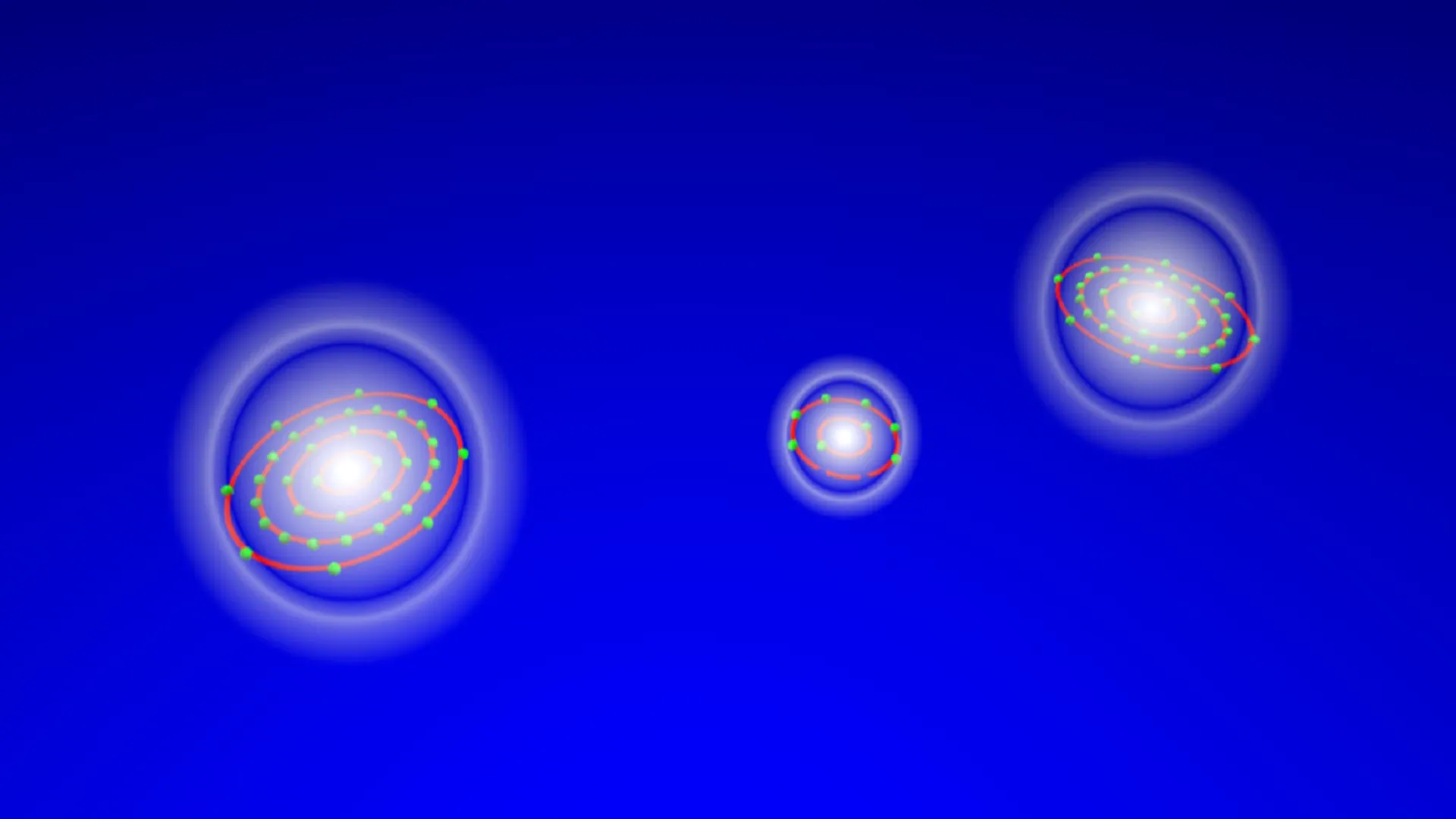
To unravel the mysteries of ETMD, the researchers devised an ingenious experimental approach utilizing a minimalist yet representative model system: a trimer consisting of one neon atom weakly bonded to two krypton atoms (NeKr2). This deceptively simple three-atom cluster provided an ideal quantum laboratory, allowing for precise control and observation of fundamental interactions. The process began by irradiating the neon atom with soft X-rays, precisely tuned to knock out an electron from its core. What followed was an astonishing journey captured over an incredibly brief, yet atomically expansive, timeframe of up to a picosecond (one trillionth of a second) – an eternity for nuclear motion and electronic rearrangement before the ultimate decay occurred. During this fleeting interval, electrons were exchanged between atoms, and a low-energy electron was ultimately emitted, marking the completion of the ETMD process.
The key to unlocking this atomic drama lay in the deployment of an advanced experimental technique: the COLTRIMS (COLd Target Recoil-Ion Momentum Spectroscopy) reaction microscope. This sophisticated instrument, housed at world-leading synchrotron facilities like BESSY II in Berlin and PETRA III in Hamburg, functions like an ultra-high-speed camera for atoms and electrons. It precisely measures the momentum vectors of all charged fragments resulting from the decay event. By meticulously analyzing these momentum vectors, the scientists could retroactively reconstruct the exact spatial arrangement of the atoms at the precise instant the ETMD process culminated.
However, the experimental observations alone were not sufficient to paint the full picture. The team augmented their empirical data with highly detailed ab initio simulations. These first-principles computational models, derived directly from fundamental physical laws without empirical input, tracked thousands of potential atomic pathways and calculated the probability of decay occurring along each trajectory. The synergy between cutting-edge experimental imaging and sophisticated theoretical modeling proved indispensable, allowing the researchers to not only "see" the atomic positions but also understand the forces and probabilities governing their motion.
What the confluence of experiment and simulation unequivocally revealed was a profound departure from prior assumptions. The atoms, contrary to expectations of remaining relatively fixed, did not maintain static positions. Instead, they engaged in a continuous, dynamic exploration of their spatial environment, constantly shifting, vibrating, and reshaping the overall molecular structure in what the researchers evocatively described as a "roaming-like pattern." This incessant nuclear motion, akin to a microscopic dance, was found to exert a dominant influence on both the temporal evolution and the final outcome of the ETMD process.
"We were literally able to witness the atoms in motion immediately preceding the decay event," stated Florian Trinter, one of the lead authors of the study, underscoring the revolutionary nature of the observation. "This decay is far from being a purely electronic phenomenon; it is, in fact, directly and intuitively guided by the motion of the atomic nuclei." This insight challenges conventional wisdom, suggesting a deeper, more intertwined relationship between electronic transitions and nuclear dynamics than previously appreciated.
The study further delineated how this atomic ballet unfolds. It demonstrated that ETMD does not originate from a singular, stable molecular configuration. Rather, a diverse ensemble of atomic arrangements contributes to the decay process at different junctures. In the earliest stages following excitation, the decay is more likely to occur while the atoms are still relatively close to their initial, unperturbed geometry. As time progresses, however, one krypton atom was observed to migrate closer to the central neon atom, while its sibling krypton atom shifted further away. This dynamic reconfiguration was found to create optimal conditions for the crucial electron transfer and subsequent energy redistribution characteristic of ETMD. At even later stages, the system explored more elongated and distorted geometries, reflecting a swinging, exploratory motion of the nuclei. Critically, these continuous structural transformations were directly correlated with significant variations in the decay rate, unequivocally linking nuclear geometry to the efficiency of the electronic decay.
Till Jahnke, a senior author on the research, emphasized the paradigm shift this discovery represents: "The atoms traverse extensive regions of the configuration space before the decay finally manifests. This emphatically demonstrates that nuclear motion is not a minor adjustment to an electronic process; it fundamentally dictates the efficiency of non-local electronic decay pathways." This statement encapsulates the core message of the research: understanding radiation damage requires moving beyond static snapshots and embracing the full dynamic complexity of atomic interactions.
The implications of comprehending ETMD, particularly its dependence on atomic arrangement and motion, are far-reaching and critical across multiple scientific disciplines. First, it is essential for developing more accurate and predictive theoretical models of radiation damage in complex environments, notably in water—the primary component of living cells—and in intricate biological macromolecules. Current models, if they neglect this dynamic nuclear influence, may inaccurately predict the distribution and effects of the damaging low-energy electrons generated by ETMD.
Furthermore, these findings provide crucial context for interpreting ultrafast X-ray experiments, which are increasingly employed to probe transient molecular structures. By revealing how nuclear motion modulates electronic decay, the study offers a new lens through which to analyze the data from such experiments, allowing for a more nuanced understanding of transient molecular states. The research also establishes a robust benchmark for the development and validation of sophisticated theoretical models, paving the way for their extension to larger and more complex systems, including solvated ions, biological molecules, and even condensed matter.
As the authors concluded, this seminal work demonstrates that "non-local electronic decay can serve as a powerful spectroscopic probe of molecular motion." By elucidating the intricate interplay between electron transfer and nuclear dynamics in the simplest possible system capable of ETMD, this study lays a foundational stone for future investigations. It opens new avenues for imaging the incredibly swift dynamics of weakly bound matter with unparalleled resolution, promising to unlock further secrets about how radiation interacts with, and ultimately damages, the building blocks of life. This deeper understanding holds the potential to inform the development of novel radioprotective agents, enhance the precision of radiation therapies, and refine our predictive capabilities for radiation exposure in critical fields from medicine to space exploration.
About the Author