As individuals navigate the landscape of later life, maintaining robust physical capabilities becomes increasingly pivotal for preserving independence and overall well-being. A common physiological shift observed after the age of 65 is a noticeable decline in muscle mass and strength, a condition scientifically termed sarcopenia. This age-related atrophy often manifests prominently in the upper body, leading to a reduction in firmness and functional strength, particularly in the arms and shoulders. While many instinctively gravitate towards isolated exercises like bicep curls, hoping to address perceived laxity, a more comprehensive and functionally relevant approach is necessary to cultivate truly strong, resilient upper limbs.
Sarcopenia is not merely an aesthetic concern; it represents a fundamental challenge to quality of life. Beginning as early as the third decade of life, and accelerating after 50, individuals can lose approximately 3% to 8% of their muscle mass per decade. This gradual erosion of lean tissue impacts metabolic rate, bone density, balance, and significantly diminishes the ability to perform daily activities. For the upper body, this translates into difficulties with tasks such as lifting groceries, reaching overhead for cabinet items, pushing open doors, or even maintaining stable posture. The loss of muscle around the triceps (the muscle on the back of the upper arm) and shoulders often contributes to the "jiggle" phenomenon, which is a combination of reduced muscle tone and changes in subcutaneous fat distribution.
The conventional wisdom often leads individuals to focus predominantly on the biceps, the muscles responsible for flexing the elbow. While biceps contribute to pulling movements, they represent only a fraction of the muscular architecture essential for complete arm and shoulder strength. The triceps brachii, located on the posterior aspect of the upper arm, are far more critical for pushing actions and contribute significantly to arm firmness. Equally vital are the muscles of the shoulder girdle – the deltoids, rotator cuff, and upper back musculature – which enable a vast range of movements, from lifting and pressing to rotating and stabilizing the arm. A truly effective upper body strengthening regimen must, therefore, engage these multiple muscle groups synergistically.
This is where the strategic incorporation of chair-based exercises offers a uniquely advantageous solution, particularly for adults over 65. The inherent stability provided by a chair minimizes concerns about balance and fall risk, allowing individuals to concentrate on muscle activation and proper form without the added challenge of standing. This supportive environment makes these exercises accessible to a broader range of fitness levels and physical conditions, including those with joint discomfort or mobility limitations. Beyond safety, chair exercises facilitate compound movements, meaning they recruit several muscle groups simultaneously. This multi-joint approach mirrors the demands of real-life activities more closely than single-joint isolation exercises, fostering greater functional strength and muscle activation across the chest, shoulders, triceps, upper back, and core. Such an integrated methodology not only promotes stronger, firmer arms but also supports improved posture, enhances overall body coordination, and contributes to sustained independence in everyday living.
A seasoned fitness professional specializing in senior populations understands that the pursuit of strength is not about lifting the heaviest weights, but rather about achieving consistent, controlled movement that progressively challenges the muscles. The emphasis shifts from maximal resistance to thoughtful engagement and full range of motion, which is gentler on aging joints while still stimulating muscle growth and neural adaptation. The following four chair-assisted exercises embody this philosophy, offering a powerful pathway to bolster upper body strength and regain functional capabilities.
1. Chair Push-Ups: Cultivating Pushing Power and Triceps Definition
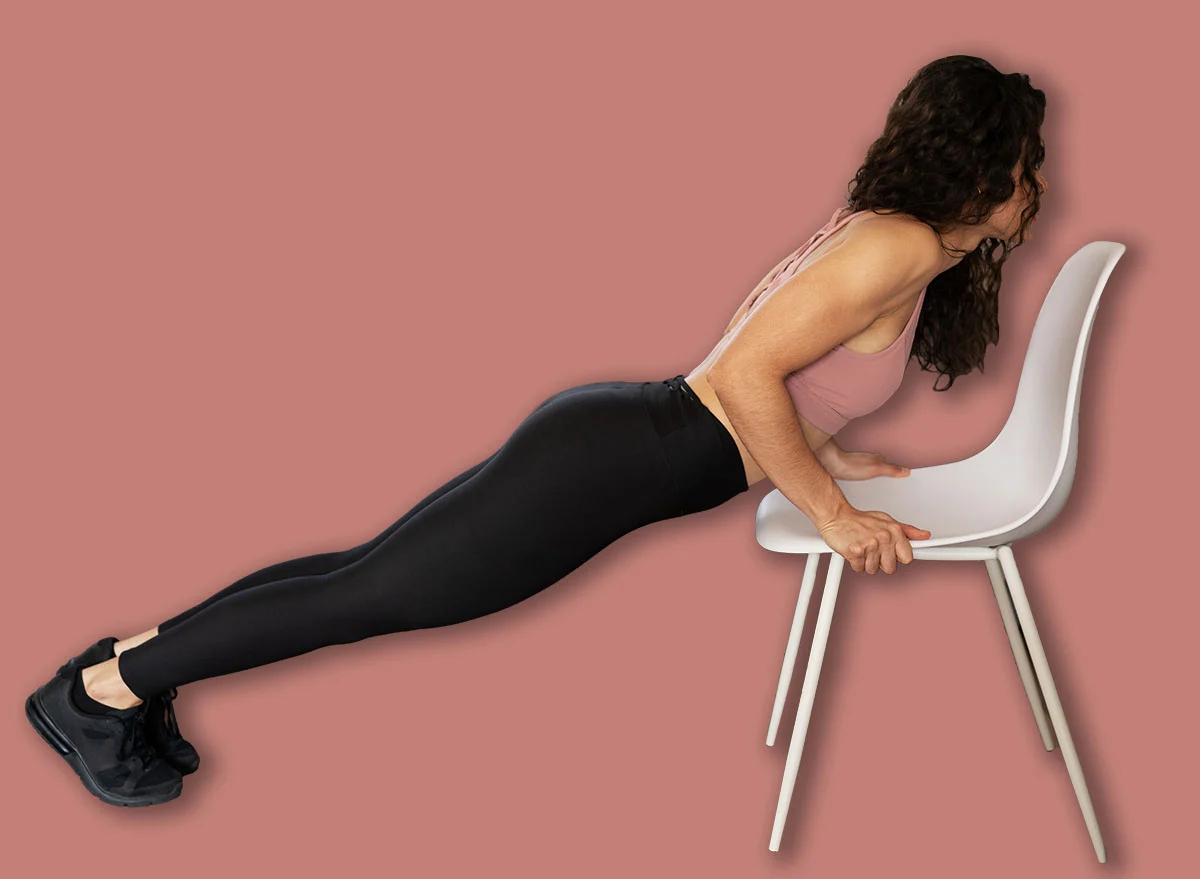
When the objective is to fortify the posterior aspect of the upper arms and enhance pushing capabilities, chair push-ups emerge as an exceptionally effective exercise. This movement comprehensively engages the triceps, the primary extensor of the elbow, while simultaneously activating the chest (pectorals), shoulders (anterior deltoids), and core muscles in a fluid, coordinated action. The profound benefit of this exercise lies in its functional relevance; it directly translates to improved ease in everyday tasks such as pushing open heavy doors, getting up from a seated position, or maneuvering a shopping cart.
To perform a chair push-up, begin by positioning yourself facing a sturdy chair, standing a few feet away. Place your hands shoulder-width apart on the edge of the chair, ensuring your body forms a straight line from head to heels. Engage your core to prevent your hips from sagging. Slowly bend your elbows, lowering your chest towards the chair in a controlled manner. Crucially, the descent phase of this movement (the eccentric contraction) is highly effective for building strength. Once your chest is close to the chair, push back up with control, extending your arms fully but without locking your elbows. Aim for 2-3 sets of 10-15 repetitions, focusing on a slow, deliberate tempo, especially during the lowering phase. As strength improves, you can increase the distance from the chair or progress to performing push-ups against a lower surface, such as a sturdy bench or step, to increase the resistance.
2. Seated Overhead Press: Restoring Reach and Shoulder Resilience
The ability to reach overhead is fundamental for countless daily activities, from retrieving items from high shelves to getting dressed. As shoulder and triceps strength diminishes with age, these movements can become increasingly challenging. The seated overhead press directly addresses this by rebuilding strength in the deltoids (shoulder muscles) and triceps, while the seated position encourages the maintenance of excellent postural alignment throughout the exercise. This minimizes strain on the lower back and promotes a stable base of support.
For this exercise, sit upright in a sturdy chair with your feet flat on the floor, core gently engaged. Hold a light dumbbell (or a household item like a water bottle or can of soup) in each hand, palms facing forward, with your elbows bent at a 90-degree angle and weights at shoulder height. Ensure your back is straight against the chair or maintaining its natural curve if not leaning back. Exhale as you slowly press the weights directly overhead, extending your arms fully but without locking your elbows. Avoid shrugging your shoulders towards your ears. Inhale as you control the descent, lowering the weights back to the starting position. The key is smooth, controlled movement rather than using momentum. Aim for 2-3 sets of 10-15 repetitions. As strength progresses, you can gradually increase the weight or use a slightly stronger resistance band looped under your feet and held in your hands. This movement directly enhances the capacity to lift, carry, and place objects at varying heights, supporting continued independence.
3. Seated Resistance Band Rows: Bolstering Posture and Pulling Strength
While pushing movements are essential, balanced upper body strength necessitates equal attention to pulling power. Seated resistance band rows are a superb exercise for strengthening the upper back, rear shoulders (posterior deltoids), and biceps, while simultaneously promoting improved posture and shoulder stability. This exercise is particularly beneficial for counteracting the common tendency towards rounded shoulders, which can not only create an appearance of weakness but also contribute to upper back pain and reduced lung capacity. By actively engaging the muscles that retract the shoulder blades, rows help pull the shoulders back and down, fostering a more upright and confident stance.
To perform seated resistance band rows, sit upright in a sturdy chair with your feet flat on the floor. Loop a resistance band around the arches of your feet or around a sturdy anchor point in front of you (like a table leg, ensuring it won’t slip). Hold one end of the band in each hand, palms facing each other, arms extended forward with a slight bend in the elbows. Keeping your back straight and core engaged, exhale as you pull the band towards your torso, squeezing your shoulder blades together. Imagine you are trying to hold a pencil between your shoulder blades. Your elbows should move towards your back, staying relatively close to your body. Inhale as you slowly and controlledly release the tension, allowing your arms to extend forward again. Focus on the contraction of your back muscles, not just your arms. Complete 2-3 sets of 12-18 repetitions. Regular practice of this exercise significantly improves the ease of tasks like opening stiff drawers, pulling heavy objects, or carrying bags, while also mitigating shoulder fatigue.
4. Seated Punch Press: Integrating Arm Strength, Endurance, and Core Engagement
To conclude an upper body routine, incorporating a dynamic movement that synthesizes arm strength, shoulder endurance, and core stability can be highly beneficial. The seated punch press, performed with controlled, alternating movements, achieves precisely this. This exercise engages multiple muscle groups simultaneously – including the triceps, shoulders, and chest – and subtly elevates the heart rate, offering a mild cardiovascular benefit. Unlike isolated bicep curls, which target a single muscle, the punch press demands integrated muscular effort, making it highly practical for the dynamic requirements of daily life and enhancing overall coordination.
Begin by sitting upright in a sturdy chair, feet flat on the floor, with your core gently braced. Hold a light dumbbell or resistance band (looped under your feet and held in your hands) in each hand, with your elbows bent and hands near your shoulders, palms facing each other or slightly downwards. Exhale as you extend one arm forward in a controlled punching motion, fully extending the arm without locking the elbow. As you punch, you can allow for a slight, controlled rotation of your torso, engaging your obliques. Inhale as you bring the arm back to the starting position. Immediately repeat with the opposite arm, maintaining a steady, rhythmic pace. The focus should be on deliberate, powerful extensions and controlled returns, rather than speed. Perform 2-3 sets, aiming for 10-15 repetitions on each side. This exercise not only builds strength and endurance but also sharpens coordination and provides a sense of invigorating energy, contributing to greater functional agility in movements requiring rapid or coordinated upper body action.
Integrating and Sustaining Progress
To realize the full spectrum of benefits from these chair-assisted exercises, consistency is paramount. Aim to incorporate this routine into your schedule several times each week, allowing for a day of rest in between sessions to facilitate muscle repair and growth. Before beginning any exercise regimen, it is always advisable to consult with a healthcare professional, especially if you have pre-existing medical conditions or concerns.
Beyond the exercises themselves, a holistic approach to wellness significantly amplifies results. Adequate protein intake is crucial for muscle synthesis and repair, while proper hydration supports joint health and muscle function. Prioritizing quality sleep ensures that the body has sufficient time to recover and adapt to the demands of physical activity.
By embracing these chair-supported, multi-faceted exercises, adults over 65 can proactively counteract the effects of sarcopenia, rebuild crucial upper body strength, and restore a sense of confidence and capability in their daily lives. The journey towards enhanced mobility and functional vitality is an empowering one, enabling individuals to continue engaging with the world with strength, independence, and renewed vigor.
About the Author