As individuals progress into their sixth decade and beyond, maintaining physical vitality becomes an increasingly deliberate endeavor. The physiological shifts that accompany aging, such as the gradual loss of muscle mass and alterations in metabolic function, necessitate a thoughtful approach to exercise. While various fitness modalities offer distinct advantages, a focus on compound, standing movements presents a particularly potent strategy for older adults aiming to enhance overall health, bolster core stability, and effectively manage body composition. This approach prioritizes functional strength and calorie expenditure, addressing the underlying factors contributing to fat accumulation more comprehensively than isolated abdominal work.
The concept of "spot reduction," the belief that exercising a specific body part will preferentially reduce fat from that area, has been widely debunked by scientific research. Fat loss is a systemic process, meaning that when the body burns fat for energy, it draws from fat stores across the entire body, not just the muscles being worked. Consequently, targeting the abdominal muscles alone, while valuable for muscular development, will not specifically diminish adipose tissue in the midsection. Instead, effective fat management, particularly the reduction of visceral fat (which surrounds internal organs and is associated with increased health risks), hinges on creating a caloric deficit through a combination of diet and exercise that burns a significant number of calories and builds lean muscle mass throughout the body.
A critical factor influencing body composition in older adults is sarcopenia, the age-related decline in skeletal muscle mass, strength, and function. This process typically begins around age 30 and accelerates significantly after 60. Muscle tissue is metabolically active, meaning it consumes more energy at rest compared to fat tissue. As sarcopenia progresses, a reduction in muscle mass leads to a lower basal metabolic rate (BMR), the number of calories the body burns simply to maintain basic functions. A diminished BMR makes it easier to gain weight and more challenging to lose it, even when dietary intake remains constant. Therefore, counteracting sarcopenia through strength-building activities is paramount for maintaining a robust metabolism and supporting healthy weight management throughout the later years.
While exercises performed on a mat, such as many traditional Pilates movements, are excellent for developing deep core strength, flexibility, and body awareness, they may not always provide the full-body muscular engagement and cardiovascular challenge necessary to maximize calorie expenditure and stimulate significant lean muscle growth across the entire physique. For older adults whose primary objective includes comprehensive body fat reduction and metabolic optimization, incorporating exercises that recruit larger muscle groups simultaneously and elevate heart rate offers a more efficient pathway.
Standing exercises are uniquely suited to address these multifaceted goals. They engage the core for stability, challenge balance and coordination, and often involve multiple joints and muscle groups, leading to a higher caloric burn per session compared to more isolated movements. Furthermore, they mimic real-life movements, enhancing functional strength vital for daily activities such as walking, lifting, and maintaining equilibrium. This functional aspect is particularly beneficial for older adults, as it directly translates to improved mobility, reduced fall risk, and greater independence. They also offer the advantage of utilizing bodyweight resistance or minimal equipment, making them accessible and often gentler on joints than heavy free weights or high-impact activities, which can be a concern for an aging population.
James Bickerstaff, a certified personal trainer at OriGym, emphasizes the significance of muscle development in aging, stating, "Building muscle is particularly important as we age because it helps maintain metabolism and supports long-term weight loss." This perspective underscores the strategic advantage of exercises that promote muscle hypertrophy and maintenance, like well-chosen standing movements.
Let’s explore several highly effective standing exercises that can form the cornerstone of a comprehensive fitness regimen for individuals over 60, focusing on their distinct benefits for metabolic health, core stability, and functional strength.
1. Sit-to-Stand Transitions
Often overlooked for its simplicity, the sit-to-stand movement is a foundational exercise that directly translates to one of the most common daily activities: rising from a seated position. Far more than just a leg exercise, it is a dynamic, full-body movement that engages the core intensely for stabilization. As you lower yourself and then push back up, your glutes, quadriceps, and hamstrings are heavily recruited, which are among the largest muscle groups in the body. Activating these substantial muscles leads to a significant caloric expenditure during the exercise itself. Moreover, the repetitive action of standing up and sitting down, especially when performed with control and intention, strengthens the lower body and improves functional power, both of which are crucial for maintaining mobility and preventing falls. The continuous engagement of core muscles throughout the movement also contributes to abdominal strength and stability, albeit in a holistic, functional manner rather than through isolated contraction. Performing this exercise using a sturdy chair or bench, focusing on controlled descent and powerful ascent, provides a safe yet challenging way to build lower body and core strength while burning calories.
2. Elevated Leg Lifts (Step-Ups)
Step-ups are an exceptional compound exercise that simultaneously builds strength in the lower body and elevates the heart rate, offering both resistance training and cardiovascular benefits. By stepping onto an elevated surface, such as a sturdy bench, step box, or even a stair, individuals work their glutes, quadriceps, and calf muscles against gravity. This unilateral movement (working one leg at a time) also significantly challenges balance and core stability, as the core must stabilize the torso to prevent swaying. Compared to high-impact exercises like running or plyometrics, step-ups are remarkably joint-friendly, making them an ideal choice for older adults. The rhythmic stepping action can improve cardiovascular endurance, while the muscle recruitment contributes to lean muscle mass, thereby supporting a healthy metabolic rate. Performing step-ups consistently can lead to stronger legs, better balance, and improved stamina for daily activities.
3. Standing Knee Drives
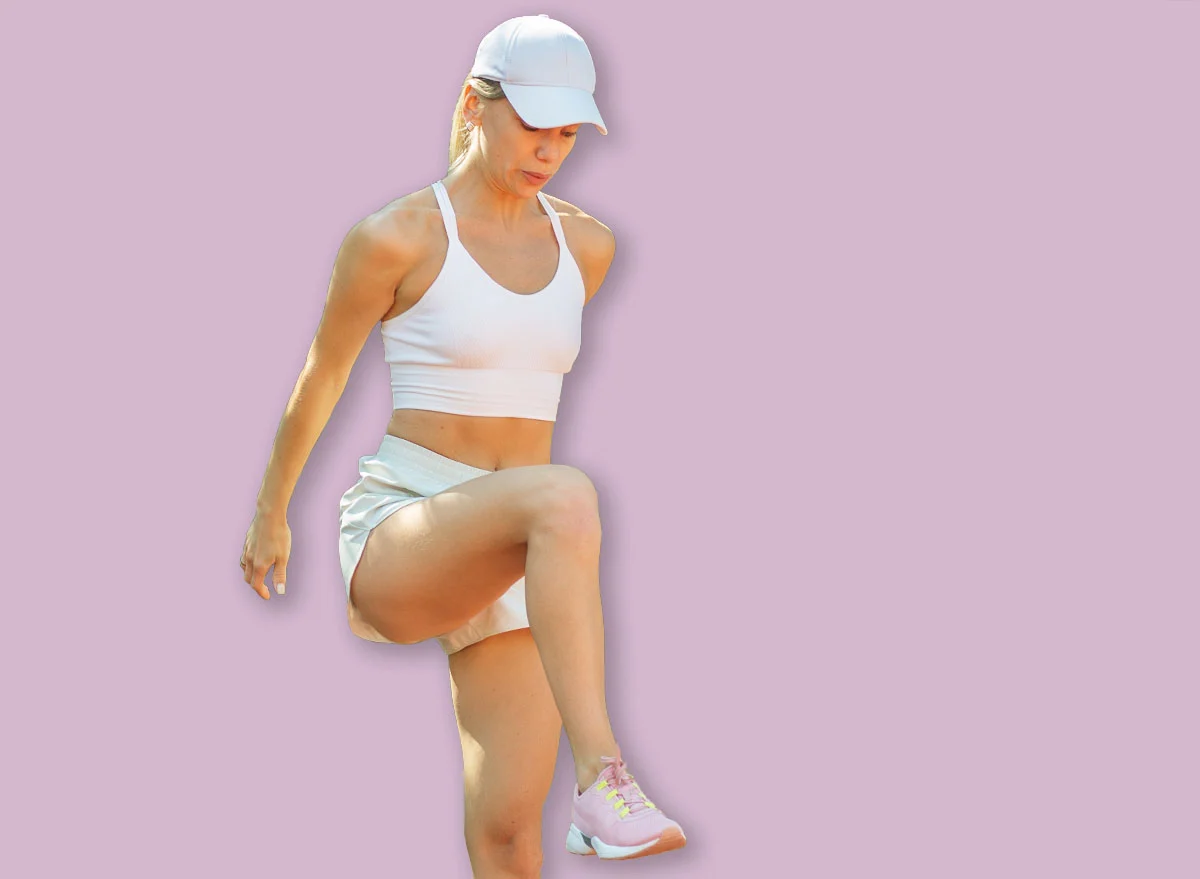
Standing knee drives offer a unique way to target the deep abdominal muscles and hip flexors without requiring individuals to get down onto the floor, which can be challenging for some older adults. As one leg is lifted towards the chest, the core muscles, particularly the obliques and transverse abdominis, must engage powerfully to stabilize the pelvis and spine, preventing the body from tilting or swaying. This simultaneous engagement of core muscles and hip flexors contributes to a strong and stable midsection. Bickerstaff highlights additional benefits, explaining, "Standing knee raises strengthen your deep abdominal muscles without getting down onto the floor. They also help improve balance, coordination, and hip mobility." The act of balancing on one leg further refines proprioception and coordination, crucial elements for fall prevention and overall functional independence. Incorporating controlled, alternating knee drives can significantly enhance both core strength and dynamic balance.
4. Rotational Torso Twists (Standing Wood Chops)
The standing wood chop is a dynamic, multi-planar exercise that provides comprehensive core engagement, integrating the entire trunk in a rotational movement. Unlike traditional crunches that primarily work the rectus abdominis in a single plane, the wood chop engages the obliques, transverse abdominis, and lower back muscles in a functional, diagonal pattern. This movement mimics natural actions such as reaching, lifting, and turning, which are integral to daily life but often see a decline in strength and stability with age. By performing a controlled twisting motion from a standing position, individuals build rotational power and anti-rotational stability, strengthening the core’s ability to resist unwanted movement. This translates to improved functional strength for tasks requiring twisting and bending, as well as enhanced protection against back injuries. When performed with a light weight (such as a medicine ball or a light dumbbell) or even just bodyweight, the standing wood chop effectively ties together the core’s various functions, promoting a strong, stable, and resilient midsection.
In conclusion, while every form of exercise holds value, a strategic focus on standing, compound movements can be particularly transformative for adults over 60 seeking to optimize their metabolic health, reduce overall body fat, and bolster core strength. By prioritizing exercises like sit-to-stand transitions, step-ups, standing knee drives, and rotational torso twists, individuals can effectively counteract age-related muscle loss, boost their metabolism, improve functional strength, and enhance balance and coordination. This holistic approach to fitness moves beyond mere aesthetics, fostering a robust and independent lifestyle that supports well-being for years to come.
About the Author