As individuals navigate the landscape of life beyond fifty, the maintenance of robust lower body strength emerges as a cornerstone of sustained independence, mobility, and overall quality of life. The natural physiological process of aging often brings with it sarcopenia, a progressive and generalized loss of skeletal muscle mass and strength, which can significantly impair daily activities, elevate the risk of falls, and diminish metabolic health. However, contemporary understanding of exercise physiology emphatically demonstrates that muscle atrophy is not an inevitable decline, but rather a challenge that can be effectively mitigated, and even reversed, through targeted physical activity. A focused regimen of functional, bodyweight-based movements offers a highly accessible and remarkably potent pathway to reinvigorating the muscles of the legs and hips, fostering a renewed sense of confidence and physical capability.
The human body, irrespective of chronological age, retains an extraordinary capacity for adaptation and growth in response to appropriate stimuli. While structured weight training certainly holds its place in strength development, a daily practice centered on bodyweight exercises provides a unique set of advantages, particularly for the over-50 demographic. These movements inherently promote better balance, coordination, and proprioception – the body’s sense of its position in space – without imposing excessive external load on joints that may be experiencing age-related changes. Furthermore, functional exercises mirror the biomechanics of everyday tasks, such as standing up from a chair, ascending stairs, or simply walking confidently on uneven terrain. This direct translation of gym efforts into real-world ease of movement makes such a protocol exceptionally rewarding and effective. Experienced fitness professionals frequently observe that clients, even those initially skeptical about their ability to regain strength, often experience rapid and encouraging improvements in lower limb function once they commit to a consistent program emphasizing fundamental movement patterns.
The efficacy of this approach lies in its ability to reactivate dormant muscle groups, improve neural pathways for muscle recruitment, and build foundational strength in a progressive manner. Consistency is paramount, transforming small, daily efforts into substantial, cumulative gains. Rather than solely focusing on the sheer quantity of muscle mass, the emphasis shifts to enhancing functional strength, stability, and power – attributes crucial for navigating daily life with vigor. The following five exercises have been carefully selected to target the primary muscle groups of the lower body, including the quadriceps, hamstrings, glutes, and core stabilizers, while simultaneously improving joint health and overall movement proficiency.
Reawakening Hip Power: The Glute Bridge
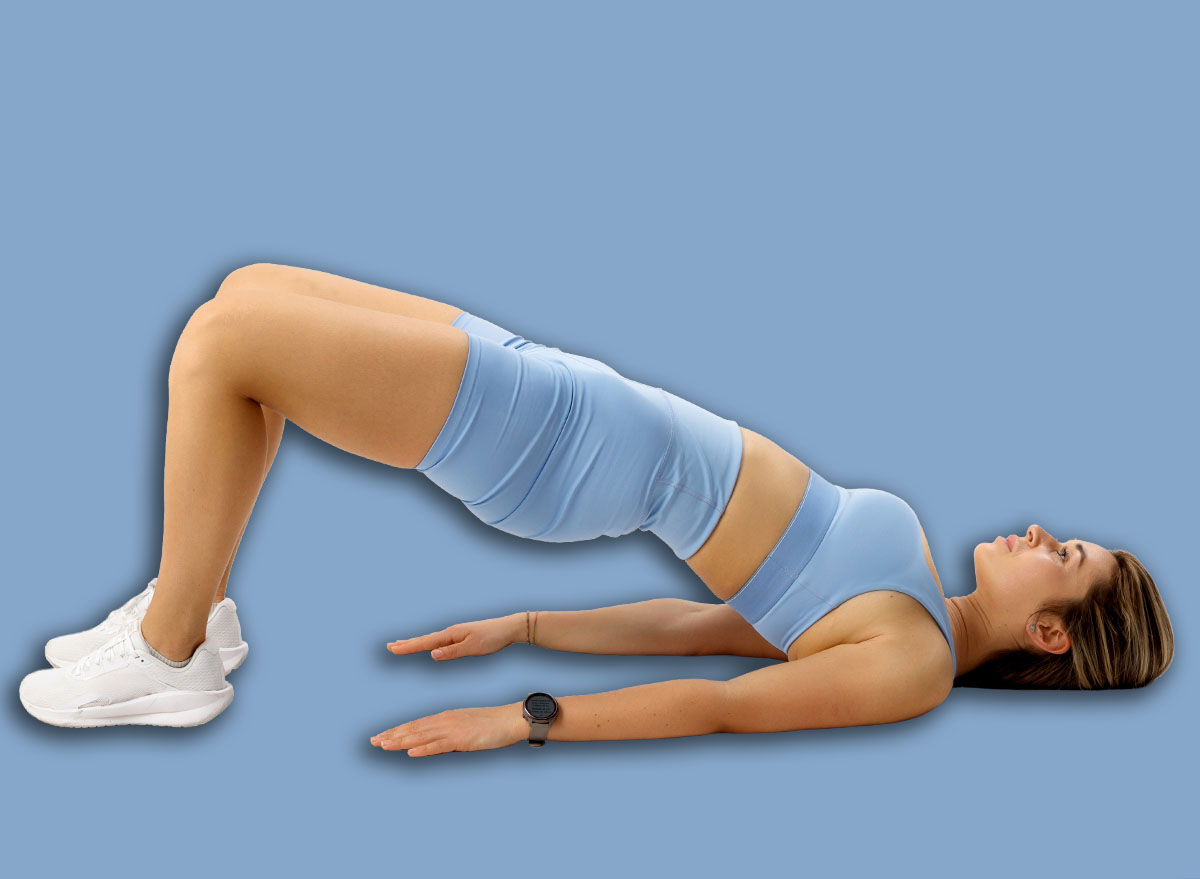
The glute bridge is a foundational exercise designed to re-engage the gluteal muscles, which are often underactive due due to prolonged periods of sitting common in modern lifestyles. These muscles are not merely aesthetic; they are critical powerhouses for hip extension, contributing significantly to walking, running, and protecting the lower back from undue strain. By restoring proper glute activation, this exercise helps realign the entire kinetic chain of the lower body, fostering more efficient and pain-free movement patterns.
Muscles Engaged: Primarily targets the gluteus maximus, with significant contribution from the hamstrings and activation of the core and lower back stabilizers.
Execution Guide: Begin by lying flat on your back on a comfortable surface, bending your knees so your feet are flat on the floor, hip-width apart, with your heels positioned relatively close to your glutes. Ensure your arms rest by your sides, palms facing down. Initiate the movement by pressing firmly through your heels and engaging your glutes. Lift your hips off the floor until your body forms a straight line from your shoulders to your knees. Concentrate on squeezing your glutes intensely at the peak of the movement. Hold this contraction for a moment before slowly and deliberately lowering your hips back to the starting position. Maintain controlled breathing throughout the exercise.
Repetition and Set Recommendations: Perform three sets, aiming for 12 to 15 repetitions in each set. Allow approximately 45 seconds of rest between sets to facilitate recovery.
Modifications and Progressions: For increased challenge, consider the single-leg glute bridge, elevating one foot off the floor. Incorporating a pause at the top of the movement can intensify muscle engagement, or try a glute bridge march by alternating lifting one foot slightly off the floor at the peak of the bridge.
Key Form Cues: Drive the force through your heels, not your toes, and consciously contract your glute muscles to lift and hold your hips. Avoid arching your lower back excessively; the movement should originate from the hips.
Building Foundational Strength: The Deliberate Bodyweight Squat
The bodyweight squat is an essential, multi-joint movement that directly translates to fundamental daily activities like sitting down and standing up. The addition of a "pause" at the bottom of the movement significantly amplifies its effectiveness by eliminating momentum and forcing the muscles to generate power from a static, often challenging, position. This deliberate pause enhances muscular endurance, improves joint stability in the hips, knees, and ankles, and teaches the body to maintain tension and control throughout the entire range of motion, which is crucial for preventing injury and improving overall functional capacity.
Muscles Engaged: Engages the quadriceps, gluteal muscles, hamstrings, and core musculature.
Execution Guide: Stand tall with your feet approximately shoulder-width apart, toes pointing slightly outward. Keep your chest lifted and your gaze forward. Initiate the squat by pushing your hips backward as if you are reaching for a chair behind you, simultaneously bending your knees. Descend until your thighs are parallel to the floor, or as deep as your mobility allows without discomfort. At the lowest point of the squat, hold this position for a count of one to two seconds, focusing on maintaining full muscular engagement. Drive through your heels to powerfully push back up to the starting standing position, fully extending your hips and knees.
Repetition and Set Recommendations: Complete three sets of 10 to 12 repetitions, ensuring a 45-second rest period between each set.
Modifications and Progressions: To advance, consider a goblet pause squat by holding a light dumbbell or kettlebell against your chest. A box pause squat, where you briefly sit on a low box or chair at the bottom, can help with depth and confidence. Tempo squats, slowing down both the descent and ascent, also build strength and control.
Key Form Cues: Actively push your hips back and maintain pressure through your heels throughout the movement. Strive to keep your chest upright and your back straight, preventing any rounding of the spine.
Enhancing Unilateral Strength: The Reverse Lunge
The reverse lunge is an excellent exercise for building unilateral (single-leg) strength, which is vital for walking, climbing stairs, and maintaining balance. By stepping backward, this variation places less stress on the knee joint compared to a forward lunge, making it a more knee-friendly option for many individuals. It promotes greater hip engagement and control, enhancing stability and coordination while strengthening the quadriceps and glutes of the front leg. This movement is particularly effective in cultivating confidence in single-leg movements, directly addressing common age-related concerns about balance.
Muscles Engaged: Primarily targets the quadriceps, glutes, and hamstrings of the front leg, with secondary engagement of the calves.
Execution Guide: Begin in a standing position with your feet hip-width apart. Take a controlled step backward with one foot, planting your toes firmly on the ground. As you step back, lower your hips until both knees are bent at approximately a 90-degree angle. Ensure your front knee remains stacked directly over your ankle and does not extend past your toes. Your rear knee should hover just above the floor. Maintain an upright torso and engage your core for stability. Drive through the heel of your front foot to push yourself back up to the starting standing position, bringing your back foot forward to meet the front. Alternate legs with each repetition or complete all repetitions on one side before switching.
Repetition and Set Recommendations: Perform three sets of 8 to 10 repetitions on each leg. Allow a 60-second rest interval between sets.
Modifications and Progressions: Introduce light dumbbells held at your sides for a dumbbell reverse lunge. The alternating reverse lunge can challenge coordination, while adding a knee drive at the top can incorporate a dynamic balance component.
Key Form Cues: Take a sufficiently large step backward to allow your front shin to remain nearly vertical. Focus on maintaining balance by keeping your weight centered over your front foot throughout the movement.
Developing Balanced Power: The Split Squat
Similar to the reverse lunge, the split squat is another powerful unilateral exercise that demands each leg to work independently. This isolation is crucial for identifying and correcting muscular imbalances that can develop over time between the left and right sides of the body. By forcing each limb to stabilize and generate force autonomously, the split squat significantly improves hip and knee stability, while simultaneously challenging balance and coordination – qualities that become increasingly vital with advancing age. The outcome is more symmetrically strong and capable legs, fostering greater confidence in complex movements.
Muscles Engaged: Primarily strengthens the quadriceps, glutes, hamstrings, and hip stabilizing muscles.
Execution Guide: Start in a staggered stance, with one foot positioned forward and the other foot placed a comfortable distance behind you. Your feet should be about hip-width apart to maintain balance. Keep your torso upright and your core engaged. Slowly lower your back knee towards the floor, allowing both knees to bend to approximately 90 degrees. The majority of your weight should be distributed over your front foot, with the back foot primarily providing balance. Ensure your front knee tracks in line with your toes and does not cave inward. Drive through the heel of your front foot to return to the starting staggered position, maintaining control throughout. Complete all repetitions on one side before switching to the other leg.
Repetition and Set Recommendations: Execute three sets of 8 to 10 repetitions for each leg, with a 60-second rest period between sets.
Modifications and Progressions: Increase the challenge with a Bulgarian split squat, elevating your back foot on a bench or sturdy surface. Elevating the front foot can also increase the range of motion. Holding a dumbbell in the goblet position can add external resistance.
Key Form Cues: Maintain an upright posture and focus on keeping your weight predominantly over your front foot. Visualize lowering straight down rather than leaning forward, ensuring your hips descend vertically.
Cultivating Explosive Power: Jump Squats
Jump squats introduce an element of power and explosiveness, which are often the first attributes to diminish with age. Incorporating fast, plyometric movements stimulates specific muscle fibers (fast-twitch) that are essential for quick reactions, balance recovery, and overall athletic capability. Beyond building power, jump squats also train the lower body to effectively absorb impact upon landing, thereby improving joint resilience and reducing the risk of injury. With consistent, mindful practice, this exercise can restore a valuable "spring" to one’s step, making everyday movements feel lighter and more dynamic. It is crucial to approach jump squats with caution, ensuring adequate foundational strength and joint health before attempting, and modifying as needed to prioritize safety.
Muscles Engaged: Engages the quadriceps, glutes, hamstrings, and calves, with a strong emphasis on power production.
Execution Guide: Begin in a standard squat position, feet shoulder-width apart, and lower your hips into a half-squat. From this position, explosively drive through your feet, propelling your body upward into a jump. Aim for a moderate jump height, focusing on the quality of the movement rather than maximum elevation. As you land, do so softly, allowing your hips and knees to bend to absorb the impact smoothly, immediately transitioning into the next squat or pausing briefly before the next jump. Maintain core engagement throughout to protect your spine.
Repetition and Set Recommendations: Perform three sets of 6 to 8 repetitions. Allow a 60-second rest period between each set.
Modifications and Progressions: If high-impact jumping is not suitable, consider low-impact squat "pops," where you rise onto your toes with a quick burst without leaving the floor. Squat jumps onto a low, stable box can help control the landing. A pause squat jump involves pausing at the bottom before jumping.
Key Form Cues: Emphasize a soft, controlled landing, absorbing the impact through your hips and knees rather than letting your joints "lock out." Prioritize proper squat mechanics before initiating the jump, ensuring your knees track over your toes.
Beyond the Movements: A Holistic Approach to Leg Vitality
Restoring and maintaining leg muscle strength after 50 extends beyond the execution of these five exercises. A holistic approach encompasses several interconnected elements that support muscle growth, recovery, and overall well-being. Consistent adherence to the exercise protocol is non-negotiable, but equally important is allowing the body sufficient time for recovery and adaptation. This means prioritizing adequate sleep, which is critical for muscle repair and hormonal balance. Nutritional intake, particularly sufficient protein, provides the building blocks for muscle synthesis, while hydration ensures optimal physiological function. Listening intently to your body, recognizing the difference between muscle fatigue and joint pain, and adjusting your intensity or taking rest days as needed, is paramount for sustainable progress and injury prevention.
By integrating these functional bodyweight exercises into a consistent daily or near-daily routine, and supporting them with thoughtful lifestyle choices, individuals over the age of fifty can experience a profound transformation in their lower body strength, stability, and overall vitality. The commitment to movement at this stage of life is not merely about preserving what exists, but actively cultivating new capabilities, fostering greater independence, and enriching the experience of aging with enduring strength and confidence.
About the Author