
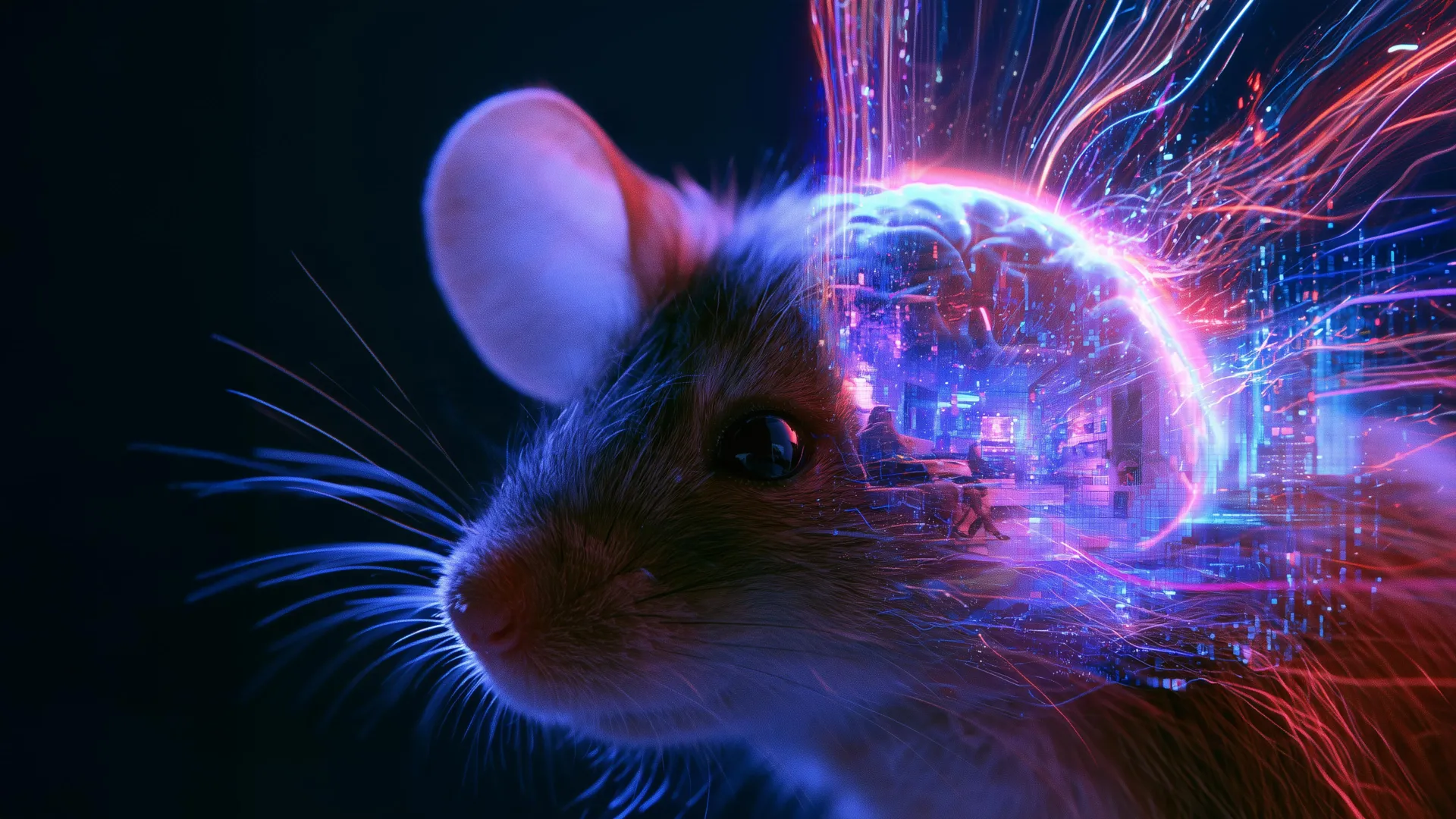
A groundbreaking study has achieved the remarkable feat of recreating visual experiences from mice by analyzing their brain activity alone, offering an unprecedented window into how mammalian brains process visual information. Researchers at University College London (UCL) have developed a sophisticated method that can generate video reconstructions based solely on the electrical chatter of individual neurons in the visual cortex, effectively translating neural patterns into recognizable visual scenes. This pioneering work, detailed in the scientific journal eLife, not only advances our understanding of the intricate mechanisms of vision but also opens up new avenues for comparative neuroscience, potentially allowing scientists to explore how different species perceive the same environment.
For decades, neuroscientists have grappled with the fundamental question of how the complex cascade of signals originating from our eyes is transformed into the rich, three-dimensional world we perceive. Previous attempts, particularly with human participants, often involved presenting visual stimuli—images and films—while employing large-scale brain imaging techniques like functional magnetic resonance imaging (fMRI). The data gathered would then be used to build computational models that attempted to reconstruct the visual input, often down to the level of individual pixels. While these methods have yielded valuable insights, they rely on relatively coarse measurements of brain activity, providing a broad overview rather than a granular understanding of neuronal representation.
The UCL team’s approach diverges significantly by focusing on the fine-grained activity of individual neurons. By recording the electrical impulses from specific brain cells within the visual cortex of mice, the researchers gained access to a much more detailed blueprint of how visual information is encoded. This cellular-level data proved instrumental in generating remarkably faithful reconstructions of the videos that the mice had been observing. Dr. Joel Bauer, the lead author of the study and a researcher at the Sainsbury Wellcome Centre at UCL, explained the team’s motivation: "Our aim was to develop a more precise tool for investigating how the brain interprets visual input. Existing methods for understanding what particular neural populations represent are often limited to highly specific, pre-defined scenarios. We sought to create a versatile methodology capable of capturing the brain’s internal representations and comparing them against objective reality."
A key area of interest for the researchers lies in understanding the discrepancies between the external visual world and its internal neural representation within the brain. By meticulously examining these differences, scientists can pinpoint which aspects of visual information the brain prioritizes, modifies, or entirely filters out during processing. This selective processing is crucial for efficient perception, allowing the brain to focus on salient features and ignore extraneous details.
The technical heart of this research lies in a sophisticated neural encoding model, originally conceived by another research group for the 2023 Sensorium Competition. This model is adept at predicting the firing patterns of individual neurons in response to visual stimuli, taking into account a multitude of factors, including the animal’s head movements and fluctuations in pupil size, which influence the amount of light entering the eye. The UCL researchers ingeniously adapted and refined this model for their specific study. Their process began by calculating the expected neural activity if the mouse had been presented with a completely blank visual field. This baseline prediction was then compared against the actual neural activity recorded while the mouse was engaged with a dynamic video.
The measurement of neural activity was achieved through an advanced microscopic imaging technique. This method identifies active neurons by detecting localized surges in calcium ion concentration, a reliable indicator of neuronal firing. By quantifying the divergence between the predicted neural responses to a blank screen and the observed activity during video viewing, an intelligent algorithm was employed. This algorithm iteratively adjusted the pixels of an initially blank digital canvas, gradually morphing it until the resulting video closely mirrored the actual content the mouse had witnessed. Each iteration brought the reconstructed image closer to the original, driven by the discrepancies in neural firing patterns.
To rigorously test the robustness of their method, the researchers presented the trained model with a new challenge. They recorded the brain activity of a mouse as it watched a video clip that had not been part of the model’s initial training dataset. The system, armed with only this novel neural data, successfully generated a 10-second video reconstruction that bore a striking resemblance to the unseen film. Dr. Bauer emphasized the significance of this achievement: "Through this innovative approach, we were able to produce high-fidelity reconstructions of 10-second video segments. The accuracy of these reconstructions demonstrably improved as we incorporated data from an increasing number of individual neurons, underscoring the critical role of comprehensive neural data in achieving detailed visual decoding." This success strongly suggests that the model was not merely memorizing previously encountered visual information but was genuinely inferring the content of a new scene based on the underlying patterns of neural activity.
The researchers employed a quantitative metric known as pixel correlation to assess the fidelity of the reconstructed videos against their original counterparts. This method systematically compares the color and intensity values of corresponding pixels in both the original and reconstructed sequences. While the analysis revealed only minor temporal discrepancies between the two, indicating a high degree of visual alignment, the researchers acknowledge that substantial improvements are still possible in terms of image resolution and the scope of the visual field that can be reconstructed. Future research endeavors will therefore concentrate on acquiring more extensive and higher-resolution neural data to facilitate sharper and more encompassing visual reconstructions.
Beyond the technical achievement, this research propels scientists toward addressing a more profound question about the nature of vision: to what extent does the brain’s internal interpretation of the world diverge from objective reality? Vision is far from a passive, camera-like recording of the environment. Instead, it is an active, interpretive process where incoming sensory data is continuously filtered, modulated, and reshaped by the brain. Elucidating the precise neural pathways and mechanisms responsible for these transformations promises to unlock fundamental principles of perceptual processing.
Dr. Bauer articulated the core of this ongoing investigation: "Our brains do not generate an exact replica of the world. The intricate pipeline of visual processing inherently biases and distorts our internal representations, actively modifying the information we receive. This deviation between the external reality and our brain’s internal model is not necessarily a flaw but rather a functional adaptation, reflecting how our minds actively interpret and augment sensory input. Our ambition is to unravel how these intricate processes unfold within the brain." By providing a tangible method to visualize neural activity as perceived reality, this research marks a significant leap forward in our quest to understand the subjective experience of sight and the complex cognitive architecture that underpins it.
About the Author












