
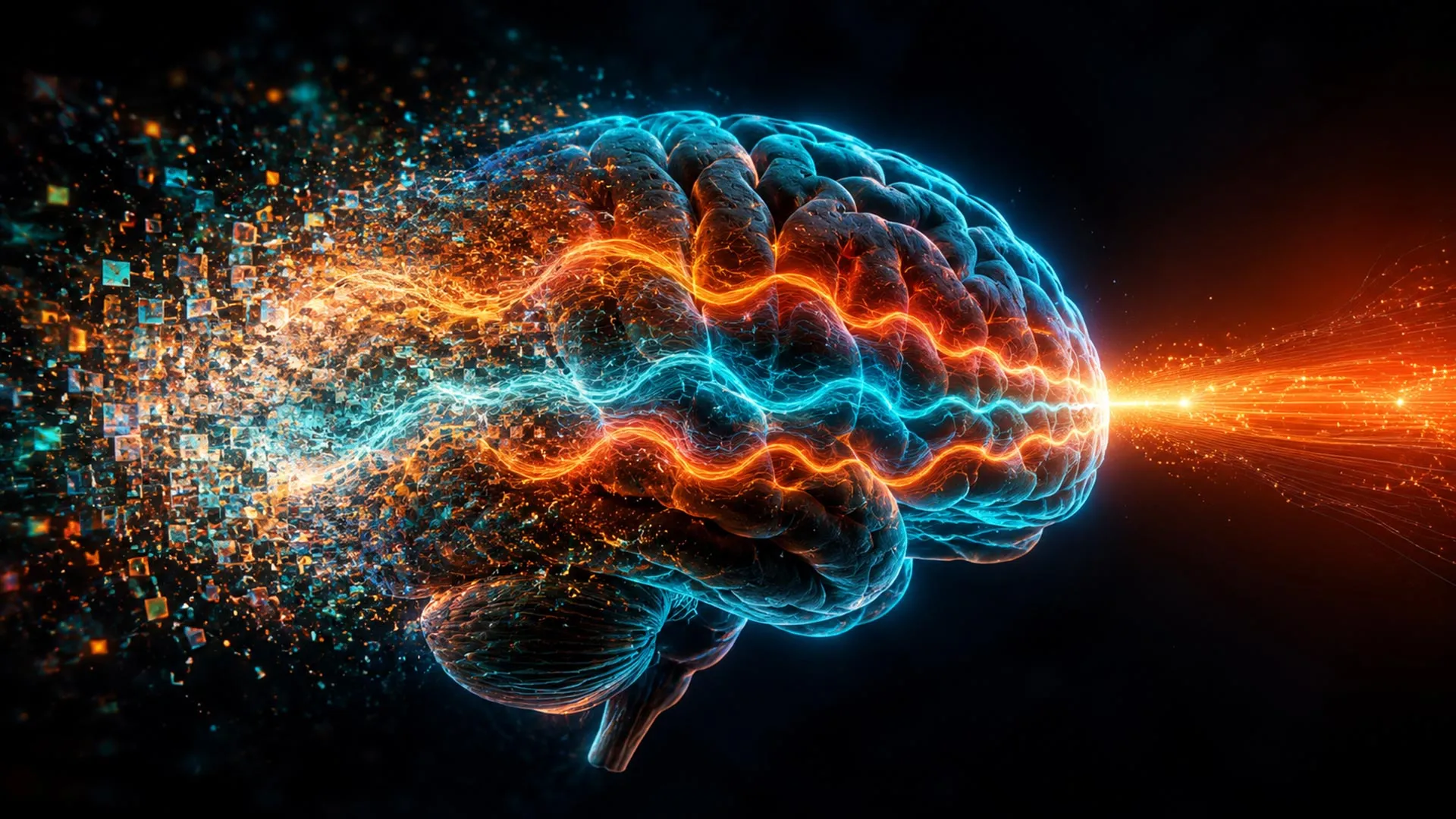
The intricate electrical symphony within the brain, particularly in the visual cortex, may be orchestrated by dynamic wave-like phenomena, moving beyond mere background noise to function as a sophisticated computational engine. Neuroscientists at the Salk Institute have synthesized existing physiological and computational research, proposing a compelling new model where these "neural traveling waves" actively construct our perception of reality, enabling us to interpret sensory input, reconstruct past experiences, and anticipate future events. This groundbreaking perspective, detailed in a comprehensive review published in the journal Neuron on July 21, 2026, offers a unified understanding of how these propagating electrical patterns contribute to the brain’s remarkable ability to make sense of a complex and ever-changing world.
The fundamental nature of traveling brain waves, characterized by their rhythmic propagation across neural circuits, has long been a subject of scientific inquiry. First identified in the visual systems of awake, behaving animals in 2020 by Salk neuroscientist John Reynolds, PhD, these waves were found to be intimately linked to an animal’s success in detecting visual stimuli. This initial discovery provided a crucial empirical anchor, suggesting that these neural oscillations were not simply epiphenomenal but played a direct role in the perceptual process. The observation that an animal might repeatedly fail to notice an object that was, in fact, clearly visible, provided a relatable analogy for the potential disconnect between sensory input and conscious awareness that these waves might help bridge. This phenomenon, akin to searching fruitlessly for misplaced keys that were in plain sight all along, highlighted the brain’s active role in gating and processing information, a role that traveling waves now appear central to.
The identification of traveling waves in awake animals and their correlation with visual perception naturally led to a more profound question: what is the underlying purpose of these endogenous wave generators? Reynolds and his colleagues’ subsequent work has culminated in the proposal that these waves are not merely passive reflections of neural activity but rather an integral component of the brain’s computational architecture. This new framework posits that the recurrent circuitry responsible for generating these waves enables the brain to perform a range of sophisticated computations, transforming raw sensory data into meaningful representations and actionable insights. The paper meticulously outlines four key functions attributed to these neural traveling waves within the visual cortex: modulating moment-to-moment perception, transforming recent sensory information into stable internal representations, generating short-term predictions about the environment, and facilitating the preservation and replay of temporal sequences associated with learned experiences.
This expanded view fundamentally reframes the understanding of neural traveling waves, moving them from the periphery of neural signaling to its core. They are no longer considered mere "electrical noise" but active participants in information processing. The connections within the neural networks that generate these waves are not static conduits for transmitting signals; instead, they possess a dynamic plasticity. These "synaptic weights" can be modified through experience, allowing them to encode learned information about the external world. Each sensory encounter, from the subtlest visual cue to the most impactful sound or action, can subtly alter the intricate web of connections that underpins wave generation. Over time, these cumulative changes sculpt the neural circuitry, refining its capacity to construct and maintain an internal model of the surrounding environment.
This process bears a striking functional resemblance to the learning mechanisms employed by advanced artificial intelligence systems, such as large language models. As John Reynolds explains, these AI models learn the statistical regularities and structural patterns inherent in vast datasets of language. They then leverage this learned knowledge to generate coherent and contextually appropriate text, mirroring the patterns they have absorbed. In a similar vein, the brain, through continuous interaction with its environment, appears to be constructing a "biological generative model." This model, built from the ground up by accumulated experience, allows the brain to understand and generate representations that are consistent with the statistical regularities of the physical world.
The fundamental challenge confronting the brain upon receiving sensory input is to answer the question: "What is the most probable interpretation of this incoming information?" The external world, while seemingly chaotic, is governed by a multitude of predictable rules. Objects maintain their three-dimensional existence, the visual panorama projected onto the retina is in constant flux due to eye and body movements, and all these changes occur within the immutable constraints imposed by physics and biological limitations. The proposed framework suggests that the brain learns these recurring patterns and embeds them within its vast network of synapses. These learned patterns, in turn, can drive the generation of traveling waves, which then assist the brain in inferring the most likely causes of sensory signals and assembling a coherent internal model of its surroundings.
In this light, traveling waves offer a compelling explanation for how the brain manages to transform the overwhelming deluge of complex sensory data into coherent perceptions, accurate predictions, purposeful behaviors, and rich subjective experiences. By understanding the mechanisms by which these waves facilitate this transformation, scientists are moving closer to unraveling the complex computational processes that enable us to navigate and comprehend our dynamic and often ambiguous world. The ability to not only perceive the present but also to reconstruct recent events and anticipate what lies ahead is a testament to the sophisticated internal modeling capabilities of the brain, a capability that neural traveling waves are now understood to significantly underpin.
This extensive research effort involved a collaborative team of scientists. Alongside John Reynolds, the study’s senior and co-corresponding author, contributions were made by Lyle Muller from UT Dallas and the Fields Institute, Alexandra Busch from the Fields Institute and Western University, and Zachary Davis from the University of Utah. The research received vital support from numerous funding bodies, including the National Institutes of Health through grants R01 EY028723, U01 NS131914, U01 NS139877, and EY014800, as well as Research to Prevent Blindness, the Natural Sciences and Engineering Research Council of Canada, Western University, Compute Ontario, and Digital Research Alliance of Canada, underscoring the collaborative and resource-intensive nature of advancing our understanding of fundamental brain functions.
About the Author












