The global imperative to mitigate climate change necessitates robust strategies for significantly reducing atmospheric carbon dioxide (CO2) concentrations. Among the suite of technologies aimed at achieving this critical goal, carbon capture stands out as a pivotal approach for preventing greenhouse gas emissions from industrial sources before they ever reach the atmosphere. While the concept of capturing CO2 has existed for decades, its widespread industrial implementation has been consistently hampered by considerable operational costs and inherent inefficiencies in most established systems. A predominant method, aqueous amine scrubbing, exemplifies this challenge; it relies on heating substantial volumes of liquid solvent to temperatures exceeding 100°C merely to release the captured CO2 and regenerate the solution for reuse. This intensive energy requirement represents a major financial burden, impeding the scalability and broad adoption of this otherwise effective technology.
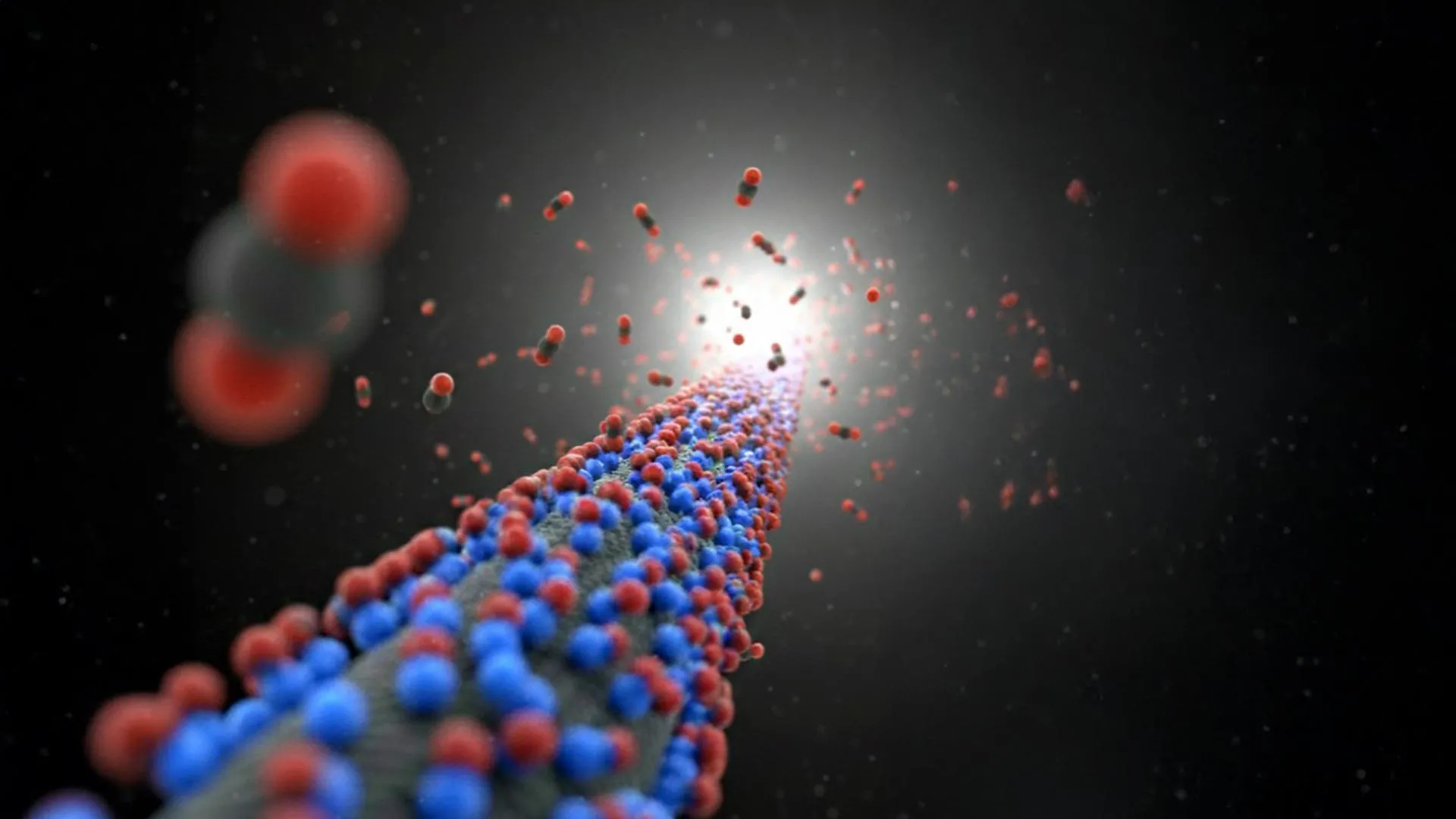
Against this backdrop, the scientific community has increasingly turned its attention to solid-state carbon materials as a potentially more viable and economical alternative. These advanced materials possess several intrinsic advantages: they are generally cost-effective to produce, boast exceptionally high surface areas conducive to gas adsorption, and exhibit the capacity to release captured CO2 at much lower thermal inputs compared to liquid amine systems. Their efficiency can be further enhanced when they incorporate nitrogen-based functional groups, which play a crucial role in improving CO2 affinity and facilitating desorption. However, a significant hurdle has persisted in the development of these solid adsorbents: conventional synthesis methods typically result in the random distribution of these critical nitrogen groups across the material’s surface. This lack of precise control makes it exceedingly difficult for researchers to systematically identify and optimize specific nitrogen arrangements that would yield superior performance, thereby limiting the potential for targeted material design.
Addressing this fundamental limitation, a pioneering research team at Chiba University in Japan has unveiled a groundbreaking advancement in carbon material engineering. Led by Associate Professor Yasuhiro Yamada from the Graduate School of Engineering and Associate Professor Tomonori Ohba from the Graduate School of Science, alongside contributions from Mr. Kota Kondo, the team successfully developed a novel class of carbon materials dubbed ‘viciazites.’ What distinguishes viciazites is their meticulously engineered structure, where nitrogen functional groups are precisely positioned adjacent to one another in a controlled, predictable manner. This innovative approach, detailed in their recent publication in the esteemed journal Carbon, marks a significant departure from previous methodologies and offers a clear pathway to designing next-generation CO2 capture technologies with unprecedented control at the molecular level.
The core of this breakthrough lies in the team’s ability to synthesize viciazites with specific, adjacent nitrogen configurations. To illustrate this capability, the researchers successfully fabricated three distinct versions of these materials, each featuring a unique type of neighboring nitrogen arrangement. For instance, to create materials embedded with adjacent primary amine groups (-NH2), the team devised a sophisticated three-step chemical process. This involved initially heating a polycyclic aromatic hydrocarbon compound known as coronene, subsequently treating it with bromine, and finally exposing it to ammonia gas. This intricate synthetic pathway demonstrated remarkable control, achieving an impressive 76% selectivity, which means a substantial majority of the nitrogen atoms were precisely incorporated into their intended adjacent positions within the carbon matrix.
Building on this success, the researchers expanded their repertoire by producing two additional viciazite variations using different precursor compounds. One iteration featured adjacent pyrrolic nitrogen configurations, exhibiting an even higher selectivity of 82%. The third material incorporated adjacent pyridinic nitrogen, achieving a respectable 60% selectivity. The ability to reliably control the placement and type of nitrogen functionalities at such high degrees of selectivity is a testament to the sophistication of their molecular engineering techniques and represents a critical step forward in tailoring material properties for specific applications.
To ensure the structural integrity and precise placement of the nitrogen groups, the team undertook rigorous verification using a suite of advanced analytical techniques. Each newly synthesized viciazite material was initially applied to activated carbon fibers to create practical, testable samples. The precise atomic architecture and the side-by-side arrangement of nitrogen atoms, rather than a random distribution, were confirmed through a combination of nuclear magnetic resonance (NMR) spectroscopy, X-ray photoelectron spectroscopy (XPS), and sophisticated computational modeling. These cutting-edge methods provided irrefutable evidence that the nitrogen atoms were indeed positioned in the intended adjacent patterns, validating the success of their controlled synthesis approach.
The subsequent performance evaluation of these meticulously crafted viciazite materials yielded compelling results, highlighting significant differences in their CO2 capture and release characteristics. Notably, the samples engineered with adjacent primary amine (-NH2) groups and those containing pyrrolic nitrogen configurations demonstrated a superior capacity for adsorbing CO2 when compared to untreated carbon fibers. In stark contrast, the pyridinic nitrogen configuration offered only marginal improvement in capture efficiency, suggesting that not all adjacent nitrogen arrangements are equally effective, and underscoring the importance of precise structural control.
Perhaps the most impactful finding revolved around the ease with which these materials could release the captured CO2, a process known as desorption. Dr. Yamada emphasized the significance of this discovery: "Performance evaluation revealed that in carbon materials where NH2 groups are introduced adjacently, most of the adsorbed CO2 desorbs at temperatures below 60°C. By combining this property with industrial waste heat, it may be possible to achieve efficient CO2 capture processes with substantially reduced operating costs." This revelation is a game-changer, as it directly addresses the high energy consumption bottleneck of current carbon capture technologies. The ability to regenerate the adsorbent at temperatures below 60°C means that vast amounts of otherwise wasted low-grade industrial heat, often abundant in manufacturing processes, could be harnessed to power the desorption cycle. This innovative integration could drastically slash the energy demand and, consequently, the operating expenses associated with large-scale CO2 capture. While the material featuring pyrrolic nitrogen required slightly higher temperatures for CO2 release, it offers a distinct advantage in terms of long-term stability due to its more robust chemical structure, presenting a valuable trade-off for certain industrial applications.
This groundbreaking research by the Chiba University team establishes a clear and validated methodology for reliably arranging nitrogen groups in specific adjacent patterns within carbon materials. This molecular-level control provides an invaluable blueprint for the rational design of vastly improved carbon capture adsorbents. Dr. Yamada articulated the broader vision behind their efforts: "Our motivation is to contribute to the future society and to utilize our recently developed carbon materials with controlled structures. This work provides validated pathways to synthesize designer nitrogen-doped carbon materials, offering the molecular-level control essential for developing next-generation, cost-effective, and advanced CO2 capture technologies." The implications extend beyond merely enhancing efficiency; this precision engineering promises to unlock a new era of affordability for carbon capture, potentially accelerating its widespread adoption across diverse industries.
The versatility of these novel viciazite materials is not confined solely to CO2 capture. Their customizable surface properties, a direct result of the controlled placement of functional groups, open doors to a myriad of other high-value applications. For instance, they could be engineered for the selective removal of specific metal ions from industrial wastewater or contaminated environments, offering advanced solutions for pollution control. Furthermore, their unique surface chemistry makes them promising candidates for use as highly efficient catalysts in various chemical reactions, potentially driving advancements in sustainable manufacturing processes.
This pioneering work was made possible through substantial support from several prestigious organizations, highlighting the collaborative nature of cutting-edge scientific discovery. Key funding and assistance were provided by the Mukai Science and Technology Foundation, the Japan Society for the Promotion of Science (JSPS KAKENHI Grant Number JP24K01251), and the "Advanced Research Infrastructure for Materials and Nanotechnology in Japan (ARIM)" initiative of the Ministry of Education, Culture, Sports, Science and Technology (MEXT) under Grant Number JPMXP1225JI0008. Such foundational backing is crucial for enabling the kind of innovative, long-term research that yields transformative solutions to pressing global challenges. The successful development of viciazites represents a significant leap forward in materials science, offering a powerful new tool in the global fight against climate change and demonstrating the profound impact of molecular-level engineering on the future of sustainable technologies.
About the Author