For an extended period, scientific consensus largely confined the capacity for spontaneous, insight-driven problem-solving to species possessing relatively large and complex brains, a category typically encompassing humans and other vertebrates. However, recent groundbreaking research involving bumble bees has dramatically challenged this entrenched assumption, revealing a remarkable cognitive flexibility in creatures with significantly simpler neural structures. A sophisticated new study has demonstrated that these diminutive insects can devise original solutions to entirely unfamiliar object manipulation challenges, a feat that was previously thought to be the exclusive domain of animals with vastly more developed cerebral cortices.
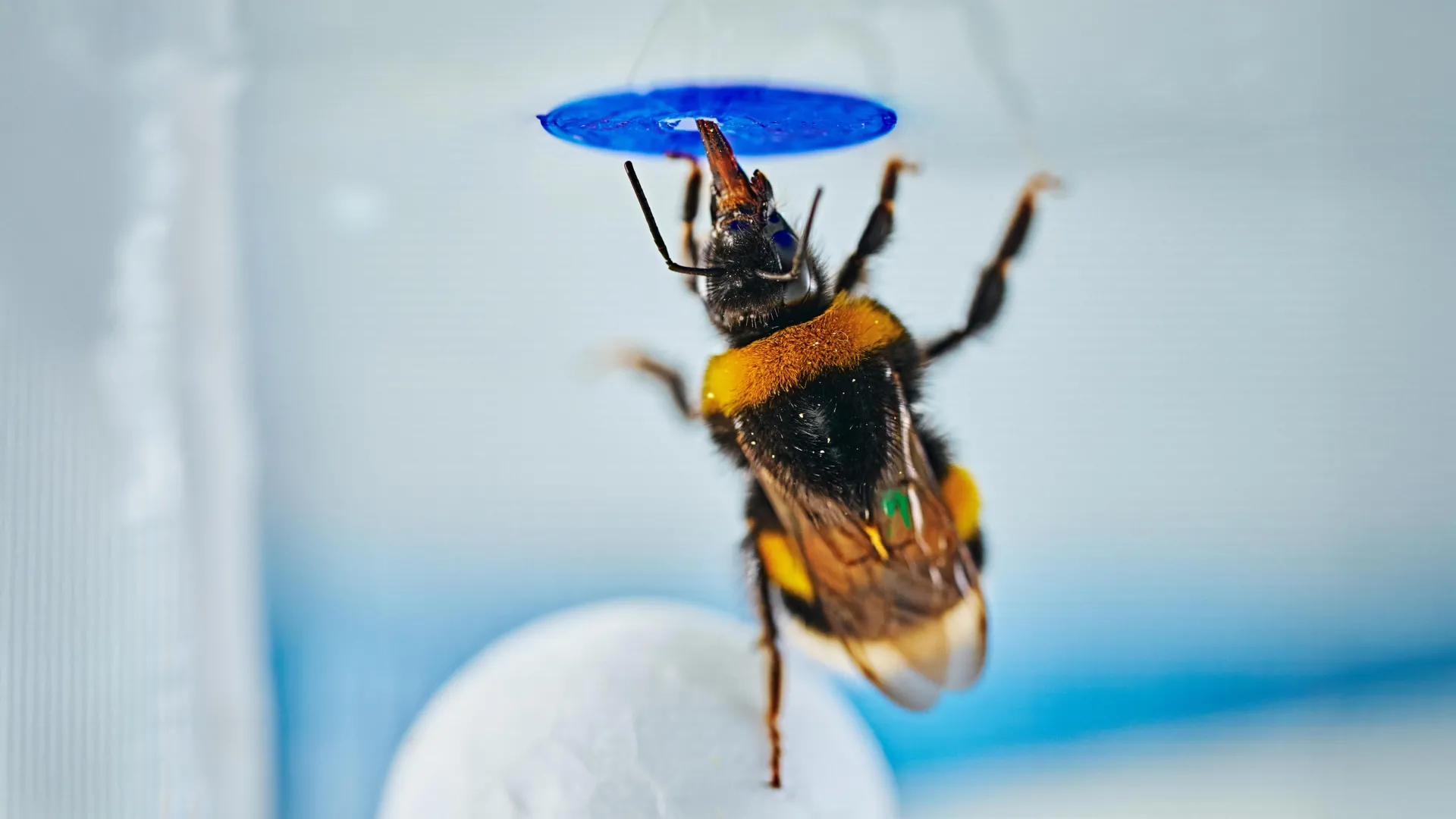
This paradigm-shifting discovery stems from a collaborative effort by researchers affiliated with the University of Oulu, the University of Helsinki, and the University of Turku in Finland, whose findings were recently published in the prestigious scientific journal Science. The investigation focused on the bumble bee species Bombus terrestris, presenting them with a specific task designed to test their innate problem-solving capabilities without any prior training or conditioning. The experimental setup involved an artificial blue flower, which the bees had initially been trained to associate with a food reward. Subsequently, this reward-bearing flower was repositioned to the ceiling of a transparent enclosure, rendering it inaccessible through conventional means.
The challenge presented to the bees was to devise a novel strategy to retrieve the coveted reward. The researchers observed that a significant proportion of the bumble bees successfully navigated this unprecedented obstacle by employing a sequence of actions that had never been demonstrated or encouraged. These adept individuals learned to manipulate a small, strategically placed ball within the enclosure. They would maneuver the ball directly beneath the elevated flower and then ascend onto it, thereby gaining the necessary height to access the reward. This intricate behavior represents a profound act of innovation, as the bees had no prior tutelage or experience with using the ball as a functional tool for reaching the inaccessible food source.
Senior author Olli Loukola, a Docent at the University of Oulu, drew a compelling parallel between this insect-based solution and the seminal experiments conducted by psychologist Wolfgang Köhler over a century ago. Köhler’s classic studies famously showcased the emergent problem-solving abilities of chimpanzees, who, when faced with similar quandaries such as reaching suspended fruit, demonstrated insight by creatively combining objects, like stacking crates. Loukola articulated that the current bumble bee study essentially replicates an "insect version of the classic ‘box-and-banana’ problem." He emphasized that the critical aspect is the animal’s realization that an object can be deliberately repositioned and then repurposed as an instrument to attain a goal that would otherwise remain out of reach. The profound significance, according to Loukola, lies in the demonstration of such spontaneous problem-solving capabilities within the insect order.
Lead author Akshaye Bhambore, also from the University of Oulu, further elaborated on the remarkable nature of this observed behavior. He underscored that the bees had received no specific training related to the manipulation of the ball in conjunction with reaching the flower; the entire scenario constituted a completely novel challenge. Bhambore noted that the bees’ actions appeared to be goal-directed, with successful individuals exhibiting more purposeful and efficient movement patterns as they approached the solution. This suggests a level of cognitive processing that goes beyond simple instinctual responses.
To rigorously substantiate their findings and eliminate any potential alternative explanations, the research team meticulously designed and executed a series of control experiments. The bees were initially taught only two distinct pieces of information: that the blue flower signified a food reward, and that the ball was an inert, movable object. They were never instructed or guided on how to use the ball to reach the flower. The subsequent novel challenge forced them to synthesize these disparate pieces of learned information into a functional, innovative solution.
Loukola highlighted the crucial element of the bees’ "naïveté" in the experimental context. He contrasted this with many prior investigations into insight-like problem-solving, where animals often possess extensive prior exposure to similar objects, experimental environments, or a history of engaging in various problem-solving tasks. In this study, the bumble bees were deliberately shielded from any such pre-existing experience that might predispose them to the observed solution. The experimental design was specifically engineered to preclude explanations rooted in accidental success, mere playfulness, rudimentary trial-and-error learning, or direct visual cues that might inadvertently guide their actions.
The meticulous control measures were essential to rule out simpler interpretations of the bees’ actions. In some of the more challenging iterations of the experiment, the blue flower was temporarily obscured from the bees’ view while they were engaged in moving the ball. This deliberate obstruction prevented the possibility of them simply steering the ball towards a visible, static target. Despite this visual handicap, a substantial number of bees still managed to successfully position the ball in the correct location, further reinforcing the idea that their actions were driven by a more abstract understanding of the problem. Lead author Bhambore affirmed that the stringent analysis of the bees’ behavior across these demanding control conditions definitively demonstrated that their actions were not merely reactive responses to visual stimuli or random movements.
The researchers themselves expressed a degree of astonishment at the ingenuity displayed by the bumble bees. Co-author Ece Nur Akmeşe from the University of Helsinki vividly described the transformation in the bees’ behavior, noting that "one moment the animal is exploring seemingly without direction, and the next it performs a highly efficient sequence of actions leading directly to the solution." She characterized the experience of observing the bees solve the task as "genuinely fascinating."
These new findings contribute significantly to an expanding body of evidence suggesting that bees possess a far more sophisticated cognitive repertoire than their minuscule brain size might initially suggest. Prior research has already established that bees are capable of socially acquiring tool-use skills, successfully navigating complex puzzle-like tasks, engaging in cooperative behaviors, and demonstrating adaptability in their actions when faced with changing environmental conditions.
However, the researchers are careful to temper these exciting revelations by emphasizing that the observed behaviors should not be interpreted as indicative of human-like thought processes or consciousness in insects. Loukola clarified, "We are not claiming that bees think like humans," but he firmly asserted that "our findings show that miniature brains can generate flexible solutions to novel problems in ways we are only beginning to understand."
In summation, the study’s implications are profound, suggesting that spontaneous, goal-directed problem-solving capabilities can emerge even in organisms with brains that are considerably smaller than those of the vertebrates that have traditionally been the focus of intelligence research. Loukola concluded by stating that for over a century, spontaneous object-based problem-solving has predominantly been studied in vertebrates, and this current research powerfully suggests that insects may now warrant inclusion in this critical scientific discourse. The study, officially titled "Spontaneous problem-solving in bumble bees," was authored by Akshaye A. Bhambore, Ece N. Akmeşe, Emma Häkkinen, Milla K. Jussila, Juha-Heikki Kantola, and Olli J. Loukola, and its publication date in Science was June 4, 2026.
About the Author