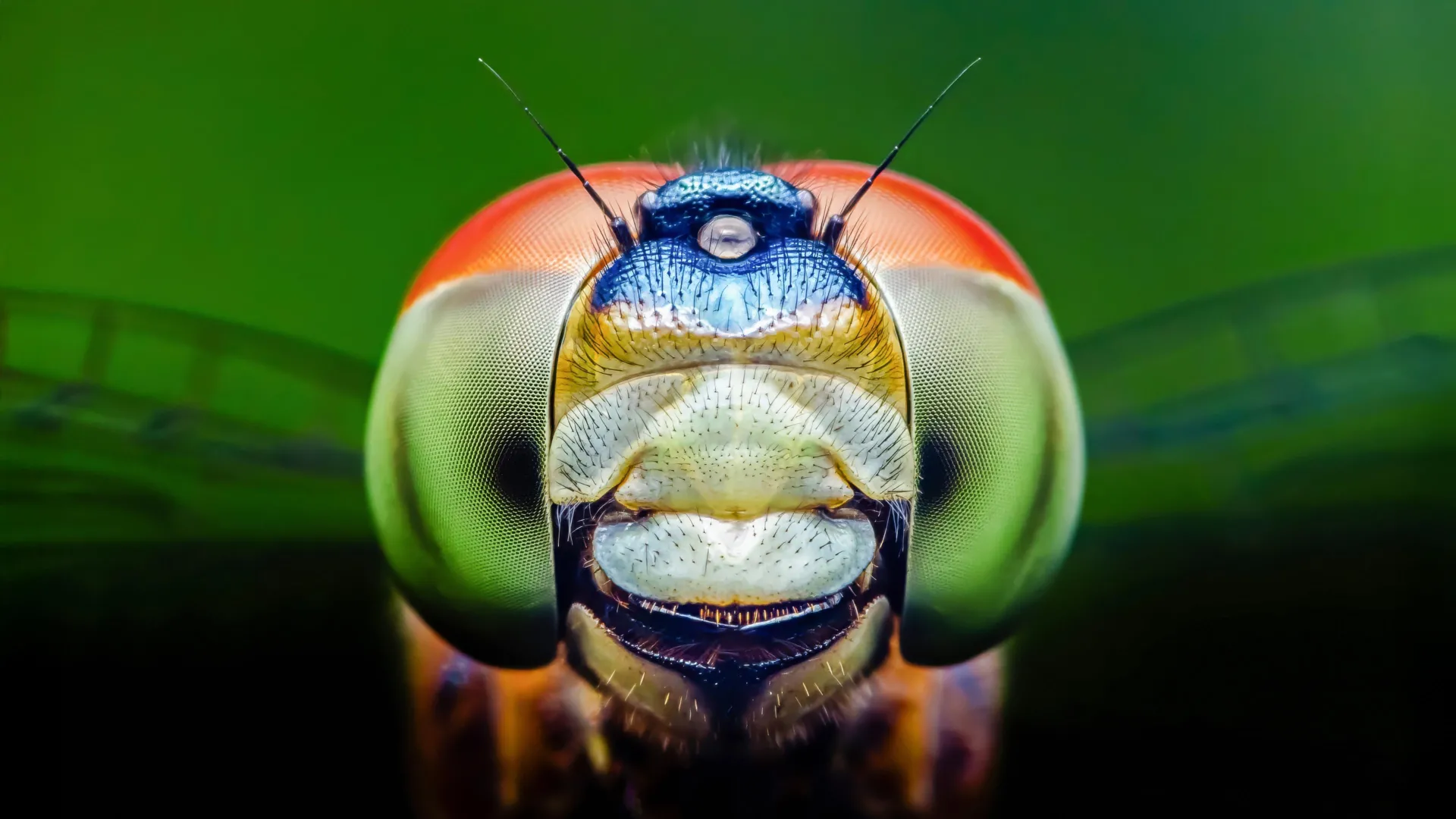
In a remarkable confluence of evolutionary pathways, researchers have identified a unique visual capability in dragonflies that echoes a fundamental aspect of mammalian vision, a discovery poised to ripple through fields ranging from evolutionary biology to advanced medical technologies. The phenomenon of parallel evolution, where distinct species independently develop similar biological traits, has long fascinated scientists, offering profound insights into the underlying principles of life’s adaptation. Now, a team from Osaka Metropolitan University (OMU) has unearthed a striking instance of this, demonstrating that dragonflies perceive red light through a mechanism remarkably akin to that employed by humans and other mammals. This finding, which extends beyond the purely entomological, carries significant implications for the development and application of various medical technologies that routinely utilize red light.
Human color vision, a complex interplay of light and biological machinery, is orchestrated by specialized proteins within the eye known as opsins. These light-sensitive molecules are the primary interpreters of the visual spectrum, each type finely tuned to specific wavelengths of light. Humans possess three principal opsin varieties, each attuned to perceive predominantly blue, green, or red light. The synergistic operation of these three systems grants us the rich tapestry of full-color perception.
Dragonflies, however, occupy a distinct position within the insect world due to their extraordinary ability to detect and process red light. A dedicated research contingent, spearheaded by Professors Mitsumasa Koyanagi and Akihisa Terakita at OMU’s Graduate School of Science, has pinpointed a specific opsin within dragonfly visual systems that exhibits a pronounced sensitivity to light frequencies around 720 nanometers. This specific wavelength represents a spectral boundary, extending into a region of red light that lies just beyond the maximal reach of typical human visual acuity.
Professor Terakita remarked on the exceptional nature of this discovery, noting that the identified visual pigment stands among the most red-sensitive ever documented. This heightened sensitivity suggests that dragonflies likely possess the capacity to discern nuances within the red spectrum that are imperceptible to the vast majority of other insect species, potentially granting them an enhanced understanding of their environment.
The biological significance of this advanced red-light perception for dragonflies appears to be deeply intertwined with their reproductive strategies. The research team posited that this enhanced sensitivity to longer wavelengths of light could play a crucial role in mate recognition and selection. To investigate this hypothesis, the scientists meticulously analyzed the reflectance properties of dragonfly exoskeletons, a measure of how much light a surface bounces back. Their findings revealed that the way dragonflies reflect red and near-infrared light differs noticeably between males and females. This spectral dimorphism, they suggest, likely provides males with subtle visual cues that enable them to swiftly and accurately identify potential mates during aerial courtship displays.
The identification of an identical molecular mechanism for red light detection in both dragonflies and mammals represents a profound convergence in evolutionary history. Ryu Sato, a graduate student and the lead author of the study, expressed his surprise at this unexpected parallel. Despite the vast evolutionary distance separating insects and mammals, both lineages appear to have independently arrived at the same sophisticated molecular solution for sensing the red end of the light spectrum. This convergent evolution underscores the potent selective pressures that can drive disparate organisms toward similar functional outcomes.
Beyond its implications for understanding the evolution of vision, the OMU team’s work has unearthed a critical detail with the potential to unlock significant technological and medical applications. They successfully isolated a single amino acid residue within the opsin protein that acts as a key determinant of its light sensitivity. By precisely altering this specific site, the researchers demonstrated the ability to fine-tune the opsin’s responsiveness, shifting its peak sensitivity further towards longer wavelengths, effectively pushing it closer to the infrared spectrum.
Building upon this understanding, the team engineered a modified version of the opsin protein capable of reacting to even greater wavelengths of light. Crucially, they then experimentally validated that cells engineered to express this altered opsin could be effectively activated by near-infrared light, a wavelength invisible to the human eye.
This breakthrough holds particularly compelling promise for the burgeoning field of optogenetics, a revolutionary discipline that leverages light-sensitive proteins to precisely control and study cellular activity within living organisms. The inherent advantage of longer light wavelengths, such as near-infrared, is their superior ability to penetrate biological tissues more deeply. Consequently, an opsin engineered to respond to near-infrared light could enable researchers to target and modulate cells situated far beneath the surface of living organisms, overcoming current accessibility limitations.
Professor Koyanagi elaborated on the practical implications, stating that the research successfully extended the sensitivity range of a modified near-infrared opsin, originally derived from Gomphidae dragonflies, even further into the longer wavelength spectrum. Their experiments confirmed that this enhanced opsin could indeed trigger cellular responses when stimulated by near-infrared light. These findings strongly suggest that this engineered opsin represents a highly promising tool for optogenetic applications, possessing the capability to detect light signals even within the deepest recesses of living biological systems. The groundbreaking findings of this research were formally published in the esteemed journal Cellular and Molecular Life Sciences.
About the Author