
As individuals navigate the landscape of life beyond 55, maintaining robust physical capabilities becomes increasingly important for preserving independence and enhancing overall quality of life. A significant component of this vitality lies in upper body strength, which underpins a vast array of daily activities, from the simple act of rising from a chair to lifting groceries or reaching for items on a high shelf. However, the natural physiological changes associated with aging, such as a decline in muscle mass (sarcopenia) and potential joint wear, often introduce a cautious approach to physical training. Many individuals experience discomfort in their elbows, wrists, or shoulders, leading to apprehension about initiating or continuing strength-building regimens. This apprehension, while understandable, can inadvertently accelerate the decline in functional strength. The key, therefore, lies in adopting a strategic, joint-conscious methodology for upper body conditioning that prioritizes safety, adaptability, and sustained efficacy.
The conventional wisdom often associates strength training with heavy weights and intense, high-impact movements, which can indeed exacerbate existing joint vulnerabilities or even precipitate new injuries in an older population. However, the paradigm for strength development in later life shifts towards movements that can be customized to individual tolerance levels, ensuring that the body is challenged appropriately without undue strain on delicate joint structures. A plan formulated by a certified strength and conditioning specialist (CSCS) emphasizes selecting exercises that are repeatable, modifiable, and allow for progressive resistance without forcing awkward or painful positions. This approach acknowledges the unique needs of older adults, focusing on restoring functional strength that directly translates to improved performance in everyday living, rather than solely on maximal strength or muscle hypertrophy.
The objective is not merely to "build muscle" in the traditional sense, but to cultivate a resilient and capable upper body that can confidently perform essential tasks, contributing to greater autonomy and reducing the risk of falls or injuries. This philosophy embraces the use of adaptable equipment, such as resistance bands and light dumbbells, and leverages bodyweight exercises that can be scaled from minimal to moderate intensity. The following five exercises exemplify this joint-friendly approach, offering a comprehensive program designed to enhance pushing, pulling, overhead stability, and direct arm strength, all while meticulously safeguarding joint integrity. Integrating these movements into a regular routine can profoundly impact an individual’s physical capacity and confidence, fostering a proactive stance against age-related decline.
1. Scalable Pressing Maneuver (The Modified Push-Up)
The push-up stands as a cornerstone exercise for developing pressing strength across the chest, shoulders, and triceps, concurrently engaging the core musculature for stability. Its unparalleled adaptability makes it exceptionally suitable for individuals concerned about joint comfort. Unlike a standard floor push-up, which can place significant stress on the wrists and shoulders, especially with reduced upper body strength, the modified version allows for an immediate adjustment of the resistance level by altering the body’s angle. Commencing with a wall push-up, where the body is nearly upright, minimizes the gravitational load, enabling individuals to practice the fundamental movement pattern in a controlled, pain-free manner. As strength improves, the angle can be progressively lowered by transitioning to a kitchen counter, a sturdy bench, or an incline surface, gradually increasing the challenge. This progressive scaling ensures that the wrists and shoulders are never subjected to a load they cannot comfortably manage, allowing for consistent training and gradual strength accrual. This exercise directly enhances the strength required for actions like pushing open a heavy door, bracing oneself to stand from a seated position, or effectively supporting body weight with the hands.
- Muscles Engaged: Pectoralis major (chest), deltoids (shoulders), triceps brachii (back of upper arm), rectus abdominis (abs).
- Joint-Friendly Aspect: Highly adjustable incline reduces gravitational stress on wrists and shoulders, allowing for gradual progression.
- Execution Guidance: Maintain a straight line from head to heels. Lower the chest towards the surface, keeping elbows angled slightly back, then press back to the starting position.
- Progression/Regression: Start with a wall, progress to a counter, then a bench, and eventually an incline push-up on the floor.
- Recommended Parameters: Perform 2 to 3 sets of 6 to 12 repetitions, with a rest period of 45 to 60 seconds between sets.
2. Resistance Band Dorsal Row (Standing Band Row)
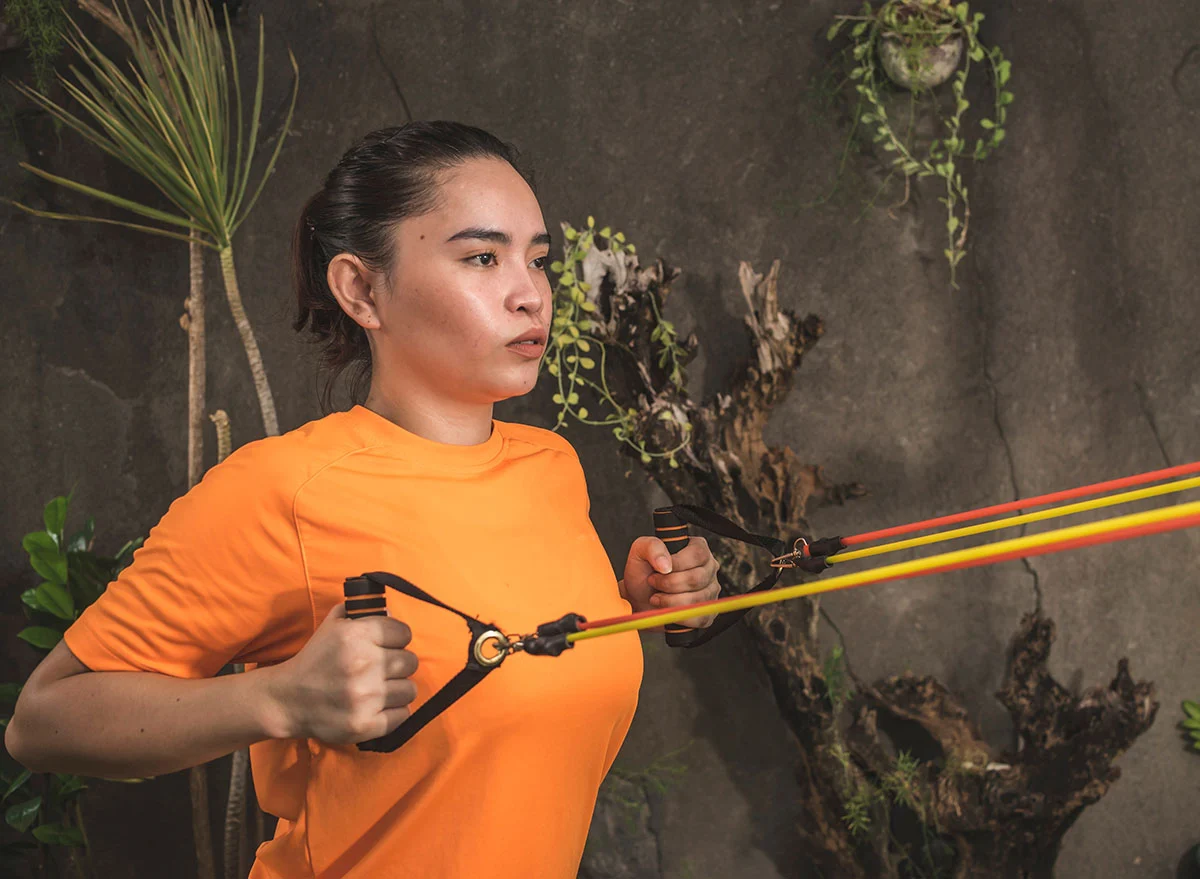
While bicep curls often dominate the perception of "arm strength," the importance of balanced muscular development, particularly in the upper back, cannot be overstated. The standing resistance band row is a crucial pulling exercise that fortifies the upper back, latissimus dorsi, and rear deltoids, all while engaging the biceps. A strong upper back provides essential support and stability for the arms, improving posture and facilitating more efficient movement. The unique characteristic of resistance bands, where tension increases as the band stretches, offers a smooth and accommodating resistance curve. This means the initial phase of the pull is often lighter, reducing sudden jolts or strain on the joints, while the peak contraction provides significant challenge. The adjustability of band tension—by selecting a lighter or heavier band, or by altering grip—allows for precise control over the workout intensity. This exercise contributes significantly to the strength needed for actions such as pulling objects towards oneself, opening heavy drawers, or stabilizing the shoulder girdle during various movements.

- Muscles Engaged: Rhomboids, trapezius (upper back), latissimus dorsi (lats), biceps brachii, posterior deltoids (rear shoulders).
- Joint-Friendly Aspect: Variable resistance of bands reduces initial joint stress and allows for smooth, controlled movement throughout the range of motion.
- Execution Guidance: Anchor a resistance band securely. Stand facing the anchor point, holding the band handles with arms extended. Pull the elbows back, squeezing the shoulder blades together, without shrugging. Control the return to the starting position.
- Progression/Regression: Adjust difficulty by using bands of varying resistance, performing single-arm rows, or transitioning to a seated position for added stability.
- Recommended Parameters: Perform 2 to 3 sets of 10 to 15 repetitions, resting for 30 to 45 seconds between sets.
3. Unilateral Half-Kneeling Overhead Press (Half-Kneeling Dumbbell Shoulder Press)
Overhead pressing can often be a source of apprehension for older adults due to perceived shoulder vulnerability. The half-kneeling dumbbell shoulder press offers an exceptional solution by emphasizing controlled movement, core stability, and unilateral strength. By adopting a half-kneeling stance—one knee on a soft pad, the other foot planted firmly—the body’s base of support is modified, which inherently reduces the potential for compensation from the lower back and forces a more deliberate, slower pressing motion. This position also engages the core muscles more effectively, providing a stable platform from which to press. Using a single, lighter dumbbell allows individuals to focus intently on the quality of the movement and the integrity of the shoulder joint throughout the full range of motion. This exercise is instrumental in rebuilding the strength necessary for tasks like reaching overhead to place items on a shelf, lifting objects above head height, or maintaining shoulder stability during dynamic movements.
- Muscles Engaged: Deltoids (shoulders), triceps brachii, upper trapezius (upper back), core stabilizers (abs).
- Joint-Friendly Aspect: Half-kneeling position enhances core engagement and stability, reducing reliance on momentum and minimizing potential for lower back or excessive shoulder strain.
- Execution Guidance: Begin in a half-kneeling position. Hold a light dumbbell at shoulder height with your palm facing forward. Press the dumbbell directly overhead, maintaining a stable torso. Slowly lower the weight back to the starting position.
- Progression/Regression: Start with very light weights. Progress by gradually increasing the dumbbell weight or transitioning to a standing single-arm press for a greater balance challenge.
- Recommended Parameters: Perform 2 to 3 sets of 6 to 10 repetitions per side, resting for 45 to 60 seconds between sets.
4. Dynamic Overhead Stability Walk (Overhead Dumbbell Carry)
While the overhead press demonstrates the ability to lift a weight, the overhead dumbbell carry proves the arm’s capacity to maintain strength and stability under load while in motion. This functional exercise is invaluable for developing dynamic shoulder stability, core strength, and grip endurance, all critical components for daily living. Carrying a light dumbbell overhead demands continuous engagement from the shoulders, triceps, upper back, and abdominal muscles to keep the weight precisely stacked over the shoulder joint. This controlled practice, rather than a frantic heavy lift, builds resilience in the supporting musculature and connective tissues. It directly translates to improved performance in real-world scenarios such as reaching into high cabinets, carrying bags with an upright posture, or maintaining balance while reaching or lifting. Starting with a very light weight and focusing on impeccable form is paramount, transforming each step into a mindful exercise in stability and control.
- Muscles Engaged: Deltoids (shoulders), triceps brachii, upper back stabilizers, core musculature (abs), forearms (grip).
- Joint-Friendly Aspect: Emphasizes controlled, sustained stability with lighter loads, strengthening the shoulder girdle dynamically without abrupt movements.
- Execution Guidance: Hold a light dumbbell directly overhead, arm fully extended and bicep near the ear. Maintain a tall posture, engaged core, and walk slowly and deliberately, keeping the weight stable above the shoulder.
- Progression/Regression: Begin with minimal weight or even just the arm’s weight as an overhead hold. Gradually increase the duration of the carry or slightly increase the weight.
- Recommended Parameters: Perform 2 to 3 carries of 15 to 30 seconds per side, with a rest period of 45 to 60 seconds between carries.
5. Progressive Resistance Arm Flexion (Band Curl)
No discussion of arm strength is complete without addressing the biceps, muscles essential for pulling, lifting, and carrying objects close to the body. The resistance band bicep curl offers a highly effective and joint-friendly method for direct bicep work. Unlike traditional dumbbell curls, where the heaviest load often occurs at the bottom of the movement, potentially straining the elbow joint, resistance bands provide progressive resistance. This means the tension gradually increases as the band stretches, reaching its peak at the top of the curl where the biceps are in their strongest contractile position. This characteristic can feel significantly more comfortable on the elbows, as the initial phase of the lift is lighter. The band curl directly enhances the strength required for everyday tasks like lifting grocery bags, pulling items off a shelf, or bringing objects closer to the body. It serves as an excellent finishing exercise, providing targeted stimulation to the biceps and forearms without requiring heavy free weights.
- Muscles Engaged: Biceps brachii, brachialis, brachioradialis (forearms), grip muscles.
- Joint-Friendly Aspect: Progressive resistance minimizes strain on the elbow joint at the bottom of the movement, increasing smoothly as the muscle contracts.
- Execution Guidance: Stand on a resistance band, holding the handles with palms facing forward, arms extended. Keeping elbows close to your sides, curl the band towards your shoulders, squeezing your biceps at the top. Control the descent.
- Progression/Regression: Adjust difficulty by using bands with different resistance levels or by performing single-arm curls.
- Recommended Parameters: Perform 2 to 3 sets of 10 to 15 repetitions, resting for 30 to 45 seconds between sets.
Building and maintaining arm strength after the age of 55 does not necessitate high-impact, joint-punishing routines. Instead, it thrives on intelligent design, consistent effort, and a deep respect for the body’s changing needs. This program, built on principles of adaptability and joint protection, provides a robust framework for developing functional upper body strength. By integrating these exercises two to four days per week, or even selecting two or three for shorter daily strength breaks, individuals can cultivate sustained physical capacity. The ultimate success of any fitness regimen for older adults hinges on its consistency and the absence of post-workout discomfort in the shoulders, elbows, or wrists. Embracing these gentle yet powerful movements is a proactive step towards a more independent, capable, and vibrant future, where daily activities are performed with renewed ease and confidence.
About the Author










