
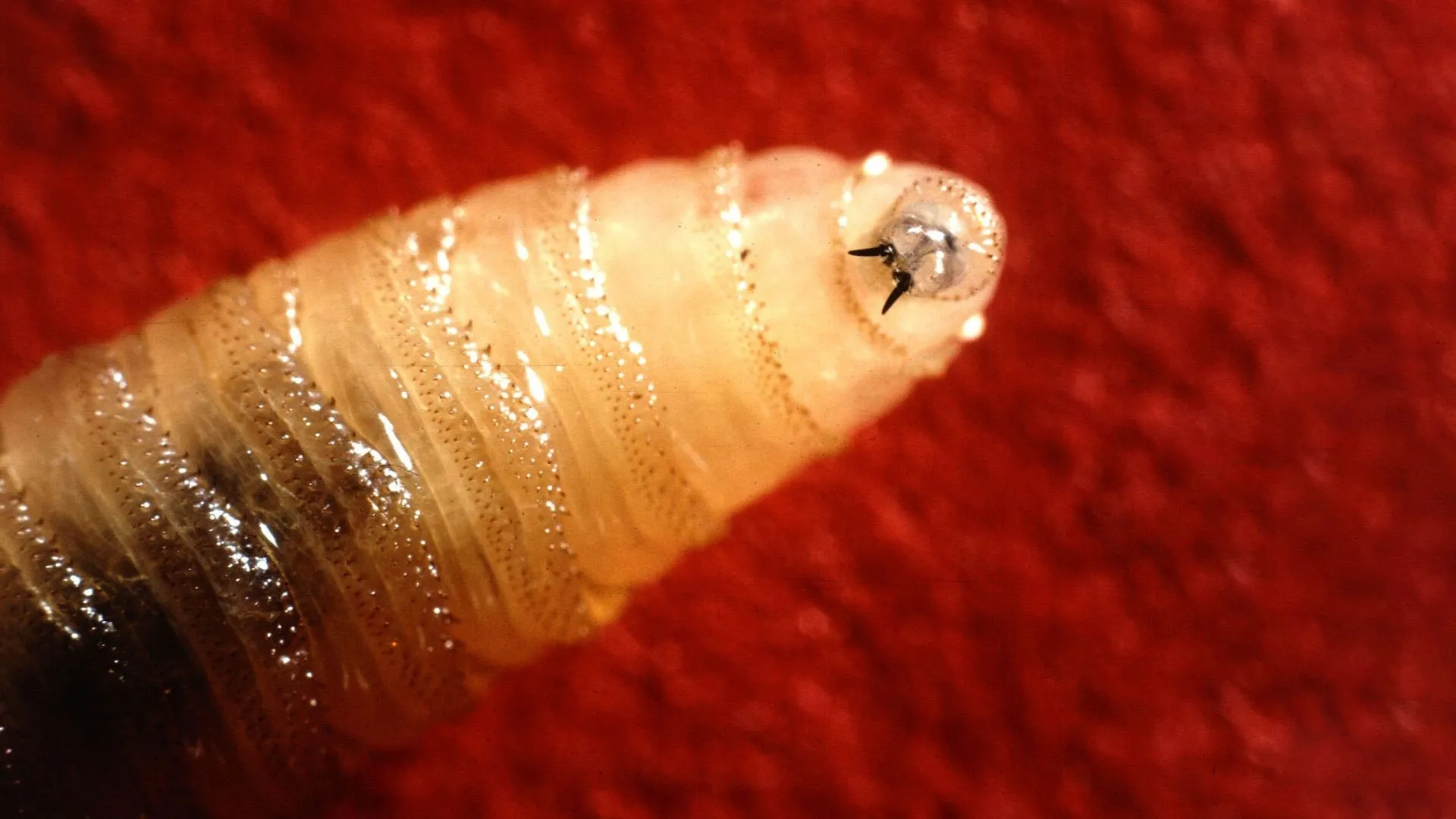
The unwelcome reappearance of the New World screwworm, a parasitic fly whose larvae feed on living flesh, has triggered significant concern across the United States, prompting a renewed focus on advanced surveillance and control strategies. This potent threat, which devastated U.S. livestock industries in the mid-20th century, causing an estimated annual economic toll of $50 million to $100 million in the Southwest alone during the 1950s, has now re-established a foothold north of its previous southern eradication boundary, with confirmed detections extending into Texas and New Mexico. The parasite’s re-emergence poses a multifaceted risk, impacting not only agricultural economies through livestock losses but also potentially endangering wildlife populations, domestic pets, and, in rare instances, human health.
In response to this escalating concern, researchers at the University of California San Diego, in collaboration with the County of San Diego Health and Human Services Agency (HHSA) Public Health Services, have developed a sophisticated digital tracking tool designed to provide enhanced situational awareness of the New World screwworm’s potential spread. This innovative dashboard aims to bolster the capacity of public health officials to anticipate and respond to emerging threats by offering regional risk profiles for the parasitic fly and its voracious larvae. The initiative stems from a direct request from county public health partners who identified a critical need for more agile and comprehensive monitoring capabilities.
The development of this dashboard exemplifies a successful model of academic and public health collaboration, mirroring the approach taken in previous critical environmental challenges. Dr. Eliah Aronoff-Spencer, a professor of medicine at UC San Diego School of Medicine and an affiliate member of the UC San Diego Design Lab and Qualcomm Institute, highlighted the project’s genesis, stating, "Our County public health partners alerted us to the need for better situational awareness of New World screwworm. We built a dashboard to generate regional risk profiles. This is just one example of how we are responding to County needs with a focus on real-world issues. It’s a model that has brought us great success, like the Tijuana River Crisis Environmental Dashboard."
This new surveillance platform synthesizes a variety of crucial data streams to estimate screwworm risk at a granular, county-by-county level across the nation. It meticulously integrates confirmed detection data with an analysis of environmental conditions conducive to the fly and its larvae, alongside information gleaned from media reports. The inclusion of news coverage represents a particularly forward-thinking aspect of the dashboard, potentially offering critical early warning signals that may precede formal reporting channels, thereby allowing for a more proactive public health response.
Initially, access to this advanced tracking tool is restricted to public health officials and designated partners directly involved in the project, ensuring that sensitive information is managed appropriately. However, the research team harbors aspirations of eventually releasing a publicly accessible version, democratizing access to this vital information and empowering broader community awareness and preparedness.
Dr. Seema Shah, Medical Director of the Epidemiology and Immunization Services Branch for the County of San Diego’s Public Health Services Department, underscored the innovative nature of incorporating media reports into the system. She noted, "Traditional reporting mechanisms for public health are often delayed. Lab confirmation can take days or weeks. By incorporating media reports, we can identify potential threats sooner and stay one step ahead." This integration addresses a common bottleneck in public health surveillance, where the lag time between detection and confirmation can significantly impact the efficacy of containment efforts.
The practical utility of the dashboard in strategic planning was further elaborated by Dr. Mark Beatty, Assistant Medical Director for the County’s Epidemiology and Immunization Services Branch. He explained, "The tool gives you a sense of where you might expect to see cases next. That’s helpful in determining how we should be preparing. Is the threat imminent, or do we have six months? We’re in a very concerning phase right now, and the tool backs that up." This predictive capability is invaluable for allocating resources, implementing preventative measures, and coordinating responses across different jurisdictions.
The biological characteristics of the New World screwworm distinguish it starkly from most other fly species. While the larvae of many flies are saprophytic, consuming dead or decaying organic matter, screwworm larvae exhibit a parasitic lifestyle, feeding exclusively on healthy, living tissue. Female screwworm flies deposit their eggs in open wounds or natural orifices of warm-blooded animals. Upon hatching, these larvae burrow into the host’s flesh, initiating a feeding process that progressively enlarges and deepens the wound. This parasitic activity not only causes significant tissue damage but also dramatically elevates the risk of secondary bacterial infections, which can be life-threatening. Left untreated, severe infestations can result in debilitating injuries or fatalities for livestock and wild animal populations.
While the New World screwworm poses a significant threat to animal health, human infections, though uncommon, are also a possibility. Unlike highly contagious infectious diseases, screwworm does not transmit directly from person to person. Instead, human exposure typically occurs when larvae gain entry into existing wounds or mucous membranes. Prompt removal of the larvae is crucial to prevent further tissue destruction and complications.
The expansion of the screwworm’s geographical range is facilitated by multiple vectors. Adult flies possess the capacity to travel considerable distances in their search for suitable hosts. Furthermore, infected animals, including livestock, pets, and various wild species, can inadvertently serve as carriers, transporting the parasite to new regions. Dr. Beatty expressed his apprehension regarding the speed of the pest’s northward progression, stating, "We knew in 2023 that New World screwworm was going to move northward, but I wasn’t expecting it to move as fast as it has. Although the source of the infections in the U.S. is still under investigation, the fact that it’s in the U.S. is 100% clear." He further observed, "Once it entered Texas, we quickly saw an increase in detections. It’s in a place where it used to live, so it’s not surprising it’s taking a hold again." This indicates a concerning resurgence in areas previously rendered screwworm-free.
The United States possesses a successful precedent in combating the New World screwworm. During the 1950s, a monumental eradication campaign employed a groundbreaking biological control method known as the sterile insect technique (SIT). This strategy involved the mass rearing and sterilization of male screwworm flies using radiation. These sterile males were then released into the environment, where they competed with wild males for mating opportunities. When wild females mated with sterile males, they produced no viable offspring, leading to a precipitous decline and eventual elimination of the wild population from the U.S. and pushing its range southward to Panama.
Drawing upon this historical success, contemporary eradication efforts are now being spearheaded by the U.S. Department of Agriculture (USDA). The current campaign integrates the sterile insect technique with the judicious application of pesticides and stringent quarantine measures designed to restrict the movement of potentially infected animals. Furthermore, authorities are pursuing approval from the U.S. Environmental Protection Agency for a genetically modified, all-male strain of sterile flies, which is currently undergoing field trials. Concurrently, researchers at UC San Diego are advancing next-generation genetic technologies that hold promise for enhancing future screwworm control and eradication initiatives.
Dr. Emily Trumbull, a veterinarian and lead for the Epidemiology Unit’s One Health Program, emphasized the collaborative nature of the current surveillance and response efforts. "We are working closely with the California Department of Food and Agriculture to connect local veterinarians with screwworm resources for surveillance in our region," she stated. "The flies can affect any warm-blooded animal, so working together with veterinarians serving livestock, pets and wildlife is critical for identifying suspect cases and preventing cases in people. The dashboard takes into account environmental factors that can help us understand how the risk to our local region is changing before the fly arrives. That’s why the dashboard is valuable." This "One Health" approach recognizes the interconnectedness of human, animal, and environmental health, underscoring the need for integrated surveillance and response strategies.
The screwworm dashboard is a product of Resilient Shield, a significant initiative at UC San Diego funded by the U.S. Centers for Disease Control (CDC) and led by Dr. Aronoff-Spencer and his co-principal investigators. Resilient Shield operates as one of 13 core facilities within Insight Net, a national network dedicated to the modeling of outbreaks and emerging disease threats. The underlying philosophy of this network is to align academic research directly with the urgent, real-world priorities identified by public health agencies.
This collaborative framework addresses a critical gap in public health preparedness. As Dr. Shah explained, "In public health, we always know our most urgent priorities, but too often we don’t have the immediate resources or in-house technical solutions to achieve them. The screwworm is a perfect example. It is a critical threat, but it is an issue our academic partners might never have prioritized without our direct ticket. This partnership solves our immediate problem while providing shareable, open reference designs that demonstrate exactly how public health, academia, and industry can successfully work together." This model ensures that research efforts are directly responsive to pressing public health needs, rather than operating in a theoretical vacuum.
Rather than relying on academic institutions to independently identify and prioritize the tools required by public health organizations, agencies facing immediate threats can submit direct requests to Resilient Shield. Beyond its partnership with San Diego County, Resilient Shield collaborates with entities such as the California Department of Public Health, the Navajo Nation, and various organizations within the broader Insight Net network, fostering a distributed and responsive research ecosystem.
The structural design of Resilient Shield is engineered to facilitate rapid deployment of specialized expertise from diverse institutions when novel public health challenges arise. The center’s inaugural request, submitted by Dr. Shah, focused on influenza tracking and was co-led by Dr. Ruy Ribeiro at Los Alamos National Laboratory. For the current screwworm threat, Dr. Aronoff-Spencer collaborated directly with Dr. Natasha Martin, a mathematical epidemiologist and professor of medicine at UC San Diego School of Medicine.
Moreover, Resilient Shield has cultivated a modular and scalable resource hub capable of adaptation to a wide spectrum of public health challenges. Through strategic alliances with technology partners such as Google and MITRE, the center aggregates and analyzes a vast array of data, encompassing human disease incidence, livestock health, environmental conditions, meteorological patterns, national health records, and social media sentiment.
When a new request is received, researchers can efficiently assemble the requisite analytical tools by drawing upon components from this shared repository. Depending on the specific nature of the problem, these assembled tools might include public-facing websites, social media engagement platforms, secure computational environments, sophisticated simulation engines, or advanced artificial intelligence agent builders.
"Our central innovation is the true convergence of partner priorities with scalable engineering," Dr. Aronoff-Spencer concluded. "We do not build in a vacuum. Our infrastructure is built directly on the priorities dictated by our partners. In addition, because our platform is built on an open, modular architecture, every solution we develop strengthens the system and makes it more adaptable for the next public health challenge." This iterative and collaborative development approach ensures that the tools created are not only effective for immediate needs but also contribute to a growing and increasingly robust public health technological infrastructure.
About the Author












