
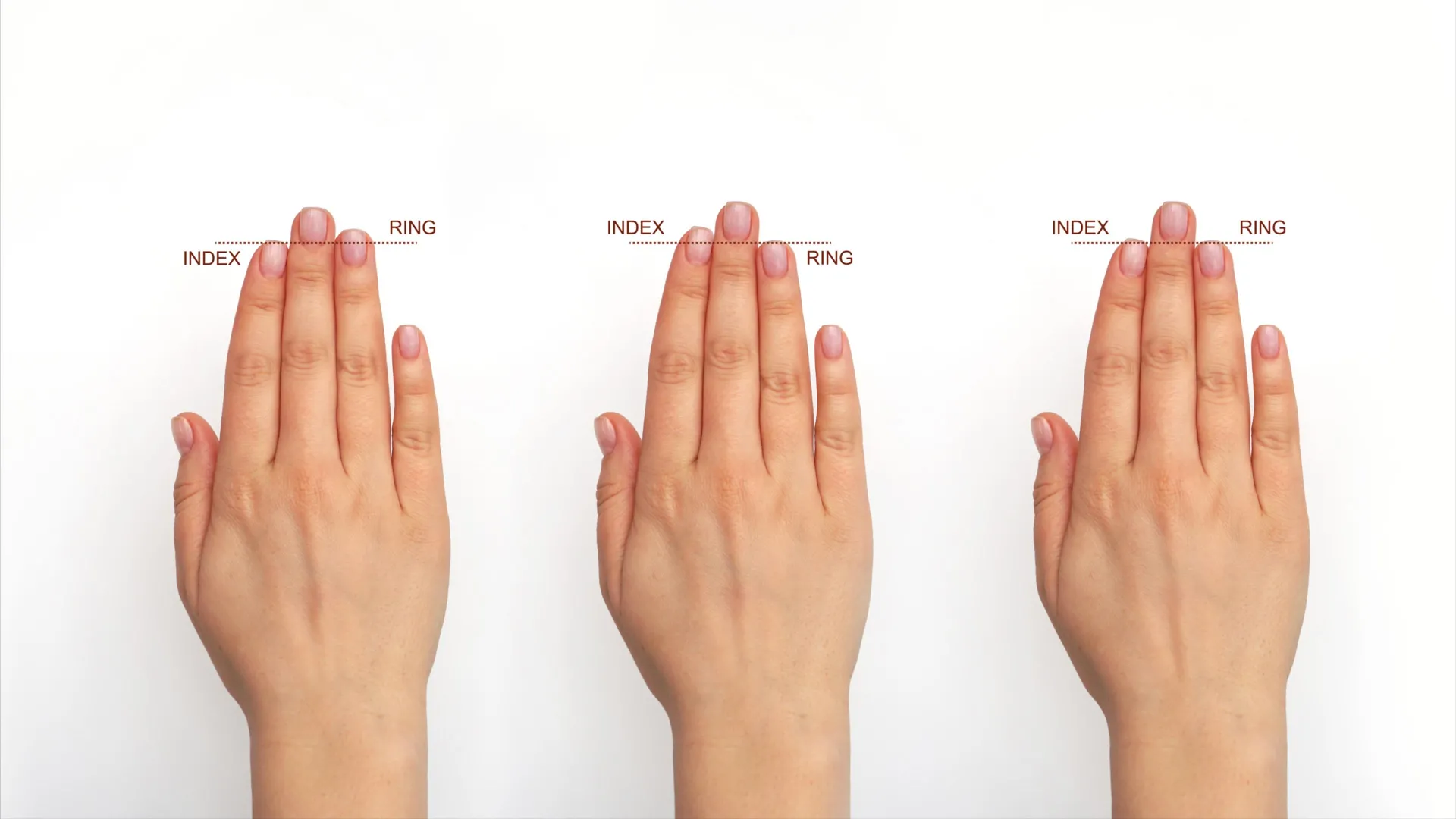
The intricate tapestry of human evolution, particularly the dramatic increase in cranial capacity, may be subtly woven with threads of prenatal hormonal exposure, with new research suggesting a fascinating link between fetal estrogen levels and the developing human brain. This hormonal signature, researchers propose, might even be discernible in the subtle proportions of our fingers, specifically the comparative lengths of the index and ring digits.
At the heart of this exploration is the concept of digit ratio, a metric that quantifies the relationship between the length of the second digit (index finger, or 2D) and the fourth digit (ring finger, or 4D). This measurement, often expressed as the 2D:4D ratio, has emerged as a potential, albeit indirect, proxy for the relative balance of androgenic and estrogenic hormones to which a fetus was exposed during its formative stages. The prevailing hypothesis posits that a higher 2D:4D ratio, characterized by a comparatively longer index finger relative to the ring finger, is indicative of greater prenatal exposure to estrogen compared to testosterone. Conversely, a lower ratio suggests a dominance of testosterone.
This line of inquiry has been significantly advanced by a collaborative study involving Professor John Manning, a key member of Swansea University’s Applied Sports, Technology, Exercise and Medicine (A-STEM) research group, renowned for his extensive work on digit ratio, and researchers from the Department of Anthropology at Istanbul University. Their latest findings, disseminated in the scientific journal Early Human Development, shed new light on the potential role of prenatal hormones in shaping human development, with profound implications for our understanding of evolutionary trajectories.
The research team meticulously examined a cohort of 225 newborns, comprising 100 males and 125 females, to investigate the correlation between their digit ratios and head circumference. Head circumference, a readily measurable parameter in infants, serves as a widely accepted proxy for brain size at birth. Furthermore, it has been correlated with subsequent cognitive development and intelligence quotient (IQ) scores, although it is crucial to acknowledge that numerous genetic, environmental, and developmental factors profoundly influence intellectual capabilities.
The analysis revealed a compelling pattern: male newborns exhibiting a higher 2D:4D ratio—a marker of greater prenatal estrogen exposure—also tended to display larger head circumferences. This observed association was notably absent in the female infants within the study group, suggesting a sex-specific influence of prenatal hormones on brain development as indicated by head size. This sex-differentiated correlation underscores the complex interplay between hormones and developmental pathways.
These findings lend considerable weight to the "estrogenized ape hypothesis," a theoretical framework that posits a co-evolutionary relationship between the expansion of the human brain and a gradual feminization of the human skeleton compared to that of earlier hominid ancestors. This hypothesis suggests that the evolutionary pressures driving increased brain size might have been accompanied by subtle shifts in skeletal morphology, rendering it less robust and more akin to female characteristics. Professor Manning elaborates on the evolutionary significance, noting that the observed correlation between higher 2D:4D ratios in males and aspects of skeletal feminization aligns with the predictions of this hypothesis.
The evolutionary implications are far-reaching. While increased brain size conferred significant advantages, potentially including enhanced cognitive abilities and social complexity, the hormonal milieu that facilitated this growth may have also presented certain biological challenges, particularly for males. Professor Manning points out that elevated prenatal estrogen levels in males, as indicated by a higher 2D:4D ratio, have been associated with a range of health concerns, including increased susceptibility to cardiovascular problems, lower sperm counts, and a predisposition to schizophrenia. However, he posits that the substantial evolutionary benefits derived from larger brains might have acted as a countervailing force, offsetting these potential disadvantages. Consequently, the evolutionary imperative for larger brains in humans could be intrinsically linked to a complex interplay of trade-offs, involving trade-offs that may have impacted male viability in certain respects.
The research team posits that the evolutionary advantage conferred by larger brains was likely so profound that it outweighed the associated biological costs. This perspective suggests that evolution often operates through such compromises, where significant gains in one area might be accompanied by costs in another, with the net benefit driving the evolutionary trajectory.
It is imperative to clarify that this study does not imply a direct causal link between finger length and brain size; rather, the digit ratio is interpreted as a potential marker, an echo of hormonal influences experienced during the critical prenatal period. The identified association provides a compelling new avenue for investigating how prenatal hormonal environments might have sculpted the evolutionary path of the human brain, contributing to the cognitive prowess that defines our species.
Professor Manning’s extensive prior research has explored the broader utility of digit ratio as a potential indicator across diverse physiological and behavioral domains. His previous investigations have delved into its association with factors such as prenatal alcohol exposure, outcomes following COVID-19 infection, and even oxygen consumption rates in elite footballers, highlighting the multifaceted potential of this seemingly simple biometric measurement as a window into complex biological processes and predispositions. This latest research further solidifies the role of digit ratio as a valuable tool in the ongoing quest to unravel the mysteries of human biology and evolution.
About the Author












