
As the global population ages, maintaining physical autonomy and quality of life in later years has become a paramount concern for individuals and public health systems alike. A significant physiological challenge accompanying advancing age is sarcopenia, a progressive and generalized skeletal muscle disorder characterized by accelerated loss of muscle mass, strength, and function. This decline often manifests subtly at first, perhaps as a slight increase in effort required to ascend stairs, a momentary lapse in balance, or difficulty rising from a seated position. However, left unaddressed, sarcopenia can lead to a cascade of negative outcomes, including increased risk of falls, diminished mobility, reduced metabolic health, and a profound impact on independence. The encouraging news, supported by extensive scientific research, is that muscular tissue retains a remarkable capacity for adaptation and rebuilding, even beyond the age of 65, when consistently stimulated with appropriate resistance and effort.
While dedicated gym environments offer a comprehensive range of equipment and expert guidance, they are not the sole avenue for effective strength development. For many older adults, logistical barriers such as travel time, perceived intimidation, or simply personal preference can make gym attendance less feasible. This highlights the immense value of accessible, time-efficient home-based exercise programs. When carefully curated with functional movements, such routines can yield comparable benefits to those achieved in a gym setting, provided the exercises are executed with proper form and progressive overload. The fundamental principle is to engage muscles sufficiently to provoke an adaptive response, then to repeat these sessions with enough regularity to foster cumulative progress in strength, coordination, and overall physical resilience.
A certified strength and conditioning specialist (CSCS) emphasizes that for older clients, the primary objective transcends mere exercise variety. Instead, the focus should be on consistent improvement in foundational movement patterns. Demonstrable enhancements in exercises like an incline push-up, a controlled reverse lunge, or a stable dead bug are tangible indicators that the body is effectively managing and generating force. These incremental gains are precisely what equip individuals to counteract the natural, age-related reduction in muscular power, balance, and overall physical tone, ultimately contributing to a more active and independent lifestyle.
To address these needs effectively, a concise yet potent 10-minute exercise protocol has been developed, integrating three fundamental movements performed across three rounds. The active work phase totals nine minutes, with the remaining minute allocated for brief transitions between exercises, ensuring a smooth flow and adherence to the overall time commitment. This structure prioritizes efficiency and effectiveness, making it an ideal choice for integrating regular physical activity into a busy schedule or for those new to structured exercise.
Executing the 10-Minute Rejuvenation Protocol
This program operates on a timed interval system: 45 seconds of active work followed by 15 seconds of recovery. Participants will cycle through the three specified exercises sequentially for a total of three complete rounds. The 15-second rest period is crucial for repositioning and preparing for the subsequent movement. Given that the dead bug exercise requires transitioning to and from the floor, the inherent flexibility in the 10-minute total allows for these necessary adjustments without disrupting the overall rhythm of the workout.
1. Incline Push-Up
- Primary Focus: The incline push-up is a highly effective compound exercise designed to strengthen the chest, shoulders, triceps, and core musculature from a posture-friendly angle. Its adaptability makes it particularly suitable for older adults.
- Benefits for Older Adults: This variation significantly reduces the strain on wrist and shoulder joints compared to traditional floor push-ups, while still building crucial upper body pushing strength. This strength is vital for daily activities such as pushing open heavy doors, rising from chairs, or preventing falls by bracing oneself. The adjustable angle allows for progressive challenge, making it accessible for varying fitness levels.
- Execution Guide:
- Stand facing a sturdy elevated surface, such as a kitchen counter, a robust table, or even a wall for beginners.
- Place your hands slightly wider than shoulder-width apart on the edge of the surface, fingers pointing forward. Your body should form a straight line from your head to your heels.
- Engage your core muscles to prevent your hips from sagging or arching your lower back.
- Bend your elbows, allowing them to track slightly backward and outward, as you lower your chest towards the elevated surface. Maintain control throughout the descent.
- Push through your hands to powerfully extend your elbows, returning to the starting position. Ensure the movement is fluid and controlled, avoiding any jerky motions.
- Key Form Tip: Actively maintain a rigid plank position with your body throughout the entire movement. Stop the descent just before you feel your hips begin to drop or your lower back arch.
- Progression Options: To increase difficulty, use a lower surface. For an easier modification, utilize a higher surface or a wall. Slowing down the tempo of each repetition also increases muscular time under tension and challenge.
2. Alternating Reverse Lunge
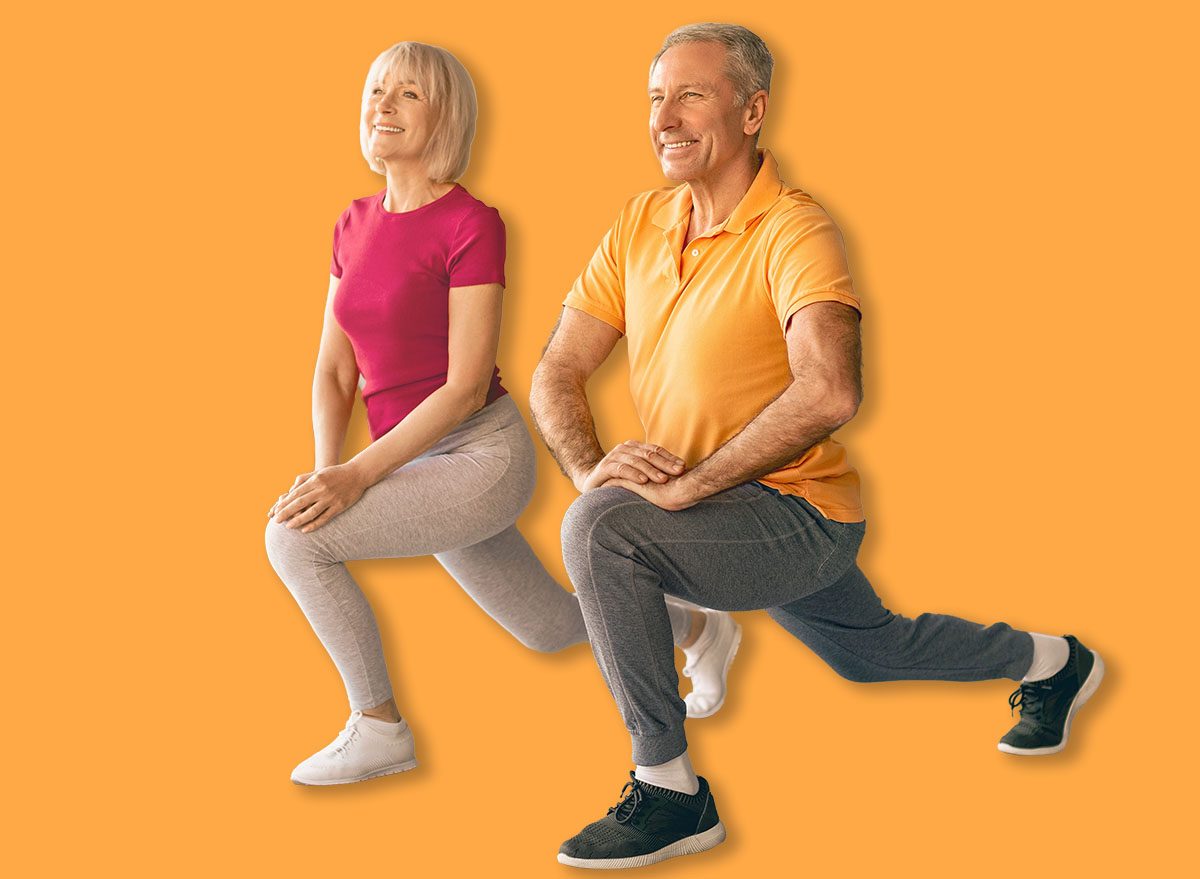
- Primary Focus: This exercise comprehensively targets leg strength, balance, and proprioceptive control, addressing these elements one step at a time. It primarily engages the quadriceps, glutes, hamstrings, and calves, while also challenging core stability.
- Benefits for Older Adults: The reverse lunge is often more manageable and safer for older adults than its forward counterpart because stepping backward typically places less strain on the knees and allows for easier recovery of balance. This movement directly enhances the strength and stability required for walking, climbing stairs, and safely navigating uneven terrain, making it a powerful tool for rebuilding lower-body function.
- Execution Guide:
- Begin in a standing position, feet hip-width apart, gaze directed forward.
- Take a controlled step backward with one foot, simultaneously bending both knees to approximately 90-degree angles. The front knee should remain stacked over the ankle, and the rear knee should hover just above the floor.
- Ensure your front heel remains firmly planted on the ground throughout the lunge.
- Engage your glutes and push through the heel of your front foot to return to the starting upright position.
- Alternate legs with each repetition, maintaining a steady and balanced rhythm.
- Key Form Tip: If balance proves challenging, perform the exercise near a sturdy support like a chair, wall, or counter. Consider taking a shorter step backward initially to enhance stability.
- Progression Options: To increase difficulty, reduce reliance on support or increase the depth of the lunge (as long as it remains pain-free). Slowing the tempo or holding light dumbbells can also add challenge. For a gentler version, perform partial range of motion lunges.
3. Dead Bug
- Primary Focus: The dead bug is an exceptional exercise for developing deep core strength and stability, emphasizing controlled limb movement while maintaining a stable trunk. It engages the deep abdominal muscles, obliques, and hip flexors.
- Benefits for Older Adults: Unlike high-impact abdominal exercises or prolonged planks, the dead bug effectively strengthens the core in a spine-friendly, supine position. A strong and stable core is paramount for maintaining good posture, preventing lower back pain, and significantly reducing the risk of falls by improving overall body control and balance.
- Execution Guide:
- Lie flat on your back on the floor, pressing your lower back firmly into the ground.
- Bring your knees up so they are bent at a 90-degree angle directly over your hips, with your shins parallel to the floor ("tabletop position").
- Extend your arms straight up towards the ceiling, directly over your shoulders.
- Slowly and deliberately extend one arm overhead while simultaneously straightening the opposite leg towards the floor. Crucially, ensure your lower back remains pressed into the ground throughout this extension; do not allow it to arch.
- Breathe out as you extend and breathe in as you return the arm and leg to the starting position.
- Alternate sides, performing the movement with control and precision.
- Key Form Tip: The paramount objective is to keep your rib cage and pelvis completely stable and anchored to the floor. If you notice your lower back beginning to arch, shorten the range of motion of your arm and leg extensions.
- Progression Options: To increase difficulty, extend the arm and leg further or hold the extended position briefly. For an easier modification, perform heel taps (tapping one heel to the floor at a time) or single-leg extensions without arm movement.
Progressing the Routine for Sustained Gains
Consistency is the cornerstone of any effective exercise regimen, particularly when aiming to reverse age-related muscle decline. This protocol is designed for implementation three to five days per week. The key to long-term success lies in the principle of progressive overload – continuously challenging your muscles as they adapt. When the current iteration of an exercise feels comfortably mastered, it’s time to introduce a small, incremental upgrade.
Consider these strategies for progression:
- Increase Duration or Repetitions: If you are comfortable with 45 seconds of work, you might gradually extend the work interval to 50 or 60 seconds, or focus on performing more controlled repetitions within the existing timeframe.
- Enhance Range of Motion: For exercises like lunges or dead bugs, if your current range is limited, gradually strive to achieve a fuller, yet still controlled, range of motion.
- Reduce Support: For the alternating reverse lunge, progressively decrease your reliance on external support (wall, chair) until you can perform the movement independently.
- Increase Resistance (Carefully): For incline push-ups, moving to a lower surface increases resistance. For lunges, holding light hand weights (e.g., water bottles, small dumbbells) can add challenge once balance is firmly established.
- Slow the Tempo: Performing movements more slowly, especially the eccentric (lowering) phase, significantly increases muscular engagement and challenge.
- Introduce Variations: Once proficient, explore the "best variations" listed for each exercise to introduce new stimuli.
Reversing the trajectory of muscle aging is not about achieving peak athletic performance; rather, it is about consistently providing your body with a compelling reason to maintain and build strength. By regularly engaging in fundamental pushing, lunging, and core-bracing movements, and by repeating this protocol with diligent consistency, the cumulative effect of these small improvements will seamlessly translate into greater ease, confidence, and independence in the myriad activities that constitute daily life. This compact, targeted approach offers a powerful pathway to sustained muscular vitality and enhanced well-being in the golden years.
About the Author










