The landscape of aging is undergoing a profound transformation, moving beyond the mere extension of lifespan to a dedicated focus on enhancing "healthspan"—the period of life spent in good health, free from chronic disease and disability. As global demographics shift, with a growing proportion of individuals living well into their later years, the conventional markers of physical fitness are being re-evaluated. Chronological age, once a primary determinant of physical capability, is increasingly understood as an insufficient measure of an individual’s true vitality and functional independence. Modern fitness professionals and gerontologists now emphasize a holistic approach, prioritizing the ability to perform daily activities with ease, confidence, and safety. This paradigm shift underscores the importance of functional fitness assessments, which gauge an individual’s capacity for movements integral to real-world living, rather than just isolated muscle strength or endurance.
Many experts in physical training observe that an individual’s physical prowess and resilience in their sixties can often surpass that of someone a decade younger, provided they have consistently engaged in activities that foster balance, muscular strength, cardiovascular endurance, and motor coordination. The human body demonstrates a remarkable adaptability to consistent physical engagement, irrespective of the number of years lived. Consequently, a person’s practical physical abilities offer a more insightful gauge of their overall well-being and potential for independent living than their birth year alone.
Rather than concentrating on specific muscle groups or performance benchmarks in a gym setting, a more pragmatic approach to evaluating comprehensive fitness involves functional standing exercises. These movements directly challenge the same physiological attributes individuals rely upon throughout their day, such as rising from a seated position, ascending stairs, transporting groceries, or regaining stability after an unexpected stumble. When an individual executes these movements with assuredness and precise control, it signifies an integrated bodily system, where various components collaborate effectively, rather than merely a collection of disparate muscles. These integrated qualities frequently hold greater significance for daily function than raw muscular power alone.
Over decades, professionals have utilized a series of four foundational standing assessments to provide a comprehensive overview of an older adult’s real-world functional fitness. These evaluations are not intended to highlight deficiencies but rather to identify areas of existing strength and pinpoint specific domains where targeted training can significantly enhance everyday ease and quality of life. Understanding these benchmarks can empower individuals to proactively maintain and improve their physical capabilities.
1. The Chair Stand Test: Foundation of Lower Body Function
The simple act of rising from a chair is a fundamental human movement, deceptively complex in its execution. Each time this action is performed, the muscles of the legs, hips, and core engage synergistically to overcome gravity and lift the body. This makes the chair stand test an invaluable functional fitness assessment. It closely mimics a ubiquitous daily activity, simultaneously revealing an individual’s lower-body strength, muscular endurance, and overall movement efficiency.
Individuals who perform this test proficiently typically exhibit enhanced stability in their gait, navigate staircases with greater comfort, and maintain a higher degree of personal autonomy. The ability to execute multiple repetitions of the sit-to-stand without undue effort is a clear indicator of well-preserved lower-body capacity. From a biomechanical perspective, this exercise heavily recruits the quadriceps, gluteal muscles, and hamstrings, while the core musculature provides essential trunk stabilization. A decline in the ability to perform this movement can be an early indicator of sarcopenia—age-related muscle loss—and a predictor of future mobility challenges, impacting everything from getting out of bed to standing up from a toilet. Maintaining strength in these muscle groups is paramount for preventing falls and preserving the ability to engage in a wide range of social and recreational activities.
2. The Standing March: Dynamic Balance and Gait Efficiency
While seemingly straightforward, the act of walking is a sophisticated interplay of strength, balance, coordination, and cardiovascular stamina. The standing march assessment effectively challenges each of these attributes, demanding continuous stabilization from the core and hip musculature. This particular evaluation is favored by trainers because it closely mirrors the rhythmic movement patterns essential for daily ambulation.
Clients who comfortably complete the standing march typically demonstrate robust functional endurance and exceptional control over their lower body. Crucially, maintaining upright posture throughout the duration of the test is as significant as merely completing it, as it highlights core stability and the body’s ability to resist gravitational forces during dynamic movement. This exercise specifically assesses the strength of the hip flexors, the coordination between reciprocal arm and leg movements, and the dynamic balance required to shift weight from one foot to the other. Deficiencies here can manifest as a shuffling gait, increased risk of tripping, or difficulty navigating uneven surfaces. The standing march also implicitly involves the vestibular system, which contributes to spatial orientation and balance, making it a critical indicator of the body’s integrated sensory-motor capabilities.
3. The Lateral Step: Crucial for Agility and Fall Prevention
A common oversight in many fitness regimens is the neglect of lateral (side-to-side) movement, despite its profound importance in preventing falls and navigating dynamic environments. The lateral step assessment concurrently measures hip strength, overall balance, agility, and motor coordination. This test is particularly insightful because it targets muscle groups—specifically the hip abductors and adductors—that often weaken with advancing age, simultaneously exposing stability deficits that might remain concealed during forward-only walking.
Individuals who execute smooth, controlled lateral movements generally experience heightened confidence when traversing crowded spaces or encountering uneven ground. Strong lateral mobility is frequently a distinguishing characteristic that sets highly functional older adults apart from their less active peers. Beyond simple muscle strength, this movement demands swift weight transfer, proprioceptive awareness (the body’s sense of its position in space), and reactive balance. The ability to quickly step sideways can be critical in avoiding obstacles, maintaining equilibrium when jostled, or stepping off a curb safely. Incorporating lateral movements into a routine can significantly bolster an individual’s capacity to react to unpredictable environmental challenges, thereby substantially reducing the risk of falls.
4. The Single-Leg Reach: An Integrated Test of Balance, Strength, and Flexibility
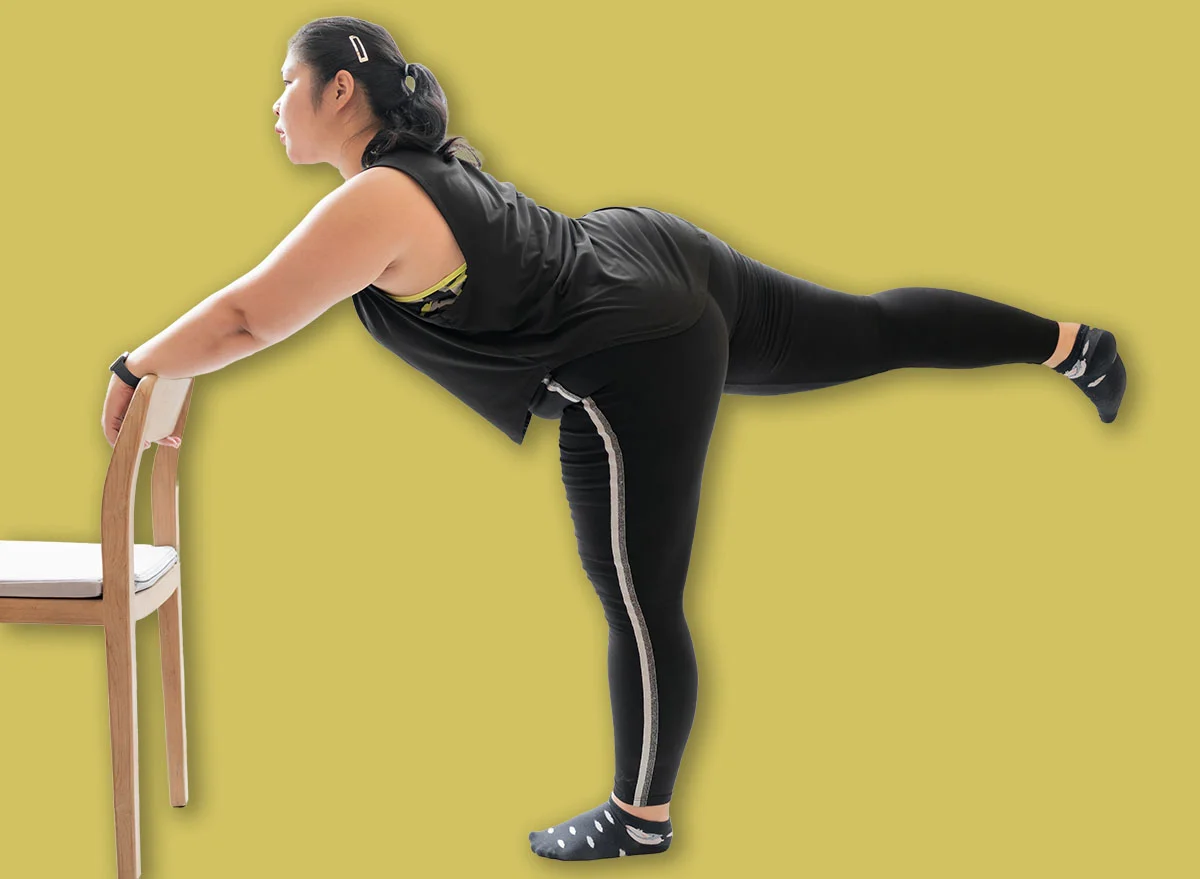
Concluding the series, the single-leg reach is a sophisticated movement that integrates balance, hip strength, flexibility, and coordination into a single, demanding challenge. Standing on one leg while simultaneously reaching forward requires the entire kinetic chain—from the ankle through the knee, hip, and core—to stabilize concurrently. Unlike a static one-leg balance test, the introduction of a dynamic reach more accurately simulates complex, real-life scenarios.
Clients who perform this exercise with confidence and control almost invariably demonstrate exceptional functional fitness, signaling efficient collaboration across their entire bodily system. This assessment probes the intricate interplay of ankle proprioception, core engagement for trunk control, and hip mobility to allow for a controlled lean and reach. It’s highly predictive of an individual’s ability to perform complex daily tasks, such as bending down to pick up a dropped object, stepping over a pet, or reaching into an overhead cabinet without losing balance. The single-leg reach offers a powerful diagnostic tool, highlighting not just isolated muscular strength but also the critical ability of the neuromuscular system to coordinate multiple movements under challenging conditions, a hallmark of robust functional independence.
Beyond the Assessment: A Pathway to Enhanced Healthspan
These four functional standing assessments collectively provide a powerful and practical lens through which to view an individual’s physical capabilities, particularly as they age. They are not merely pass/fail tests but rather valuable diagnostic tools that can illuminate strengths and pinpoint areas ripe for improvement. The insights gained from these evaluations can serve as a personalized roadmap for developing a targeted fitness regimen that emphasizes movements essential for maintaining independence and enhancing quality of life.
The overarching implication is clear: consistent engagement in exercises that mimic daily activities can significantly contribute to an individual’s "fitness age," often making it considerably lower than their chronological age. It underscores the vital message that age should not be viewed as an insurmountable barrier to physical capability, but rather as a stage where strategic and consistent movement can yield profound benefits. By focusing on functional strength, dynamic balance, and integrated body control, individuals can proactively invest in their long-term health, ensuring not just a longer life, but a more vibrant, independent, and fulfilling one. Consulting with a qualified fitness professional can provide tailored guidance, ensuring these assessments are performed safely and that subsequent training is optimally designed to meet individual needs and goals, fostering a sustained commitment to active living.
About the Author