In meticulously designed experiments conducted on delicate slices of murine brain tissue, these synthesized neural units demonstrated a remarkable capacity to elicit discernible responses from native neurons. This groundbreaking achievement signifies a significant leap forward in bridging the intricate gap between electronic technologies and the complex, dynamic architecture of living nervous systems. The implications of this development are far-reaching, propelling researchers toward the realization of sophisticated electronic interfaces capable of seamless integration with the human nervous system. Such advancements hold immense promise for the development of next-generation brain-machine interfaces and advanced neuroprosthetic devices, potentially restoring lost sensory or motor functions, such as sight, hearing, or movement, for individuals facing debilitating neurological conditions.
Beyond the realm of direct neural interfacing, this innovative technology also paves the way for a transformative new paradigm in computing, drawing profound inspiration from the inherent efficiency and architecture of the biological brain. By meticulously emulating the sophisticated communication mechanisms employed by biological neurons, future computational hardware could potentially tackle immensely complex tasks with an astonishingly reduced energy footprint. The human brain, a marvel of biological engineering, remains the undisputed benchmark for energy-efficient computation, and scientists are increasingly looking to its principles as a guiding force for the design of next-generation technological solutions. This research, set to be formally unveiled on April 15th in the esteemed scientific journal Nature Nanotechnology, represents a pivotal moment in this pursuit.
Mark C. Hersam, a leading figure at Northwestern University and the principal investigator of this transformative study, articulated the critical need for such innovations in the current technological landscape. "The world we inhabit today is increasingly shaped by artificial intelligence," Professor Hersam observed. "The prevailing method for enhancing AI capabilities involves training it on ever-expanding datasets. This data-intensive training process, however, results in an enormous and unsustainable power consumption challenge. Consequently, it is imperative that we devise more energy-efficient hardware architectures to manage the immense demands of big data and artificial intelligence. Given that the human brain operates with an energy efficiency that is five orders of magnitude greater than that of a conventional digital computer, it is profoundly logical to seek inspiration from its intricate design for the development of next-generation computing systems."
Professor Hersam, a distinguished expert in the burgeoning field of brain-inspired computing, holds a multifaceted academic portfolio at Northwestern University. He is the Walter P. Murphy Professor of Materials Science and Engineering at the McCormick School of Engineering, a professor of medicine at the Northwestern University Feinberg School of Medicine, and a professor of chemistry at the Weinberg College of Arts and Sciences. Furthermore, he presides over the department of materials science and engineering, directs the Materials Research Science and Engineering Center, and is a key member of the International Institute for Nanotechnology. This groundbreaking research was co-led by Vinod K. Sangwan, a research associate professor at the McCormick School of Engineering, underscoring a collaborative effort at the forefront of scientific discovery.
The fundamental disparity between the operational principles of modern silicon-based computers and the biological brain lies at the heart of this research. Conventional computing systems achieve their processing power by densely packing billions of identical transistors onto rigid, two-dimensional silicon substrates. Each of these components functions in a uniform manner, and once fabricated, the system’s architecture remains static. In stark contrast, the brain is a testament to biological complexity, comprising a vast array of neuron types, each endowed with specialized functions, intricately interwoven into flexible, three-dimensional networks. These neural networks are not static entities; they are dynamically reconfigurable, continuously forging and refining connections in response to learning and experience.
"Silicon-based computing achieves complexity through the sheer aggregation of billions of identical devices," Professor Hersam explained. "Every component is the same, rigid, and immutable once manufactured. The brain, however, represents the antithesis of this approach. It is characterized by its heterogeneity, its dynamic adaptability, and its three-dimensional organization. To progress towards computing architectures that can emulate this biological sophistication, we require novel materials and innovative fabrication methodologies."
While the concept of artificial neurons is not entirely new, many previous iterations have produced signals that are overly simplistic and lack the nuanced complexity of their biological counterparts. To achieve more sophisticated behaviors, researchers have historically relied on constructing extensive networks of these artificial devices, a strategy that invariably leads to increased energy expenditure. The Northwestern team’s breakthrough lies in their ability to imbue artificial neurons with a greater degree of functional complexity at a more fundamental level.
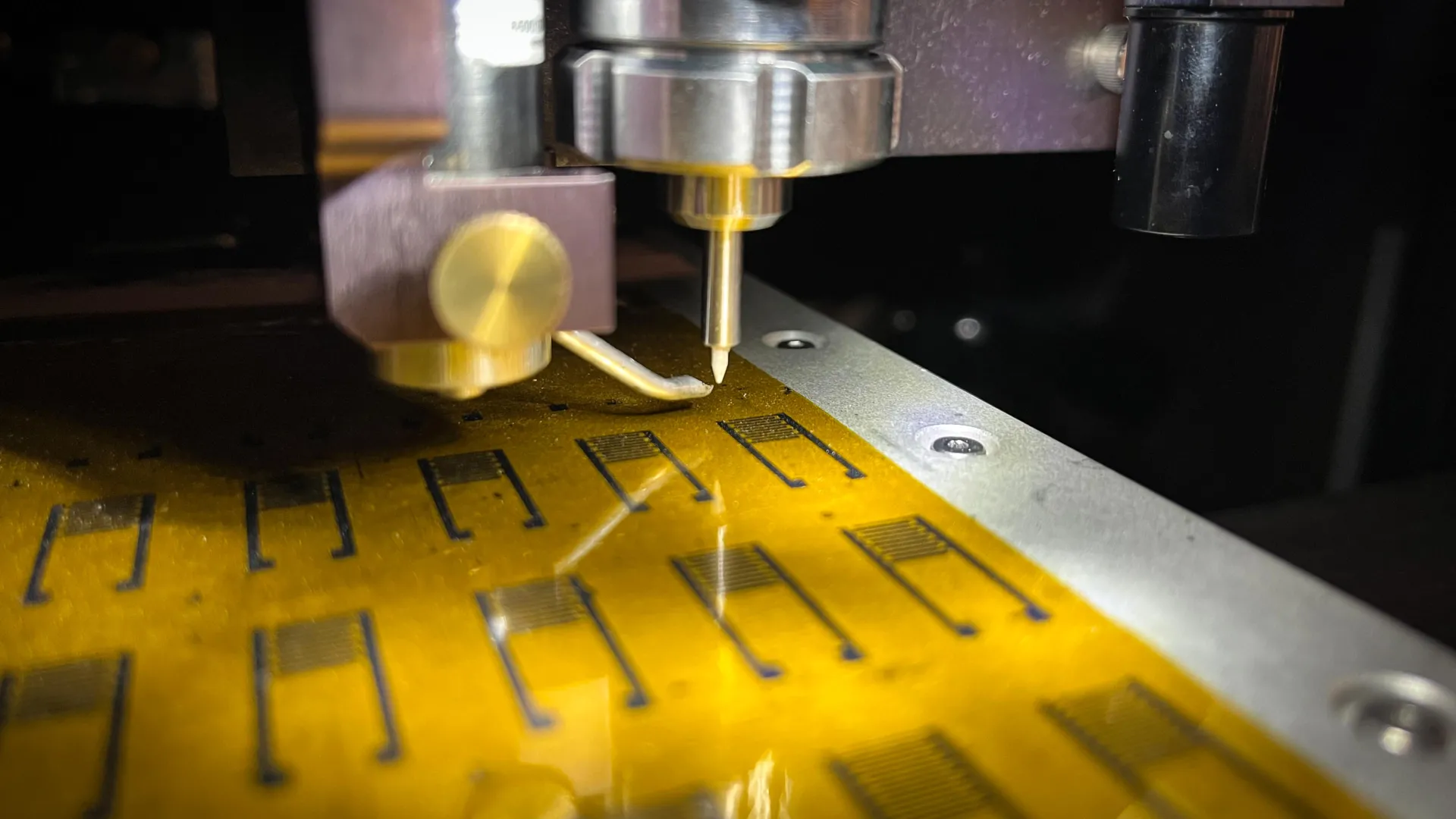
The key to replicating authentic neural activity with greater fidelity lies in the use of soft, printable materials that more closely approximate the inherent structural properties of the brain. The innovative approach developed by Professor Hersam’s team centers on the utilization of specialized electronic inks formulated from nanoscale flakes of molybdenum disulfide (MoS2), a material renowned for its semiconductor properties, and graphene, an exceptional electrical conductor. These advanced materials were meticulously deposited onto flexible polymer substrates using a sophisticated aerosol jet printing technique.
Historically, researchers have often viewed the polymer component within these electronic inks as a detrimental impurity, as it tended to impede optimal electrical performance. Consequently, it was typically removed post-printing. However, in a pivotal departure from conventional methods, this research team ingeniously leveraged this very feature to enhance the device’s functionality.
"Rather than completely eradicating the polymer, we opted for a controlled partial decomposition," Professor Hersam elaborated. "Subsequently, when an electrical current is passed through the device, this process induces further decomposition of the polymer. Crucially, this decomposition unfolds in a spatially heterogeneous manner, leading to the formation of a conductive filament. This phenomenon effectively constrains all the electrical current to flow through a remarkably narrow region within the device."
This precisely localized conductive pathway is instrumental in generating a sudden and distinct electrical response, strikingly analogous to the action potential, or "spike," characteristic of a neuron firing. The resultant artificial neuron is capable of producing a diverse spectrum of signaling patterns, encompassing single impulses, sustained firing, and intermittent bursting behaviors, all of which closely mimic the intricate communication modalities observed in natural neural networks. The ability of each artificial neuron to generate such multifaceted signals implies that a significantly reduced number of components would be necessary to perform advanced computational tasks, thereby offering a substantial improvement in overall computing efficiency.
To rigorously assess the potential for these synthesized neurons to interact meaningfully with living biological systems, the research team collaborated with Professor Indira M. Raman, the Bill and Gayle Cook Professor of Neurobiology at Weinberg College. Her team meticulously applied the generated artificial signals to delicate slices of the mouse cerebellum, a brain region critical for motor control and coordination.
The experimental outcomes were profoundly encouraging, revealing that the electrical spikes produced by the artificial neurons closely matched key biological parameters, including their precise timing and duration. These signals consistently and reliably activated the native neurons, initiating neural circuit activity in a manner remarkably similar to that observed during natural brain processes.
"Previous attempts by other research groups to create artificial neurons using organic materials often resulted in signals that fired too slowly," Professor Hersam noted. "Conversely, utilizing metal oxides often led to signals that were excessively rapid. Our synthesized neurons, however, operate within a temporal range that has not been previously demonstrated for artificial neuronal devices. The visual evidence of living neurons responding to our artificial neurons is compelling. We have thus succeeded in generating signals that not only align with the correct temporal scales but also possess the appropriate spike morphology to engage directly and effectively with living neurons."
Beyond the paramount importance of performance, this novel manufacturing approach presents a compelling array of environmental and practical advantages. The fabrication process itself is characterized by its inherent simplicity and cost-effectiveness. Furthermore, the additive printing methodology ensures that material is deposited only at the precise locations where it is required, thereby significantly minimizing material waste.
The imperative to enhance energy efficiency in computing is becoming increasingly critical as artificial intelligence systems continue to grow in complexity and computational demand. The vast energy consumption of large-scale data centers, which already requires substantial water resources for cooling, highlights the urgency of this issue.
"To satisfy the escalating energy demands of artificial intelligence, major technology corporations are investing in the construction of gigawatt-scale data centers, often powered by dedicated nuclear power plants," Professor Hersam stated. "It is abundantly clear that this colossal power consumption poses a fundamental limitation to the further scalability of computing, as it is difficult to envision future data centers requiring the equivalent of 100 nuclear power plants. An additional, critical concern is the substantial heat dissipation associated with the expenditure of gigawatts of power. Given that data centers rely on water for cooling, the immense power demands of AI are placing severe strain on global water supplies. From every perspective, the development of more energy-efficient hardware for AI applications is an undeniable necessity."
The findings of this pivotal study, titled "Multi-order complexity spiking neurons enabled by printed MoS2 memristive nanosheet networks," were made possible through the generous support of the National Science Foundation.
About the Author