
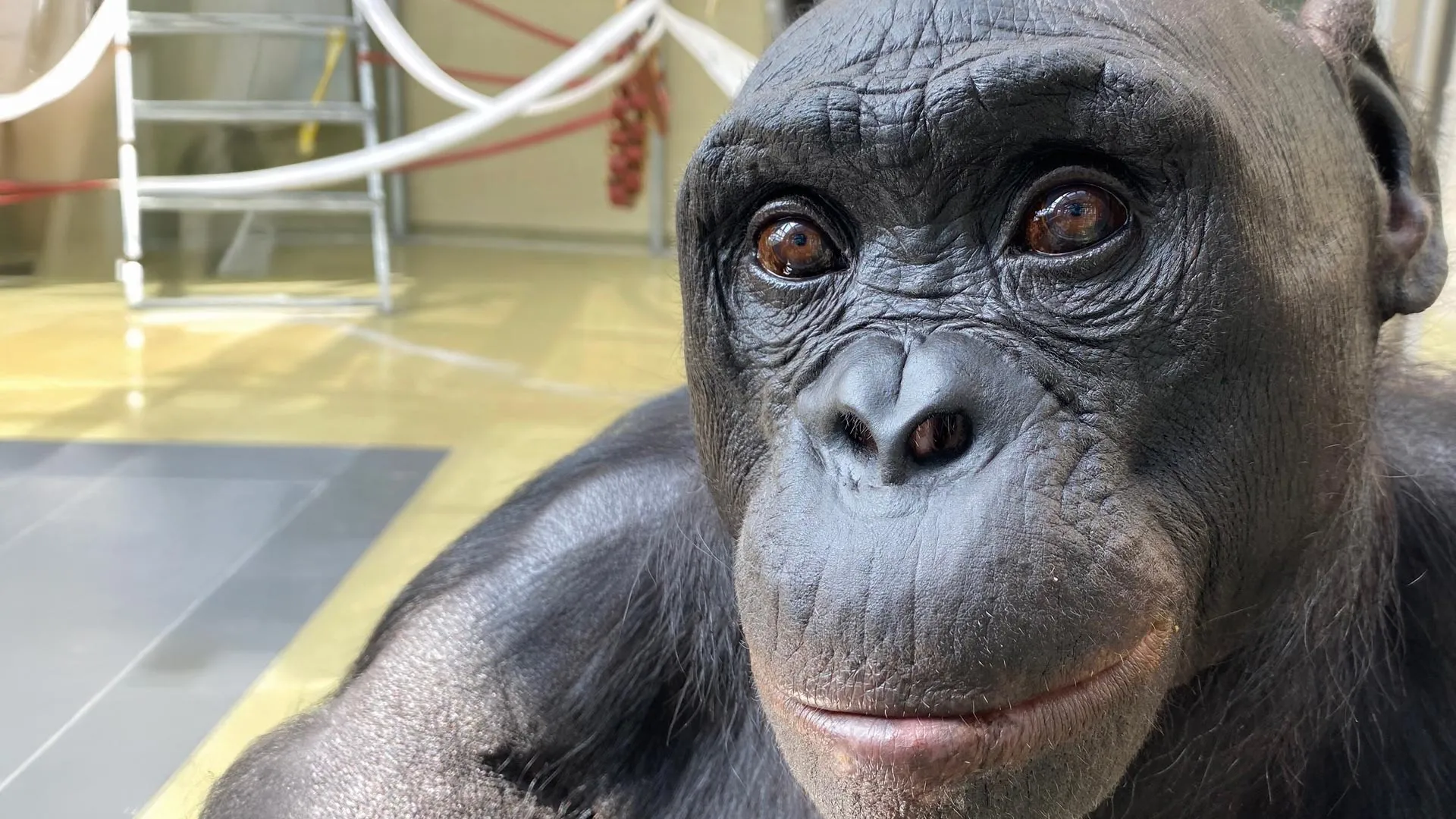
A groundbreaking series of experiments conducted at Johns Hopkins University has provided compelling evidence that a bonobo, through simulated social interactions akin to human children’s tea parties, can engage in imaginative thought and pretend play, abilities previously thought to be exclusively within the human cognitive domain. These meticulously designed studies, involving a single bonobo named Kanzi, have not only challenged long-held assumptions about the intellectual capacities of other species but also suggest a far greater cognitive flexibility in certain non-human primates than ever before demonstrated. The implications of this research extend to our understanding of the evolutionary origins of complex thought processes and our ethical considerations towards other intelligent life forms.
The research team, comprising Dr. Christopher Krupenye, an assistant professor in Psychological and Brain Sciences at Johns Hopkins, and Dr. Amalia Bastos, a former postdoctoral fellow at Johns Hopkins now lecturing at Scotland’s University of St. Andrews, embarked on a mission to scientifically investigate the presence of pretend play in non-human animals. Their work was motivated by the significant gap in controlled experimental data, despite numerous anecdotal observations of seemingly imaginative behaviors in both wild and captive primates. While young chimpanzees in their natural habitats have been observed carrying sticks as if they were infants, and captive chimpanzees have exhibited behaviors suggesting the manipulation of non-existent objects, these instances have lacked the rigorous scientific validation necessary to draw definitive conclusions.
The experimental design deliberately mirrored the familiar context of a child’s pretend tea party, a developmental milestone typically observed in human toddlers around their second year. Even infants as young as 15 months often display early indicators of understanding make-believe, reacting with surprise when a pretend action, such as emptying a cup, is not followed by the expected outcome. This established framework for studying pretend play in humans provided a solid foundation for the researchers to adapt for their primate subjects.
At the heart of the investigation was Kanzi, a 43-year-old bonobo housed at Ape Initiative, who had prior indications of exhibiting pretend behaviors and demonstrated an ability to comprehend and respond to spoken inquiries through a lexigram system. The experimental setup involved Kanzi seated opposite an experimenter at a table adorned with items suggestive of a social, playful activity, such as empty cups, pitchers, bowls, and jars.
The first phase of the experiment focused on Kanzi’s capacity to track an imaginary beverage. An experimenter placed two empty transparent cups and an empty transparent pitcher on the table. The experimenter then enacted a pretense of pouring liquid from the pitcher into both cups. Following this, the experimenter mimicked emptying one of the cups and gestured to indicate it was now empty, before posing the question, "Where’s the juice?" In a significant majority of trials, Kanzi consistently indicated the cup that was meant to still contain the simulated juice, even when the experimenter manipulated the positions of the cups.
To rigorously exclude the possibility that Kanzi was responding to some residual cue or misinterpreting the experimenter’s actions as indicating the presence of actual liquid, a second, crucial test was implemented. In this variation, one cup contained genuine juice, while the other contained only an empty space, representing the pretend juice. When presented with the choice and asked what he desired, Kanzi almost invariably selected the cup containing the real juice. This outcome strongly suggested that Kanzi could differentiate between a real substance and a simulated one, indicating a cognitive grasp of the "pretend" status of the juice.
Building upon the success with the imaginary juice, a third experiment replicated the core logic but employed pretend grapes as the focal point. The experimenter mimed eating a grape from an empty container, then placed this container into one of two jars. After theatrically emptying one of the jars, the experimenter inquired, "Where’s the grape?" Once again, Kanzi reliably indicated the jar that contained the imaginary grape. While Kanzi’s accuracy was not absolute, his responses demonstrated a consistent and statistically significant ability to discern the location of the pretend object.
The findings from these experiments carry profound implications for our understanding of animal cognition. Dr. Bastos articulated the excitement surrounding the data, stating, "It’s extremely striking and very exciting that the data seem to suggest that apes, in their minds, can conceive of things that are not there. Kanzi is able to generate an idea of this pretend object and at the same time know it’s not real." This capacity to mentally represent something that is absent or non-existent is a cornerstone of imaginative thought.
The researchers posit that this mental skill may have deep evolutionary roots, potentially tracing back 6 to 9 million years to the common ancestor shared by humans and modern apes. This ancestral capacity for imagination could have been a crucial factor in the subsequent cognitive divergence that led to the unique mental abilities of humans. The study, published in the esteemed scientific journal Science, represents a significant step forward in exploring the cognitive landscape of other species.
Dr. Krupenye emphasized the transformative nature of these findings, stating, "It really is game-changing that their mental lives go beyond the here and now. Imagination has long been seen as a critical element of what it is to be human but the idea that it may not be exclusive to our species is really transformative." He drew a parallel to Jane Goodall’s seminal work with chimpanzees, which revolutionized our definition of "human" by demonstrating tool-making capabilities in non-human primates. Similarly, this research compels a re-evaluation of what sets humans apart and prompts deeper consideration of the rich inner lives of other creatures.
These results are expected to catalyze further research into the cognitive abilities of other ape species and potentially a wider range of animals. The research team is keen to explore whether similar capacities for pretend play or the tracking of imaginary objects are present in other primates. Furthermore, they intend to investigate related cognitive functions that may be intertwined with imagination, such as the ability to anticipate future events or comprehend the mental states of others, often referred to as theory of mind.
The implications of this research extend beyond the scientific community, urging a reconsideration of our ethical obligations towards animals. Dr. Krupenye concluded, "Imagination is one of those things that in humans gives us a rich mental life. And if some roots of imagination are shared with apes, that should make people question their assumption that other animals are just living robotic lifestyles constrained to the present. We should be compelled by these findings to care for these creatures with rich and beautiful minds and ensure they continue to exist." This research underscores the interconnectedness of cognitive evolution and calls for a more profound respect for the complex mental worlds of our fellow inhabitants on Earth.
About the Author












