
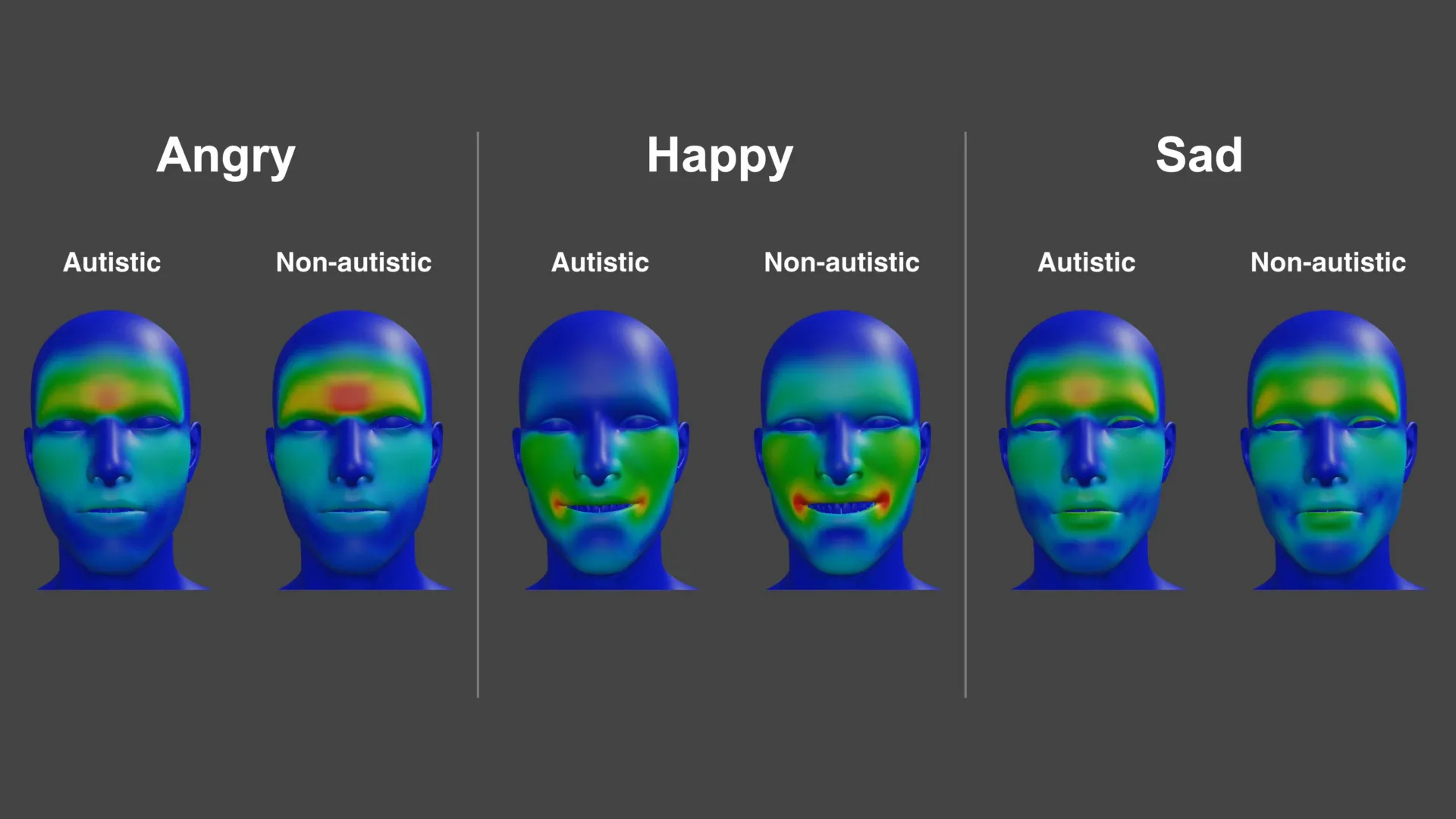
Groundbreaking scientific inquiry from the University of Birmingham has illuminated significant divergences in how autistic and neurotypical individuals utilize their facial musculature to convey emotional states, a discovery that may fundamentally reframe our understanding of interpersonal communication challenges within the autism spectrum. This comprehensive investigation, detailed in the esteemed journal Autism Research, meticulously mapped the intricate choreography of facial movements associated with core human emotions, generating an unprecedentedly granular dataset. Employing sophisticated facial motion capture technology, the research team meticulously documented over 265 million distinct data points, thereby constructing one of the most comprehensive digital archives of emotional facial kinematics ever assembled.
The study’s methodology involved a carefully curated cohort comprising 25 adults diagnosed with autism spectrum disorder and 26 neurotypical adults, all of whom contributed to the generation of nearly 5,000 individual facial expressions. Participants were systematically tasked with manifesting specific emotions, including anger, happiness, and sadness, under two distinct experimental conditions: first, by mirroring facial movements synchronized with auditory cues, and second, while engaging in verbal communication. The results unequivocally revealed discernible discrepancies in the expressive repertoires of the two groups. Notably, autistic participants exhibited a broader spectrum of unique facial configurations when portraying emotions.
Further analysis pinpointed specific patterns that consistently differentiated the groups. For instance, the subtle nuances in the activation and coordination of facial muscles responsible for conveying particular emotions were found to vary significantly. While neurotypical individuals often displayed more conventional and widely recognized patterns of muscle engagement for each emotion, the autistic participants’ expressions, while distinct, did not necessarily conform to these established norms. This suggests a fundamental difference not just in the outcome of the facial display, but in the underlying motor control and execution of those displays.
A critical dimension explored within this research was the pervasive influence of alexithymia, a psychological construct often co-occurring with autism, characterized by pronounced difficulties in identifying, processing, and articulating one’s internal emotional experiences. The study’s findings indicated a strong correlation between higher levels of alexithymia and less clearly defined facial expressions for emotions such as anger and happiness. This ambiguity in outward emotional signaling, stemming from internal processing challenges, likely contributes to the perceived inscrutability of these emotions in individuals experiencing significant alexithymia. The researchers hypothesize that this internal disconnect between felt emotion and its outward expression creates a communication barrier, making it more challenging for observers to accurately interpret the individual’s affective state.
The implications of these findings extend to the persistent challenge of emotional misunderstandings that frequently arise in interactions between autistic and neurotypical individuals. Dr. Connor Keating, the lead researcher on this project, who has since transitioned to the Department of Experimental Psychology at the University of Oxford, elaborated on the profound nature of these observed differences. His insights suggest that the disparities are not merely superficial; they represent a fundamental divergence in the very mechanics and temporal sequencing of facial expressions. "Our findings suggest autistic and non-autistic people differ not only in the appearance of facial expressions, but also in how smoothly these expressions are formed," Dr. Keating stated. He further posited that these observed mismatches in the generation and perception of facial cues may offer a compelling explanation for why autistic individuals often encounter difficulties in accurately recognizing the emotional expressions of neurotypical individuals, and conversely, why neurotypical individuals may struggle to interpret the emotional signals from autistic individuals. This bidirectional communication gap underscores the complexity of affective signaling.
Professor Jennifer Cook, the senior author of the study and a researcher at the University of Birmingham, underscored a crucial perspective: these observed differences should not be construed as indicative of a deficit within the autistic population. Instead, she advocates for a more nuanced understanding that acknowledges the validity of diverse expressive modalities. "Autistic and non-autistic people may express emotions in ways that are different but equally meaningful — almost like speaking different languages," Professor Cook explained. She further articulated that what has historically been misinterpreted as a communication deficiency on the part of autistic individuals might, in reality, represent a reciprocal challenge in mutual comprehension. The research team is actively pursuing this hypothesis, indicating that future investigations will delve deeper into this concept of a "two-way challenge" in understanding affective expressions, promising further updates as their work progresses. This reframing shifts the focus from a singular interpretation of "misunderstanding" to a more collaborative exploration of differing communication styles.
The extensive research underpinning these revelations received crucial financial backing from both the Medical Research Council (MRC) in the United Kingdom and the European Union’s Horizon 2020 Research and Innovation Programme, providing the necessary resources for such an ambitious and complex scientific endeavor. This multidisciplinary support highlights the recognized importance of understanding the neurological and psychological underpinnings of social interaction and emotional processing. The commitment of these funding bodies underscores a growing recognition of the need for detailed, evidence-based research to foster greater empathy and effective communication across diverse neurocognitive profiles. The long-term objective of such research is to foster a society where neurodiversity is not only accepted but understood, leading to more inclusive and supportive environments for all individuals. The detailed analysis of facial kinematics, coupled with an understanding of internal affective processing, offers a pathway toward developing more targeted interventions and educational strategies aimed at bridging these communicative divides. Ultimately, this study contributes significantly to the ongoing dialogue about neurodiversity and the intricate tapestry of human emotional expression.
About the Author












