As individuals progress through their sixties and beyond, maintaining physical vitality and addressing changes in body composition, particularly around the midsection, becomes a common area of focus. The natural aging process introduces a confluence of physiological shifts that can influence abdominal appearance and overall stability. These include sarcopenia, the age-related loss of muscle mass and strength; a deceleration in metabolic rate; alterations in hormonal balance; and often, a gradual reduction in daily physical activity. These factors, compounded by prolonged periods of sitting and cumulative postural habits, can collectively contribute to a perceived increase in lower abdominal prominence and a decrease in core functional capacity. For many, the vigorous, high-impact nature of traditional floor-based abdominal exercises, such as crunches or planks, can be challenging or even uncomfortable, potentially exacerbating joint pain in the wrists, spine, or hips, making consistent engagement difficult.
However, a highly effective and significantly more accessible approach lies in incorporating bed-based exercise routines. This methodology offers a unique solution to the common barriers faced by older adults, transforming the bed from a place of rest into a supportive platform for gentle yet impactful movement. Exercising in bed minimizes gravitational strain and provides a cushioned surface, reducing the impact on sensitive joints and the lumbar spine. This inherent support allows practitioners to concentrate more intently on precise muscle activation and controlled breathing patterns, fostering a stronger mind-muscle connection. The ease of access—being able to perform these movements first thing in the morning or as a calming activity before sleep—greatly enhances the likelihood of consistent adherence. It is this very consistency, rather than sporadic bursts of intense effort, that yields more profound and sustainable physiological adaptations over time, contributing to improved muscle tone, enhanced stability, and a more supported midsection.
Understanding the complexity of core health is paramount. The objective of cultivating a stronger and more streamlined midsection after 60 extends far beyond merely targeting the superficial abdominal muscles. A truly effective strategy acknowledges the interconnectedness of the entire kinetic chain, emphasizing the synergistic roles of the gluteal muscles, hip stabilizers, and deeper core musculature in maintaining optimal pelvic alignment and spinal integrity. When these posterior chain and deep stabilizing muscles are actively engaged and strengthened, the pelvis naturally adopts a more neutral and robust position. This realignment not only facilitates more efficient movement patterns throughout the day but also alleviates the compensatory burden often placed on the anterior abdominal wall, which can otherwise contribute to a protruded appearance. By addressing this foundational muscular support, the body achieves a more balanced distribution of workload, leading to improvements in both physical function and overall physique.
The following five gentle yet potent bed-based exercises are designed to foster comprehensive body engagement, enhance muscle resilience, and support the body’s natural capacity for fat utilization without resorting to high-intensity abdominal work. These movements are specifically tailored for individuals over sixty, emphasizing safety, efficacy, and ease of integration into a daily wellness regimen.
1. Glute Bridge Hold
The glute bridge hold is a foundational exercise that powerfully activates the posterior chain, which is critical for good posture and stabilizing the pelvis. Strengthening these muscles helps to anchor the lower spine and can contribute to a more supported and elongated appearance of the lower abdominal region by improving pelvic tilt. Sustaining the elevated position encourages full-body isometric tension and mindful respiration, enhancing core integration and muscular endurance without direct spinal compression.
- Muscles Engaged: Primarily targets the gluteus maximus, with significant involvement from the hamstrings, erector spinae (lower back stabilizers), and deep abdominal muscles like the transverse abdominis, which work to support the lumbar spine.
- Execution Guide: Begin by lying comfortably on your back on the bed, knees bent, and feet flat, positioned approximately hip-width apart. Ensure your heels are close enough to your glutes so you can comfortably touch them with your fingertips. With a controlled exhale, press through your heels and actively engage your glutes to lift your hips off the bed. Continue lifting until your body forms a straight line from your shoulders through your hips to your knees. Hold this peak position, consciously maintaining tension in your glutes and hamstrings. Avoid arching your lower back excessively; instead, focus on drawing your navel gently towards your spine.
- Recommended Protocol: Perform 3 sets, holding the elevated position for 20 to 30 seconds per set. Allow a 30-second recovery period between each set.
- Progression Options: To increase the challenge, consider a single-leg bridge (lifting one foot off the bed while holding the bridge), a bridge with a slight heel lift (to further engage hamstrings), or performing the bridge with arms extended overhead.
- Refinement Cue: As you lift your hips, visualize gently pulling your rib cage downwards towards your pelvis to maintain core engagement and prevent overextension of the lower back.
2. Heel Slides
Heel slides are a low-impact exercise that promotes smooth, controlled movement in the hip joint while maintaining full spinal support from the bed. This exercise is excellent for improving the coordinated action between the hips and the trunk, which is essential for restoring efficient walking mechanics and reducing stiffness. The gentle, repetitive motion also encourages healthy blood flow and enhances joint lubrication, making it an ideal choice for a morning mobility routine or an evening cool-down. Consistent practice can lead to improved hip control, which in turn reduces undue strain on the anterior pelvic and lower abdominal regions.
- Muscles Engaged: Works the hip flexors (e.g., iliopsoas), hamstrings (eccentrically as the leg extends), inner thigh adductors, and core stabilizers that prevent pelvic shifting.
- Execution Guide: Lie flat on your back on the bed with both legs extended straight. Maintain a neutral spine, gently drawing your navel inward. Slowly bend one knee, allowing your heel to slide along the surface of the bed towards your glutes. Control the movement, keeping your heel in continuous contact with the bed. Once your knee is fully bent, reverse the motion, slowly extending your leg back to the starting position. Focus on maintaining a relaxed upper body and stable pelvis throughout.
- Recommended Protocol: Complete 2 to 3 sets of 8 to 10 repetitions per side. Rest for 30 seconds between sets.
- Progression Options: Try alternating heel slides (one leg slides in as the other extends), performing double heel slides simultaneously, or incorporating a light resistance band around the feet for added challenge.
- Refinement Cue: Prioritize a slow, deliberate tempo for each slide, ensuring your hips remain anchored and steady against the bed’s surface, minimizing any rocking motion.
3. Bent Knee Fallouts
Bent knee fallouts are a superb exercise for cultivating hip control and pelvic stability without requiring dynamic bracing or traditional crunching movements. This exercise teaches the deep core and hip muscles to resist unwanted rotational forces, which translates into improved postural support during daily activities. It also effectively addresses stiffness in the hips and lower back by promoting controlled internal and external rotation. Regular engagement with this movement enhances intrinsic muscle tone while being exceptionally gentle on the joints.
- Muscles Engaged: Primarily strengthens the inner thigh (adductor group), outer hip (abductor group, including gluteus medius/minimus), and deep stabilizing muscles of the core, particularly the obliques and transverse abdominis, which prevent pelvic rotation.
- Execution Guide: Lie on your back on the bed with your knees bent and feet flat, positioned about hip-width apart. Keep your arms relaxed by your sides. While keeping your feet firmly planted and your spine neutral, slowly allow one knee to fall outwards towards the bed, controlling the movement from your hip. Crucially, resist any tendency for your pelvis to tilt or lift off the bed. The movement should be solely from the hip joint. Once you’ve reached your comfortable range of motion, slowly and deliberately bring the knee back to the starting upright position.
- Recommended Protocol: Perform 2 to 3 sets of 8 to 10 repetitions per side. Take a 30-second break between each set.
- Progression Options: Integrate slow-tempo fallouts (extending the time for both the outward and return phases), use a light resistance band around the knees for added challenge, or alternate sides continuously.
- Refinement Cue: Envision your pelvis as a heavy, immovable object firmly rooted to the bed, resisting any movement as your knee falls out.
4. Marching Bridge
Building upon the stability established in the static glute bridge, the marching bridge introduces a dynamic element by incorporating controlled leg movement. This variation significantly challenges balance, coordination, and unilateral hip strength while still benefiting from the supportive bed surface. It reinforces robust hip and core stability, which directly impacts how the lower abdominal region is supported and functions. The rhythmic, controlled lifting of each leg also improves confidence and capability in performing everyday tasks such as walking, climbing stairs, and maintaining balance.
- Muscles Engaged: Engages the glutes and hamstrings for hip extension, hip flexors for the leg lift, and a heightened activation of core stabilizers (especially the obliques and transverse abdominis) to resist rotation and maintain a level pelvis.
- Execution Guide: Begin in the standard glute bridge position, with your hips lifted off the bed, forming a straight line from shoulders to knees. Ensure your core is engaged and your glutes are squeezed. From this stable bridge position, slowly and deliberately lift one foot a few inches off the bed, as if you are marching in place. Focus on keeping your hips as steady and level as possible, avoiding any drop or tilt. Gently lower the foot back to the bed, then repeat the movement with the opposite leg.
- Recommended Protocol: Complete 2 to 3 sets of 6 to 8 repetitions per side. Allow a 45-second rest period between sets to recover.
- Progression Options: Incorporate marching bridge holds (holding one leg lifted for a few seconds), perform slow alternating marches for increased time under tension, or elevate your feet on a stable cushion or pillow for a greater range of motion.
- Refinement Cue: Imagine balancing a glass of water on your hips throughout the exercise; strive to keep it perfectly still and prevent any spillage.
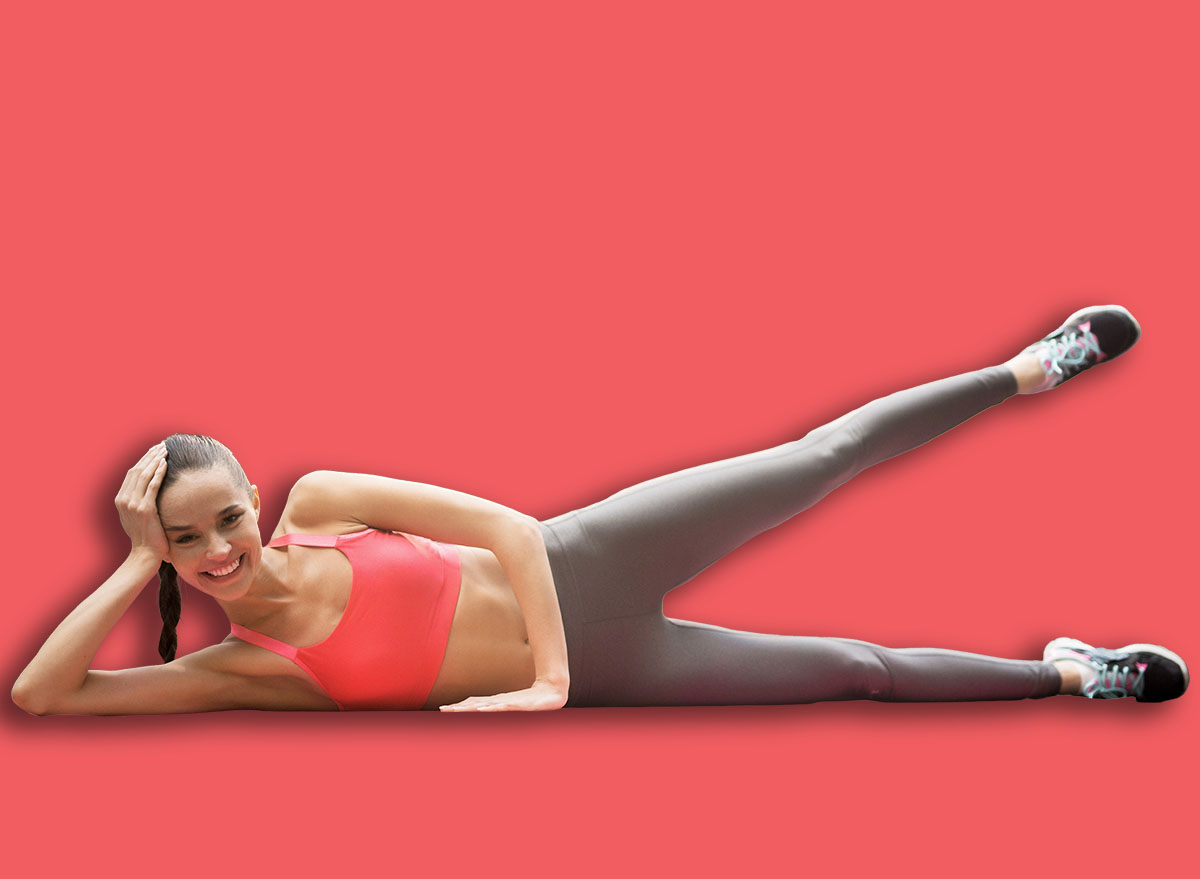
5. Side Lying Leg Lifts
Side-lying leg lifts are highly effective for isolating and strengthening the abductor muscles of the outer hips, particularly the gluteus medius and minimus. These muscles are fundamental for stabilizing the pelvis during walking and standing, playing a crucial role in maintaining proper alignment. When these outer hip muscles are weak, the body often compensates by placing undue stress on the lower back and anterior core. Strengthening them helps to redistribute muscular effort across the entire kinetic chain, leading to improved gait, reduced lower back discomfort, and a more supported, flatter midsection over time.
- Muscles Engaged: Primarily targets the gluteus medius and minimus (outer hips), with supporting engagement from the tensor fasciae latae, and internal/external oblique stabilizers to prevent trunk rotation.
- Execution Guide: Lie on your side on the bed, ensuring your body forms a straight line from head to heels. You can support your head with your lower arm or a pillow. Bend your bottom leg slightly for added stability. Your top leg should be extended straight, aligned with your torso. With a controlled motion, slowly lift your top leg directly towards the ceiling, leading with your heel rather than your toes. The movement should originate from your hip, not your lower back. Lift only as high as you can without tilting your pelvis or rolling forward/backward. Slowly lower the leg back to the starting position with control.
- Recommended Protocol: Perform 2 to 3 sets of 10 to 12 repetitions per side. Rest for 30 seconds between each set.
- Progression Options: Experiment with small range pulses at the top of the lift, extended holds at the peak contraction, or slow-tempo lifts to increase time under tension.
- Refinement Cue: Maintain a stacked hip position throughout the movement, as if your hips are perfectly aligned one directly above the other, and initiate the lift from your outer hip, driving with your heel.
Beyond Exercises: Comprehensive Daily Strategies for Midsection Support After 60
While targeted bed exercises are immensely beneficial, optimizing the appearance and function of the midsection after the age of sixty is a holistic endeavor that extends to everyday habits. These complementary strategies focus on fostering muscle tone, enhancing circulation, and improving overall postural integrity through consistent, mindful choices rather than intense, sporadic efforts.
- Prioritize Hydration: Adequate water intake is fundamental for countless bodily functions, including metabolism, nutrient transport, and maintaining satiety. Staying well-hydrated can also aid in reducing bloating and supporting healthy digestive processes. Aim for at least 8 glasses of water daily, adjusting based on activity levels and individual needs.
- Embrace Nutrient-Dense Nutrition: Focus on a balanced diet rich in whole, unprocessed foods. Incorporate lean proteins (essential for muscle maintenance), ample fiber (aids digestion and satiety), healthy fats, and a wide array of fruits and vegetables. Minimizing refined sugars, processed carbohydrates, and excessive sodium can significantly impact abdominal well-being and overall health.
- Integrate Mindful Movement: Beyond structured exercise, consciously seek opportunities to move throughout the day. Breaking up prolonged periods of sitting with short walks, gentle stretches, or simply standing up every hour can improve circulation, prevent stiffness, and gently engage core muscles. This consistent, low-level activity adds up over time.
- Cultivate Stress Management Techniques: Chronic stress elevates cortisol levels, a hormone linked to increased abdominal fat storage. Incorporate stress-reducing practices such as deep diaphragmatic breathing, meditation, spending time in nature, or engaging in hobbies. Managing stress supports metabolic health and can indirectly influence body composition.
- Ensure Sufficient, Quality Sleep: Sleep plays a critical role in hormone regulation, including those that control appetite and metabolism. Aim for 7-9 hours of uninterrupted sleep each night to support physical recovery, reduce cravings, and optimize the body’s fat-burning processes.
- Maintain Postural Awareness: Throughout the day, consciously check your posture whether sitting, standing, or walking. Actively lengthen your spine, engage your core gently, and avoid slouching. Good posture not only makes you appear taller and more confident but also naturally engages the deep core muscles, contributing to a more supported midsection.
When these integrated habits—combining targeted, gentle exercise with thoughtful lifestyle choices—work synergistically, the body responds with greater efficiency. Muscle strength and endurance improve, postural alignment becomes more optimal, and the lower abdominal region gradually reflects these positive changes, fostering both aesthetic improvement and enhanced functional independence. Embracing this comprehensive approach leads to sustainable well-being and vitality throughout the later decades of life.
About the Author