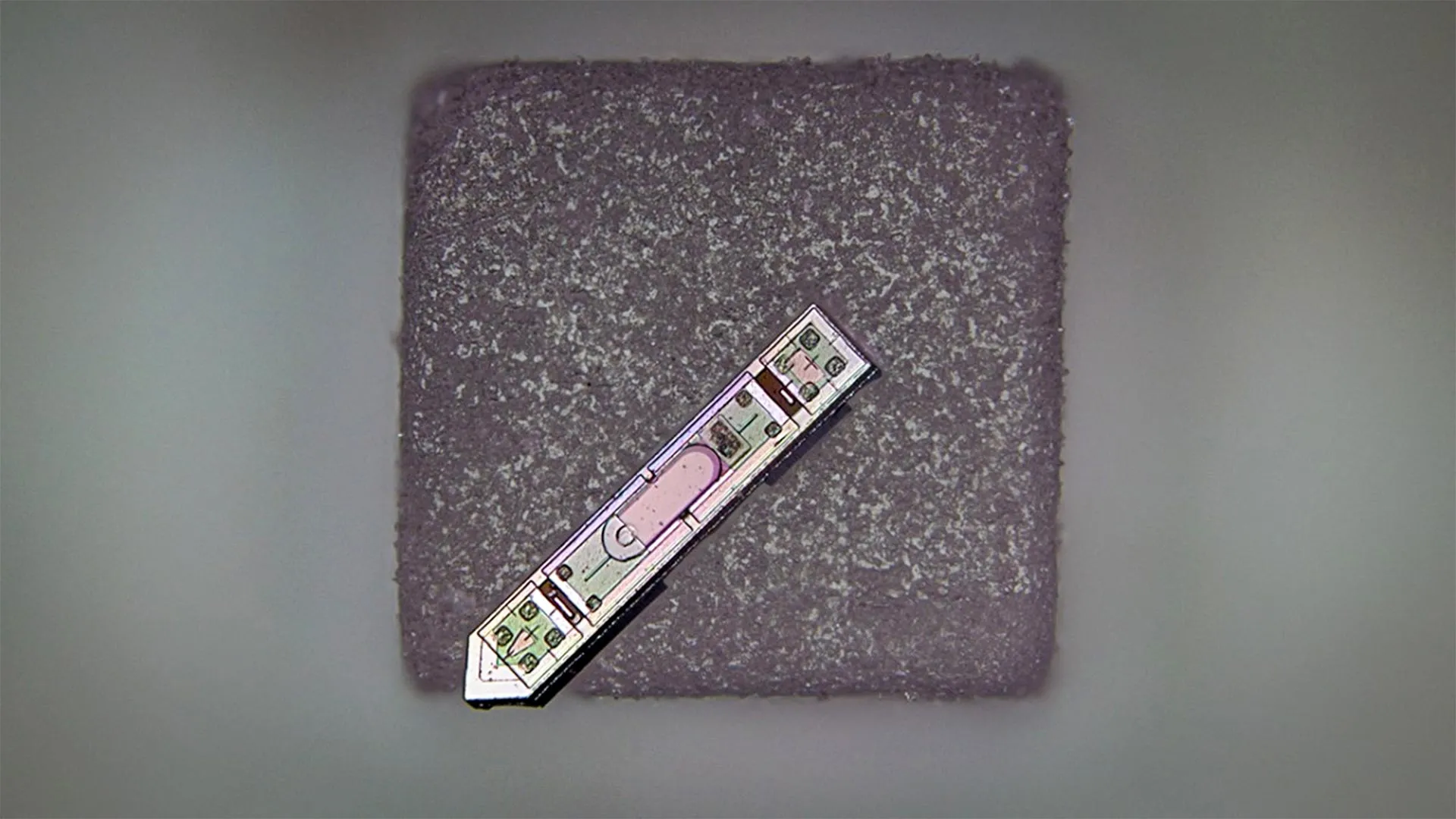
A groundbreaking advancement in bioelectronic engineering has yielded an implantable device so diminutive, it rivals the size of a single grain of salt, yet possesses the remarkable capability to wirelessly capture and transmit neural data from the brain of a living organism for over a year. This innovation, spearheaded by a collaborative team of researchers from Cornell University and Nanyang Technological University, represents a significant leap forward in the miniaturization of microelectronic systems, promising to unlock new frontiers in neurological research, the development of bio-integrated sensors, and a spectrum of advanced medical and technological applications.
The core of this technological marvel is a sophisticated piece of engineering christened the microscale optoelectronic tetherless electrode, or MOTE. The genesis of this project can be traced back to the visionary work of Professor Alyosha Molnar, a distinguished figure in Cornell’s School of Electrical and Computer Engineering, in collaboration with Assistant Professor Sunwoo Lee of Nanyang Technological University, who initially pioneered key aspects of this technology during his tenure as a postdoctoral researcher within Professor Molnar’s laboratory. Their combined expertise and relentless pursuit of miniaturization have culminated in a device that redefines the boundaries of what is possible in neural interfacing.
At the heart of the MOTE’s operational paradigm lies an ingenious application of light-based communication, circumventing the need for bulky external wires or power sources that have historically plagued neural implant designs. The device leverages safe, penetrating beams of red and infrared lasers, which traverse brain tissue without causing damage. Crucially, it transmits captured neural information back to external receivers by emitting minuscule pulses of infrared light. These light pulses are meticulously modulated to encode the electrical signals generated by brain activity, effectively translating the complex electrochemical language of the brain into a transmissible optical signal.
The internal architecture of the MOTE is a testament to cutting-edge semiconductor fabrication techniques. Central to its function is a precisely engineered diode crafted from aluminum gallium arsenide. This pivotal component serves a dual purpose: it efficiently absorbs incoming light, harnessing it as the primary power source for the entire system, and simultaneously emits outgoing light signals for data transmission. Complementing the diode are a low-noise amplifier and an optical encoder, both meticulously constructed utilizing the same high-performance semiconductor technologies commonly found in the fabrication of everyday microchips. This integration of sophisticated circuitry into an incredibly small form factor is a hallmark of the MOTE’s revolutionary design.
The physical dimensions of the MOTE are truly astonishing, measuring approximately 300 microns in length and a mere 70 microns in width. To put this into perspective, a micron is one-millionth of a meter, making this device significantly smaller than a typical strand of human hair. Professor Molnar underscored the unprecedented nature of this achievement, stating, "As far as we know, this is the smallest neural implant that will measure electrical activity in the brain and then report it out wirelessly." The efficiency of its communication system is equally remarkable. By employing pulse position modulation, a data encoding technique renowned for its efficiency and employed in demanding applications such as satellite optical communications, the MOTE achieves robust data transmission with exceptionally low power consumption, thereby extending its operational longevity in vivo.
The implications of this miniaturized, wirelessly communicating neural interface are profound and far-reaching. The unique material composition of the MOTE opens up unprecedented possibilities for simultaneous brain activity recording and advanced medical imaging techniques like Magnetic Resonance Imaging (MRI). Currently, the presence of conventional neural implants often interferes with MRI scans, limiting their utility in such diagnostic contexts. However, the MOTE’s materials are designed to be largely compatible with MRI environments, potentially enabling researchers and clinicians to gather high-resolution brain activity data concurrently with detailed anatomical imaging. This capability could revolutionize the study of neurological disorders and the monitoring of brain function during diagnostic procedures.
Beyond its immediate application in brain research, the foundational technology behind the MOTE is poised for adaptation across various physiological systems. Researchers envision its integration with other vital areas of the body, including the spinal cord, where it could provide invaluable insights into neural pathways and facilitate the development of advanced neuromodulation therapies. Furthermore, the ongoing evolution of bio-integrated electronics suggests a future where such microscale interfaces could be seamlessly incorporated into more complex constructs, such as artificial skull plates or other advanced prosthetics, creating truly integrated human-machine interfaces.
The development of the MOTE is not merely an incremental improvement; it represents a paradigm shift in how we can interact with and understand the intricate workings of the nervous system. By overcoming the size, power, and data transmission limitations of previous neural implant technologies, this tiny device has paved the way for more discreet, long-term, and less invasive methods of monitoring neural processes. Its potential to illuminate the complexities of brain function, aid in the diagnosis and treatment of neurological conditions, and serve as a building block for future bio-integrated technologies marks it as a landmark achievement in the field of neurotechnology. The ability to capture and transmit neural signals wirelessly from a device smaller than a grain of salt signifies a new era in our capacity to explore the biological frontier within our own bodies.
About the Author