Insects Exhibit Unforeseen Ingenuity in Novel Problem-Solving Scenarios
Bumblebees, long admired for their vital role in pollination, have now captivated the scientific community with an unexpected display of cognitive prowess, successfully navigating a complex, unlearned task that challenges long-held assumptions about the neurological underpinnings of problem-solving. This groundbreaking research, conducted by a collaborative team from Finland’s University of Oulu, University of Helsinki, and University of Turku, reveals a sophisticated capacity for spontaneous innovation in an invertebrate, pushing the boundaries of our understanding of animal intelligence.
For decades, the capacity for insight and spontaneous problem-solving, the ability to devise novel solutions to unfamiliar challenges without prior training or trial-and-error, was largely considered a hallmark of animals possessing relatively large and complex brains, primarily vertebrates. This perspective was significantly shaped by seminal work conducted over a century ago by psychologist Wolfgang Köhler. His famous experiments with chimpanzees, involving tasks such as stacking boxes to access out-of-reach food, provided compelling early evidence of this advanced cognitive function. These observations became cornerstones in the study of animal cognition, illustrating a remarkable ability to mentally manipulate objects and devise creative strategies in real-time.
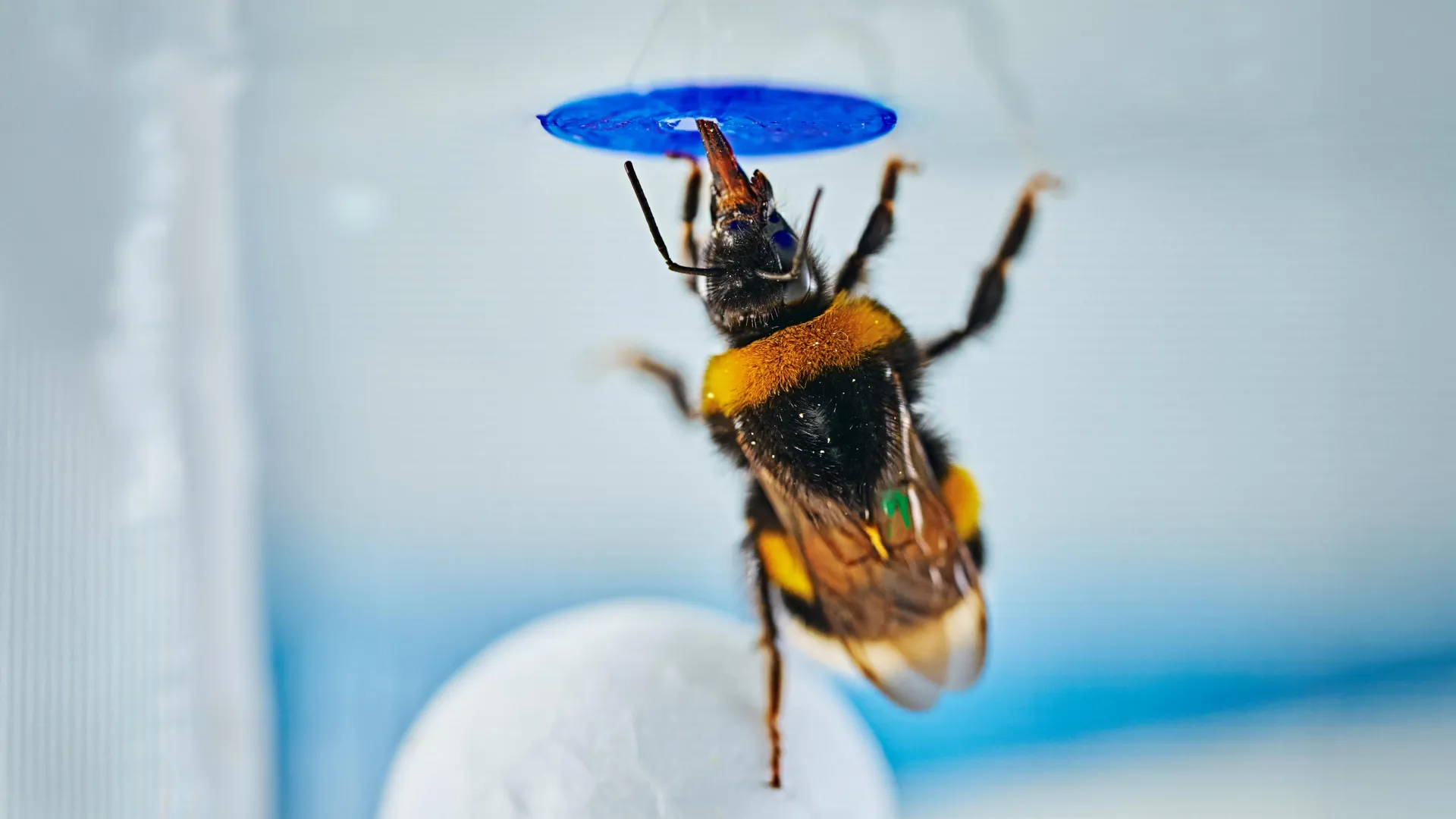
The recent investigation, detailed in the prestigious journal Science, directly confronts these established notions by demonstrating a comparable level of problem-solving acumen in the humble bumblebee (Bombus terrestris). Researchers presented the insects with a carefully constructed scenario that required them to devise an entirely original approach to obtain a valuable reward. Initially, the bees were trained to associate a specific visual cue – a blue artificial flower – with a sugary reward. In the critical experimental phase, this blue flower was strategically relocated to the ceiling of a transparent enclosure, rendering it inaccessible through conventional means.
Faced with this novel predicament, a significant proportion of the bumblebees exhibited an astonishing ability to devise a solution that went far beyond their learned behaviors. The successful individuals autonomously figured out how to retrieve a small, movable ball situated within the enclosure, position it precisely beneath the elevated flower, and then ascend the ball to reach the coveted reward. This intricate sequence of actions – the precise manipulation of an object to serve as a platform – was a behavior the bees had never been exposed to, nor had they received any form of instruction or reinforcement for performing it.
Senior author Olli Loukola, a Docent at the University of Oulu, drew a direct parallel between the bees’ challenge and Köhler’s classic "box-and-banana" experiments. He emphasized that the core of the problem lies in the animal’s realization that a seemingly independent object can be repurposed and utilized as a tool to overcome an obstacle. "What stands out about the result is that this kind of spontaneous problem-solving is now demonstrated in an insect," Loukola stated, underscoring the profound implications of finding such a complex cognitive feat in a creature with a vastly different neural architecture.
Lead author Akshaye Bhambore from the University of Oulu further highlighted the remarkable nature of this observed behavior, noting that the bees were not trained to interact with the ball in any specific way prior to the experiment. "Their behavior appeared goal-directed with successful individuals showing more directed movement patterns," Bhambore explained, indicating that the actions were not random but rather purposeful and oriented towards achieving the ultimate objective.
To rigorously validate their findings and to exclude any simpler explanations, the research team meticulously designed and executed a series of stringent control experiments. The bees were initially taught two distinct pieces of information: the association between the blue flower and a reward, and the fact that the ball was a movable, inert object. Crucially, they were never trained to use the ball as a means to access the flower. The subsequent success of many bees in combining these separate pieces of knowledge into a novel, functional strategy provided compelling evidence for flexible cognitive processing.
The researchers took great care to ensure the subjects were "fully naive" with respect to the problem-solving task itself, minimizing the influence of prior experience that could confound the results. Loukola elaborated on this point, stating, "In many previous studies of insight-like problem-solving, the animals have had extensive experience with objects, test environments, or other problem-solving tasks. Here, the bees had never been trained to use the ball to reach the flower, and they had no previous experience with this kind of solution." Furthermore, the experimental design was specifically engineered to preempt explanations rooted in accidental discovery, mere playful exploration, associative learning through repeated failed attempts, or simple visual cues guiding the bees to the solution.
In some of the more challenging control scenarios, the blue flower was deliberately obscured from view while the bees were manipulating the ball. This deliberate elimination of direct visual guidance meant that the bees could not simply navigate towards a visible target. Despite this added complexity, many bees still successfully transported the ball to the correct location, indicating an internal representation of the goal and a plan to achieve it. Bhambore affirmed the robustness of these findings, stating, "By analyzing the bees’ behavior across unusually stringent control experiments, we could show that they were not simply reacting to visual stimuli or moving the ball randomly."
The scientists involved in the study expressed a sense of awe at witnessing the bees’ problem-solving process firsthand. Ece Nur Akmeşe, a co-author from the University of Helsinki, described the experience as "genuinely fascinating," observing the rapid transition from seemingly undirected exploration to the execution of a precise and effective sequence of actions leading directly to the solution. This observation underscores the dynamic and emergent nature of problem-solving behaviors.
These findings contribute to an expanding body of evidence suggesting that bees, despite their minuscule brains – which contain roughly one million neurons compared to the billions found in humans – possess remarkably sophisticated cognitive capabilities. Prior research has already established their aptitude for social learning of tool use, their ability to navigate complex puzzle-like tasks, their capacity for cooperation, and their adaptability in altering their behavior in response to changing environmental conditions.
However, the researchers are careful to temper these revelations, emphasizing that the observed abilities should not be misconstrued as evidence of human-like consciousness or identical cognitive processes. "We are not claiming that bees think like humans," Loukola clarified. Instead, he proposed that "our findings show that miniature brains can generate flexible solutions to novel problems in ways we are only beginning to understand."
Collectively, the results of this study powerfully suggest that the capacity for spontaneous, goal-directed problem-solving can arise in organisms with brains significantly smaller than those of the vertebrates that have historically dominated intelligence research. Loukola concluded by positing that this research extends the conversation about spontaneous object-based problem-solving, a domain largely confined to vertebrates for over a century, to include insects, thereby broadening our evolutionary perspective on cognitive complexity. The study, officially titled "Spontaneous problem-solving in bumble bees," was authored by Akshaye A. Bhambore, Ece N. Akmeşe, Emma Håkkinen, Milla K. Jussila, Juha-Heikki Kantola, and Olli J. Loukola, and its publication in Science marks a significant milestone in entomological and cognitive science research.
Related posts:

Related News