As individuals progress beyond the age of 55, a natural physiological phenomenon known as sarcopenia begins to exert a more pronounced influence on the body. This age-related, involuntary loss of skeletal muscle mass, strength, and function represents a significant challenge to independent living and overall quality of life. Far from being a mere aesthetic concern, sarcopenia contributes to reduced metabolic rate, diminished balance and coordination, increased susceptibility to falls, and a heightened risk of various chronic health conditions. While traditional strength training methods are universally recommended, a growing body of evidence, reinforced by expert coaching experience, suggests that a focus on integrated, multi-joint, functional movements utilizing free weights often yields more comprehensive and enduring benefits for older adults than reliance on isolated exercises performed on gym machines.
The decline in muscle tissue in later adulthood is not an inevitable surrender of the body’s capabilities; rather, it frequently stems from a confluence of factors, including reduced physical activity, decreased neuromuscular tension, and a general tapering of daily physical exertion. Many individuals seeking to counteract this decline gravitate towards gym equipment, believing it offers a safer and more controlled environment. However, many fixed-path resistance machines, while seemingly convenient, can inadvertently limit the true scope of muscle engagement and functional development. These devices typically stabilize the torso, guide the weight through a predetermined trajectory, and minimize the demand on crucial stabilizing muscles in the core, hips, and shoulders. This reduction in stabilizing work means that fewer muscle fibers are activated, and the body learns to produce force in an artificial, isolated manner, which often fails to translate effectively to real-world movements.
For adults navigating the challenges of aging, the objective extends beyond mere muscle contraction; it encompasses the cultivation of integrated strength that compels the entire musculoskeletal system to operate synergistically. This holistic approach is where genuine physiological restoration and enhancement of functional capacity truly emerge. By prioritizing movements that mirror activities encountered in daily life—such as lifting groceries, climbing stairs, maintaining balance, or rising from a chair—individuals can stimulate a broader spectrum of muscle fibers, improve intermuscular coordination, and build resilience that directly supports independence and vitality. These types of exercises not only foster significant muscle hypertrophy but also enhance proprioception (the body’s sense of self-movement and position), bone density, and metabolic efficiency more effectively than many machine-based circuits. The key lies in executing these movements with precision, gradually increasing resistance, and maintaining diligent form, thereby unlocking the body’s innate capacity for rejuvenation.
Understanding the Limitations of Machine-Based Training for Older Adults
While gym machines have their place in a diverse fitness regimen, their design often works against the specific needs of an aging body. The seated or supported positions characteristic of many machines can diminish the engagement of critical core musculature, which is vital for spinal stability and balance. Furthermore, the single-plane, guided motion of these devices often neglects the multi-directional demands of real-life activities. For instance, a leg press machine strengthens the quadriceps and glutes in a linear fashion, but it does little to improve the stability needed when walking on uneven terrain or quickly shifting weight to prevent a fall. The absence of a requirement for the body to self-stabilize means that essential neural pathways responsible for coordination and balance remain largely untrained. As such, while muscle isolation might be achieved, the development of integrated, functional strength—the kind that truly enhances life quality—is often compromised.
The Foundational Principles of Functional Strength Rebuilding
To effectively combat sarcopenia and cultivate robust functional strength, the focus shifts to exercises that challenge the body to move as a cohesive unit, engage multiple joints simultaneously, and demand active stabilization. These movements promote not just muscle growth but also improvements in neuromuscular efficiency, balance, and coordination. The principles guiding this approach include:
- Multi-joint movements: Prioritize exercises that involve the movement of more than one joint (e.g., a squat involves hip, knee, and ankle flexion/extension).
- Standing patterns: Performing exercises while standing increases the demand on core stabilizers and improves balance, directly translating to daily activities.
- Unilateral work: Incorporating single-limb exercises enhances balance, addresses muscular imbalances, and increases the load on each limb.
- Progressive overload: Gradually increasing the resistance (weight), repetitions, or sets over time is crucial for continued muscle adaptation and growth.
- Intentional movement: Focusing on the quality of movement, mind-muscle connection, and full range of motion maximizes recruitment and safety.
- Consistency: Regular practice is paramount for achieving and maintaining results.
By adhering to these principles, older adults can embark on a transformative journey to reclaim and enhance their physical capabilities. The following five dumbbell exercises exemplify this functional approach, targeting major muscle groups while concurrently improving stability, coordination, and overall strength.
1. Dumbbell Romanian Deadlift (RDL)
The Romanian Deadlift is an exceptionally potent exercise for fortifying the posterior chain, a collective term for the muscles running along the back of the body, including the glutes, hamstrings, and erector spinae (spinal stabilizers). These muscle groups are particularly susceptible to atrophy with age, impacting everything from posture to the ability to lift objects safely. The RDL teaches a fundamental human movement pattern: the hip hinge, which is essential for bending over without straining the lower back. By mastering this movement, individuals can generate power from the ground up, crucial for tasks like gardening, picking up grandchildren, or even simply standing up from a low chair.
- Execution: Begin by standing tall with a dumbbell in each hand, palms facing the body, and a slight bend in the knees. Initiate the movement by pushing the hips backward as if reaching for a wall behind you, allowing the torso to hinge forward while maintaining a neutral, straight spine. Keep the dumbbells close to the legs throughout the descent. Lower until a stretch is felt in the hamstrings, typically when the torso is roughly parallel to the floor or slightly above, ensuring the back remains flat. Drive through the heels, squeezing the glutes forcefully, to return to the upright starting position, bracing the midsection firmly as you stand. The controlled lowering phase is as important as the upward drive for muscle recruitment and spinal protection.
2. Standing Dumbbell Reverse Lunge
Unilateral (single-leg) training is a cornerstone of functional strength, and the reverse lunge stands out as an outstanding exercise for rebuilding lower-body strength and enhancing balance, a critical component that often diminishes concurrently with muscle mass. Unlike forward lunges, the backward stepping motion of a reverse lunge tends to place less stress on the knee joint while still effectively recruiting the glutes and quadriceps. This movement mimics natural walking and stair-climbing patterns, directly improving gait stability and the power required for navigating uneven surfaces.
- Execution: Hold a dumbbell in each hand, standing with feet hip-width apart. Take a controlled step backward with one leg, lowering the hips until both knees are bent at approximately a 90-degree angle. The front knee should remain aligned over the ankle, and the back knee should hover just above the floor. Maintain an upright torso throughout the movement. Drive powerfully through the heel of the front foot to return to the starting standing position, bringing the back leg forward. Alternate legs with each repetition, focusing on smooth, controlled descent and ascent to build both strength and coordination.
3. Dumbbell Push Press
Upper-body musculature, particularly in the shoulders and triceps, can experience accelerated atrophy in older adults. The dumbbell push press is a dynamic, full-body exercise that not only restores mass in these upper-body regions but also integrates lower-body power. Unlike seated shoulder presses, which isolate the upper body, the push press leverages momentum from a slight knee dip, forcing the legs and core to contribute significantly to the movement. This synchronized drive stimulates a greater number of muscle fibers across the body, fostering more comprehensive strength gains and enhancing the ability to perform overhead tasks without discomfort or strain.
- Execution: Stand with feet shoulder-width apart, holding a dumbbell in each hand at shoulder height, palms facing forward. Begin by performing a slight, quick dip at the knees, engaging the lower body. Immediately, in a fluid motion, drive explosively upward from the legs and press the dumbbells overhead until the arms are fully extended, bracing the core throughout. Lower the dumbbells back to shoulder height with control before initiating the next repetition. This coordinated sequence builds explosive power and integrates upper and lower body strength more effectively than isolated pressing movements.
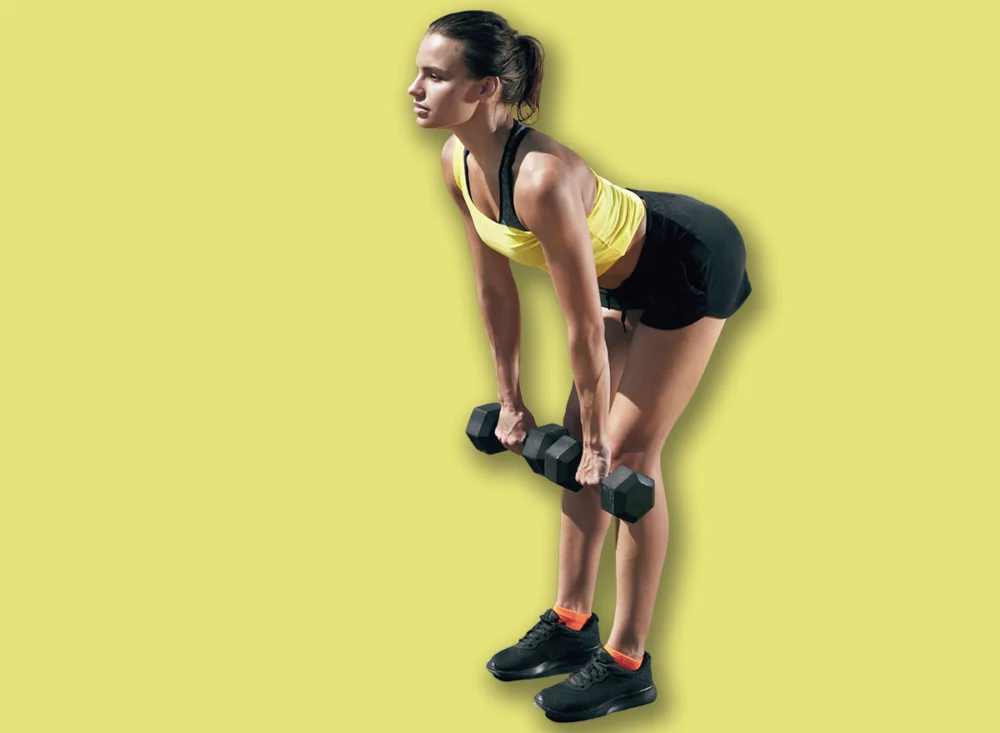
4. Dumbbell Bent-Over Row
A robust and stable back is fundamental for maintaining good posture, preventing injuries, and supporting overall upper-body strength. Many machine-based rowing exercises often minimize the necessity for trunk stabilization, which is a crucial element for functional back strength. The dumbbell bent-over row, conversely, compels the posterior chain and core muscles to actively support the body while the lats, rhomboids, and trapezius muscles engage to pull the weight. Mastering this lift not only leads to noticeable improvements in shoulder definition and muscular density in the upper back but also significantly contributes to better postural alignment and spinal health, counteracting the common tendency towards kyphosis (forward rounding of the upper back) in older age.
- Execution: Hinge forward at the hips, allowing a slight bend in the knees, until the torso is nearly parallel to the floor (or at a comfortable angle that maintains a neutral spine). Hold a dumbbell in each hand, letting them hang directly beneath the shoulders, palms facing each other. Keeping the core engaged and the spine straight, pull the dumbbells toward the lower ribs, squeezing the shoulder blades together at the top of the movement. Avoid shrugging the shoulders towards the ears. Lower the dumbbells back to the starting position with controlled tempo, ensuring a full stretch in the back muscles before initiating the next pull.
5. Dumbbell Front Squat
For comprehensive, full-body muscle stimulation and the development of functional lower-body strength, the dumbbell front squat is unparalleled. By holding dumbbells at shoulder height, the exercise significantly increases the demand on the core musculature and naturally encourages an upright torso, promoting optimal spinal alignment. This movement powerfully challenges the quadriceps, glutes, upper back, and core in concert, making it a highly efficient exercise for restoring lower-body muscle and improving the ability to perform everyday activities such as sitting down into and rising from a chair, or navigating stairs with ease and power. The front-loaded position specifically targets the quadriceps and core more intensely than traditional back squats, while still engaging the glutes effectively.
- Execution: Stand with feet shoulder-width apart, holding a dumbbell vertically in each hand, resting one end on your shoulders with elbows lifted high to create a "rack" position. Maintain an upright chest and engaged core. Begin the descent by pushing the hips back and bending at the knees, as if sitting into a chair, keeping the elbows lifted and the chest proud. Lower until the thighs are at least parallel to the floor, or as deep as flexibility allows while maintaining good form and tension. Drive powerfully upward through the heels, squeezing the glutes at the top of the movement, to return to the standing position. This integrated tension across the entire body is instrumental for comprehensive muscular rebuilding and functional strength.
In conclusion, for adults over 55 seeking to revitalize their physical capabilities and mitigate the effects of sarcopenia, a strategic shift towards functional, multi-joint, free-weight exercises offers profound advantages. By moving beyond the limitations of isolated machine training, individuals can cultivate integrated strength, enhance balance and coordination, and build a more resilient body capable of meeting the demands of daily life with confidence and vigor. These five dumbbell exercises represent a powerful starting point, providing a framework for developing strength that truly translates into improved mobility, reduced risk of falls, and a sustained quality of life. As with any new exercise regimen, consulting with a qualified healthcare provider or certified fitness professional is highly recommended to ensure exercises are performed safely and effectively, tailored to individual needs and health conditions.
About the Author