Computational Genomics Redraws Evolutionary Blueprint for Viruses and Intracellular Nanocompartments
A groundbreaking investigation led by scientists at the University of Miami has unearthed a previously unrecognized lineage of viruses, offering profound insights into the foundational stages of life’s development and challenging long-held assumptions about the origins of cellular architecture. This seminal work postulates an intricate, bidirectional evolutionary trajectory between viral entities and the miniature protein-based compartments found within cells, known as encapsulins, suggesting a more interconnected past than previously conceived. Published in the esteemed journal Nature Communications, these findings do not merely add a new chapter to our understanding of virology; they propose a radical reinterpretation of how some of the most fundamental biological structures on Earth came into being.
For decades, the prevailing scientific consensus posited a largely unidirectional evolutionary pathway, where encapsulins—spherical protein shells crucial for metabolic processes in many bacteria and archaea—were thought to have emerged directly from ancient viral ancestors. This new research, however, complicates that straightforward narrative, presenting compelling evidence for a dynamic interplay where viruses and encapsulins may have repeatedly given rise to one another over eons. This reciprocal evolutionary relationship implies a deeper, more intertwined history, blurring the lines between what we traditionally define as viral machinery and essential cellular components. The implications extend far beyond theoretical biology, touching upon advancements in biotechnology and offering a fresh perspective on the fundamental nature of viral existence itself, suggesting they may harbor biological functions scientists have largely overlooked.
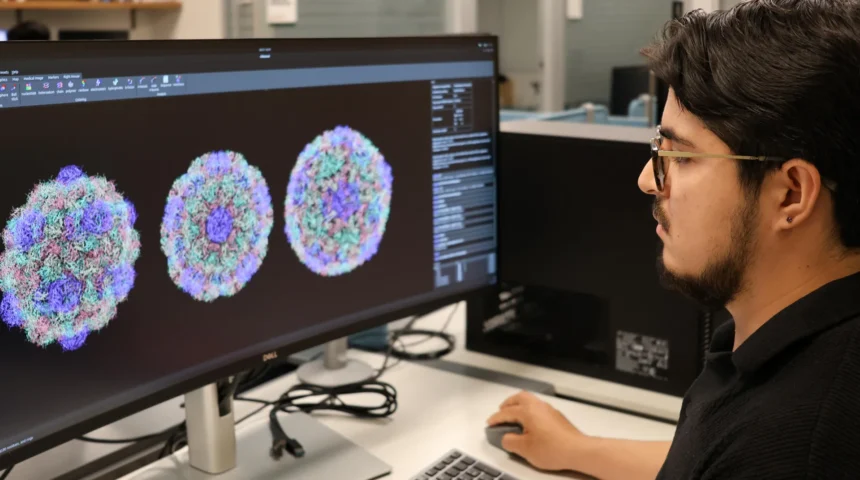
Central to this transformative discovery are proteins characterized by a distinct three-dimensional configuration known as the HK97-fold. These versatile proteins possess the remarkable capacity to self-assemble into robust, protective shells. Intriguingly, this specific structural motif is not confined to a single domain of life; it is found ubiquitously across both viral particles and the encapsulin systems within various cellular organisms. The viruses identified in this study stand apart from their known relatives due to their notably smaller and less complex genetic blueprints. Crucially, they exhibit a mosaic of features that resonate with both established viral characteristics and those typically associated with encapsulins. This unique blend positions them as potential evolutionary intermediates, providing a tangible link in the long chain of biological development. Studying these atypical viral forms could unlock secrets regarding the progressive emergence of biological systems, from simple molecular assemblies to the intricate complexities observed in modern life forms.
Abelardo Aguilar, the lead author of the study and a doctoral candidate in the Department of Biology at the University of Miami’s College of Arts and Sciences, underscored the profound significance of the HK97-fold proteins. "The compelling aspect of HK97-fold proteins lies in their dual capacity," Aguilar explained. "They construct compartments that facilitate biochemical reactions within diverse cellular lineages, encompassing archaea and bacteria. Concurrently, they fulfill genetic imperatives in viruses, safeguarding and housing their genetic material." This dual functionality, he elaborated, directly connects to fundamental questions surrounding the very genesis of life and its primordial evolution. "At its core," Aguilar added, "life revolves around the compartmentalization of reactions and the secure enclosure of inheritable information, ensuring the continuity of those reactions into the future." The ability of a single protein fold to serve both these critical roles hints at a shared, ancient origin for these essential biological functions.
The identification of these previously elusive viruses was not achieved through conventional laboratory culture methods, which often struggle to replicate the complex environmental conditions necessary for viral proliferation. Instead, Aguilar collaborated with Antoni Luque Santolaria, the study’s senior author and an associate professor across the Departments of Biology, Physics, and Chemical, Environmental and Materials Engineering at the University of Miami. Their team pioneered an innovative computational approach, sifting through vast repositories of genetic data. This multidisciplinary project involved researchers from several institutions, leveraging cutting-edge bioinformatics, sophisticated models of protein behavior, and advanced artificial intelligence tools, including protein language models and AlphaFold. These powerful computational engines allowed them to decode the structural information encoded within billions of DNA sequences, thereby revealing the hidden architectures of life.
The massive genetic databases utilized, such as IMG/M—a comprehensive resource affiliated with the U.S. Department of Energy’s Joint Genome Institute and the University of California, Berkeley—are populated with genetic information harvested from a dizzying array of global environmental samples. These include diverse matrices like soil, deep-sea sediments, wastewater treatment facilities, the intricate microbial communities of the human gut, and countless other ecological niches. This metagenomic approach, which analyzes genetic material directly from environmental samples without prior culturing, represents a paradigm shift in virology. It enables scientists to investigate a vast realm of viruses that have never been successfully propagated in a laboratory setting, dramatically expanding the scope of observable organisms and the evolutionary relationships that can be rigorously explored.
Luque emphasized the transformative power of this methodology. "The vast majority of viruses remain unculturable in laboratory environments. However, through advances in high-throughput sequencing, we now possess unprecedented access to genetic data from viruses whose hosts are unknown, and which defy traditional culture methods, yet are pervasive across all ecosystems," Luque stated. "This technological leap has unlocked a multitude of previously unaddressable questions concerning evolution and the adaptive strategies viruses have employed to thrive in our world, making bioinformatics an indispensable tool for exploration."
Beyond merely identifying these novel viral entities, the research team put forth a compelling molecular model explaining how viruses and encapsulins could have mutually evolved. Their hypothesis centers on the concept of procapsids—the immature, unformed protein shells that precede the mature viral capsid. These procapsids, the researchers propose, could represent a pivotal intermediate stage, offering a structural bridge between the two distinct types of protein structures. They theorize that these nascent shells could potentially accommodate both the genetic imperative of containing and protecting viral DNA and the metabolic requirement of facilitating specific biochemical reactions.
This intriguing proposition opens up a fundamentally new perspective on the roles of viral capsids. While conventionally understood primarily as protective containers for genetic material, this research suggests that certain forms of these protein shells might also actively contribute to creating controlled microenvironments conducive to biochemical activity. Aguilar further elaborated on this possibility: "A significant implication of our research is the potential for viral capsids to actively facilitate biochemical reactions. If validated, this would dramatically broaden our understanding of the diverse ecological and physiological roles that capsids play within broader environments."
While acknowledging that further empirical investigation is necessary to fully substantiate these proposed functions, the current findings strongly suggest that the scientific community may need to expand its focus beyond the well-documented infectious stages of viruses. A comprehensive understanding of their pervasive roles in nature, the study implies, demands a closer examination of their less apparent, non-infective forms and the latent biological capabilities they might possess. "When we investigate viruses, our attention typically gravitates towards their infective particles," Aguilar noted. "This study, however, underscores the critical need to place greater emphasis on the non-infective versions of viruses and to explore the myriad other functions these viral-like particles may have performed, functions we might have inadvertently overlooked in the past."
The study also serves as a powerful testament to the revolutionary impact of artificial intelligence and computational biology on the field of virology. By strategically integrating advanced analytical tools with a deep understanding of protein structure and biophysical principles, scientists are now equipped to tackle intricate evolutionary puzzles that were previously beyond the reach of conventional research methodologies. This project, generously supported by prestigious organizations such as the Gordon and Betty Moore Foundation and the U.S. National Science Foundation, establishes a robust methodological framework that can be readily applied to the study of other poorly understood viruses and their enigmatic biological capabilities.
The researchers firmly believe that these innovative computational methods hold immense potential beyond the realm of evolutionary biology. They envision their application in critical areas such as understanding the emergence and transmission of novel viruses and pathogenic agents, offering new avenues for surveillance and response. "When the right scientific question is meticulously paired with the appropriate computational tools and informed by profound physical insights, it empowers researchers to scrutinize viruses in ways previously unimaginable," Luque articulated. "While profound evolutionary questions are being addressed, these methodologies are equally pertinent to confronting challenges posed by emerging pathogens or novel viruses. The sophisticated toolkit we have developed is inherently adaptable and can be effectively deployed across a diverse array of scientific contexts." This convergence of cutting-edge technology and biological inquiry promises a new era of discovery in our ongoing quest to comprehend the complex world of viruses and their fundamental role in shaping life on Earth.
Related posts:

Related News