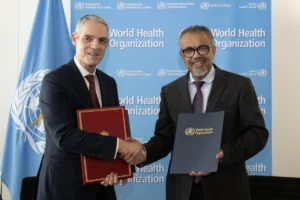
A landmark moment for global public health unfolded recently as fourteen African nations, alongside a diverse coalition of international partners, collectively committed over US$45 million to the World Health Organization’s (WHO) inaugural Investment Round. This significant financial injection marks a pivotal step in strengthening the global body’s capacity, aiming to secure predictable and adaptable funding streams essential for its overarching mission to safeguard and promote human health worldwide. The commitments, announced during the crucial WHO Regional Committee for Africa, underscore a burgeoning recognition among global leaders of the imperative to invest robustly in the institutions at the forefront of international health security.
This initiative, barely three months since its formal launch, represents a strategic pivot for the WHO, which has historically grappled with a funding model often characterized by its volatility and earmarking. The Director-General of the WHO, Dr. Tedros Adhanom Ghebreyesus, voiced profound gratitude for the decisive support from African Member States, highlighting their proactive role in establishing a more stable financial foundation. He emphasized that reliable, flexible resources are not merely operational necessities but are foundational to empowering the WHO to effectively assist countries in cultivating healthier, more robust, and ultimately more prosperous societies. This vision extends beyond mere crisis response, aiming for sustained development of national health infrastructures and proactive disease prevention strategies.
The assemblage of nations and collaborators for this historic fundraising endeavor was driven by a shared conviction: that a sustainably financed WHO is indispensable for advancing universal health objectives and fulfilling its extensive mandate. The participating African countries, demonstrating remarkable regional solidarity, included Botswana, Cabo Verde, Chad, the Republic of Congo, Ethiopia, The Gambia, Mauritius, Namibia, Niger, Rwanda, Senegal, Seychelles, South Africa, and the United Republic of Tanzania. Their collective pledge signals a powerful message about Africa’s commitment to multilateralism and its understanding of the interconnectedness of global health challenges.
Beyond sovereign states, a diverse array of philanthropic organizations, development banks, and private sector entities also stepped forward with pledges or declarations of intent to contribute. These included prominent names such as the Helmsley Charitable Trust, the World Diabetes Foundation, Roche, the Kuwait Fund for Arab Economic Development, the Bill & Melinda Gates Foundation, the African Development Bank, and the WHO Foundation. This broad spectrum of stakeholders underscores a growing consensus that addressing complex global health issues demands a multi-sectoral approach, moving beyond traditional government-centric funding models. The involvement of the WHO Foundation, a relatively new entity established to broaden the organization’s donor base, further exemplifies this innovative approach to resource mobilization.
Dr. Matshidiso Moeti, WHO Regional Director for Africa, articulated the critical importance of a robustly funded WHO, particularly for a continent facing a complex interplay of health threats. Her remarks highlighted that a strong, predictable, and resilient WHO is paramount for Africa and the global community to effectively counter myriad health adversities and implement evidence-based disease prevention measures. She passionately affirmed that every financial contribution and every collaborative effort contributes meaningfully towards a future where health and well-being are universally attainable, emphasizing the cumulative power of collective action.
The genesis of the WHO Investment Round can be traced back to the World Health Assembly in May 2024, where member states formally endorsed a transformative vision for the organization’s financial future. For decades, the WHO has operated under a funding structure heavily reliant on voluntary contributions, which, while substantial, often came with strict earmarking for specific projects or regions. This system frequently limited the organization’s agility, hindering its ability to allocate resources to emerging crises or underfunded programmatic areas deemed most critical by its strategic framework. The Investment Round directly addresses these systemic challenges by championing three core principles for contributions: flexibility, predictability, and resilience.
Flexibility, in this context, means that funds are unearmarked, allowing the WHO to direct resources to its core strategic priorities as approved by its Member States. This contrasts sharply with previous models where specific donors dictated how their contributions could be used, sometimes creating imbalances in program funding. Predictability ensures that resources are committed at the commencement of the four-year budget cycle, enabling long-term planning, strategic decision-making, and the efficient allocation of human and technical resources. This shift moves away from a hand-to-mouth existence to one of strategic foresight. Lastly, resilience refers to diversifying the donor base, moving beyond reliance on a few large contributors. By attracting a broader, more varied set of donors, the Investment Round aims to insulate the WHO from potential funding shocks and ensure greater financial stability, thereby bolstering its capacity to respond to unforeseen global health emergencies without compromise.
The African continent’s leadership in this initial phase of the Investment Round holds particular significance. Africa shoulders a disproportionate share of the global disease burden, ranging from endemic infectious diseases like malaria and HIV/AIDS to the growing prevalence of non-communicable diseases and the profound impacts of climate change on health. Strengthening the WHO’s capacity directly translates into enhanced technical support for African nations in developing robust health systems, improving disease surveillance, expanding access to essential health services, and bolstering preparedness for future pandemics. The high-level participation of heads of state and government during the Regional Committee meeting underscores a deep-seated understanding that investing in global health is not merely an act of philanthropy but a strategic imperative for national development and regional stability. This political commitment elevates the discussion from technical health budgets to national security and economic prosperity.
The African Development Bank’s involvement further illustrates the continent’s integrated approach to health and development. Recognizing that health is a cornerstone of economic growth, the Bank’s contribution signals an understanding that investments in health yield substantial dividends in terms of human capital and productivity. This holistic perspective aligns with the broader Sustainable Development Goals (SDGs), particularly SDG 3, which aims to ensure healthy lives and promote well-being for all at all ages.
Looking ahead, the WHO Investment Round is designed as an ongoing initiative, with subsequent pledging events scheduled to take place around the globe in the coming months. This initial success, spearheaded by African nations, sets a powerful precedent and builds crucial momentum. It serves as an invitation for other regions and countries to join this collective endeavor, recognizing that global health security is a shared responsibility requiring sustained, multilateral engagement. The long-term implications of a successfully funded WHO are profound: it promises a more agile, responsive, and equitable global health body, better equipped to prevent and respond to health crises, drive innovation, set vital global health norms and standards, and ultimately, build a healthier world for everyone. This renewed commitment to collective financing represents not just an infusion of capital, but a reaffirmation of the multilateral spirit in addressing humanity’s most fundamental challenge.
About the Author