Maintaining robust physical capability becomes increasingly vital with advancing age, particularly as individuals navigate life beyond their mid-fifties. The common misconception often links significant muscle development and strength enhancement exclusively with specialized gym equipment and rigorous weightlifting routines. However, a growing body of evidence and expert consensus suggests that highly effective and sustainable upper body conditioning can be achieved through accessible, at-home methods, frequently surpassing the practical benefits derived from traditional heavy resistance training for many in this demographic. The focus shifts from merely lifting heavy objects to cultivating practical, functional strength that directly supports independence and quality of life.
For many mature adults, time constraints, the logistical demands of commuting to a fitness center, or concerns about joint stress can present formidable barriers to consistent exercise. Yet, a proactive approach to muscular maintenance is paramount. As individuals age, a natural process known as sarcopenia—the gradual loss of muscle mass and strength—commences. This decline can significantly impact daily activities, from lifting groceries to opening doors, and can diminish overall physical autonomy. Engaging in regular strength-building activities is a potent countermeasure against sarcopenia, helping to preserve muscle tissue, bolster bone density, and enhance metabolic health. Crucially, these routines need not be complicated or require extensive apparatus. Simple tools, often already present in one’s home environment, combined with the body’s own resistance, offer a remarkably potent pathway to revitalized strength.
Research underscores the efficacy of alternative resistance modalities for older adults. Scientific investigations have repeatedly demonstrated that strength development programs incorporating equipment such as resistance bands or relying solely on bodyweight can lead to substantial improvements in muscular strength and overall physical function among the aging population. This evidence supports the notion that consistent engagement in accessible exercise protocols can yield profound long-term benefits, fostering renewed arm strength and systemic vitality across various age groups. The key lies in regularity and appropriate technique, rather than the sheer magnitude of the load lifted.
To elucidate these principles, we consulted James Bickerstaff, a certified personal trainer affiliated with OriGym, an esteemed fitness education provider. Bickerstaff emphasizes that the resources typically found within a home are often more than sufficient to initiate and sustain a comprehensive strength regimen. "These particular movements are designed to simultaneously engage the pectoral muscles, deltoids, triceps, and core musculature," Bickerstaff explains, highlighting the holistic benefits of the prescribed exercises. This integrated approach ensures that multiple muscle groups work in concert, mirroring the demands of real-world movements and contributing to greater overall stability and power. The objective is not merely aesthetic but profoundly functional, equipping individuals with the physical capacity to perform everyday tasks with greater ease and confidence.
Let us explore four highly effective home-based exercises recommended for individuals over 55, specifically engineered to foster significant upper body strength gains. These selections prioritize safety, adaptability, and the promotion of functional movement patterns, offering a compelling alternative to traditional heavy weight training for many.
1. Vertical Push-ups (Wall Push-ups)
The vertical push-up stands out as an exceptionally safe and remarkably effective foundational exercise for cultivating upper body strength in individuals past the age of 55. This variation of the classic push-up significantly reduces the load on the wrists and shoulders compared to its floor-based counterpart, making it an ideal starting point for those new to strength training or returning after a hiatus. Its primary advantage lies in its inherent adjustability, allowing users to effortlessly modify the exercise’s intensity by altering their proximity to the wall. This adaptability ensures that the movement remains challenging yet achievable, facilitating progressive overload without undue risk. The exercise primarily targets the chest (pectorals), shoulders (anterior deltoids), and triceps, while also engaging the core for stability. It builds the pushing strength essential for tasks like pushing open heavy doors or regaining balance.
- Execution Protocol:
- Stand approximately two to three feet away from a sturdy wall, facing it directly.
- Place your palms flat against the wall, positioned slightly wider than shoulder-width apart, at roughly chest height. Ensure your fingers point upwards.
- Keeping your body in a straight line from head to heels, engage your core.
- Slowly bend your elbows, allowing your chest to move closer to the wall. Maintain control throughout the descent, ensuring your elbows point slightly downwards and back, not flaring out excessively.
- Push actively through your hands to return to the starting position, extending your arms fully but without locking your elbows.
- Perform 10-15 repetitions for 2-3 sets, resting briefly between sets.
- Progression and Regression: To increase difficulty, incrementally move your feet further away from the wall, increasing the angle and thus the body’s resistance. For a reduced challenge, stand closer to the wall.
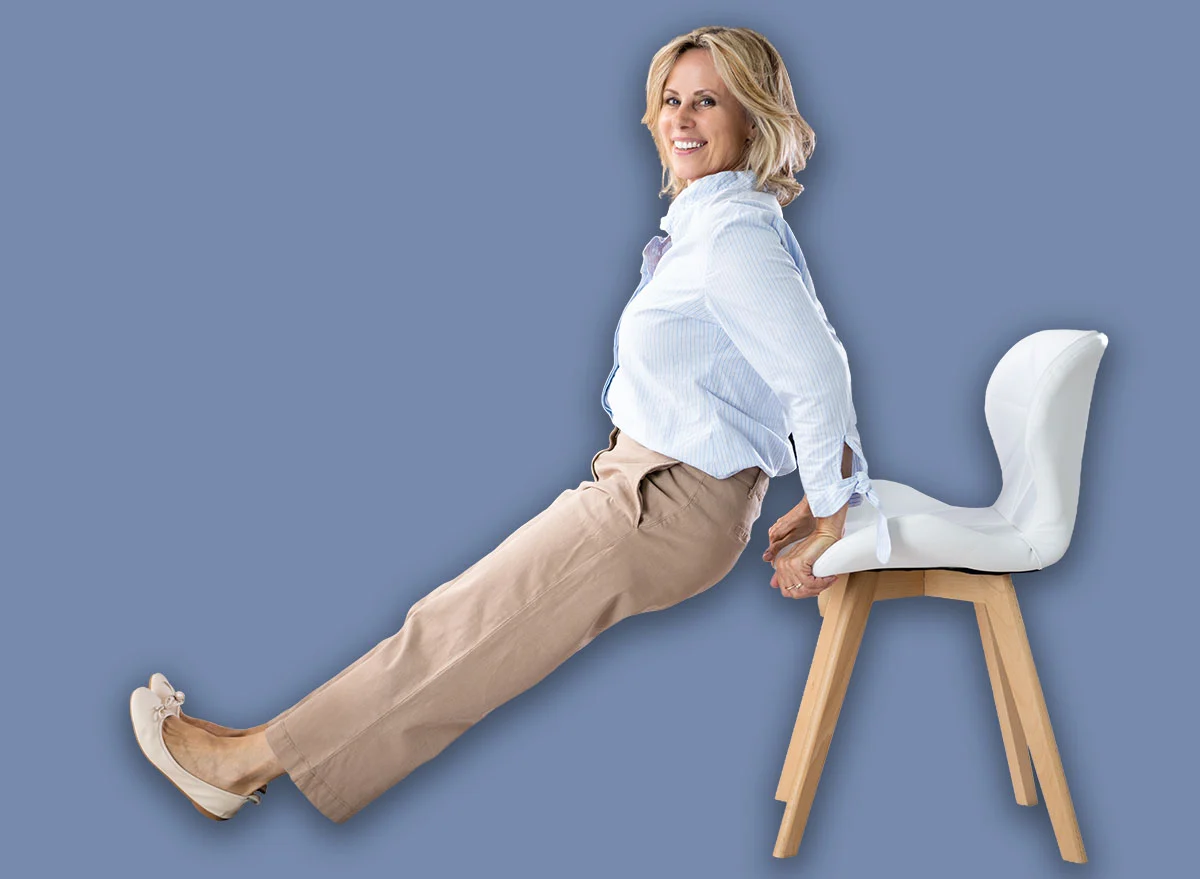
2. Chair Triceps Dips
The triceps brachii muscle group, located at the back of the upper arm, often contributes significantly more to daily "pushing" mechanics than generally recognized. Bickerstaff highlights its anatomical importance: "The triceps constitute approximately two-thirds of the upper arm’s total mass, meaning that fortifying these muscles can have a profound impact on both arm functionality and aesthetic definition." Chair dips are an excellent exercise for enhancing pushing power, crucial for everyday actions such as rising from a seated position or maneuvering weighty objects. This movement targets the triceps directly, while also engaging the shoulders and chest secondarily.
- Execution Protocol:
- Position a stable, non-rolling chair or bench behind you. Sit on its edge and place your hands on the seat beside your hips, fingers pointing forward or slightly outward, gripping the edge.
- Slide your hips off the chair, supporting your weight with your hands and heels. Your knees should be bent at a 90-degree angle, with feet flat on the floor.
- Slowly lower your body by bending your elbows until your upper arms are roughly parallel to the floor, or slightly below. Maintain a controlled descent and keep your back close to the chair.
- Push firmly through your hands to extend your arms and elevate your body back to the starting position.
- Complete 8-12 repetitions for 2-3 sets, focusing on controlled movement.
- Progression and Regression: To make it easier, keep your feet closer to the chair or use a higher surface. To increase difficulty, extend your legs further forward, or even elevate your feet on another stable object, increasing the bodyweight load.
3. Resistance Band Bicep Curls
When aiming to develop upper arm strength, substituting traditional dumbbells or barbells with resistance bands offers a significantly more joint-friendly approach, particularly beneficial for individuals concerned about wrist or elbow strain. As Bickerstaff explains, "Resistance bands deliver continuous tension throughout the entire range of motion, establishing them as an outstanding alternative to free weights." This constant engagement ensures muscles are working harder through both the concentric and eccentric phases of the lift. They are particularly advantageous for strengthening the biceps without imposing undue stress on vulnerable joints. The biceps are primarily responsible for pulling motions, such as lifting objects, carrying bags, and performing various household tasks.
- Execution Protocol:
- Stand with both feet placed firmly on the center of a resistance band. Ensure your feet are shoulder-width apart, or adjust based on the band’s length for appropriate tension.
- Grasp one end of the band in each hand, palms facing forward (supinated grip). Your arms should hang fully extended at your sides.
- Keeping your elbows tucked close to your body, slowly curl your hands upwards towards your shoulders, contracting your biceps. Only your forearms should move.
- Pause briefly at the peak contraction, then gradually lower your hands back to the starting position, controlling the band’s resistance throughout the descent.
- Perform 10-15 repetitions for 2-3 sets, choosing a band that provides adequate challenge.
- Progression and Regression: To increase resistance, use a thicker band, shorten the band by gripping it lower, or widen your stance. To decrease resistance, use a thinner band or narrow your stance.
4. Standing Resistance Band Shoulder Press
The final recommended exercise specifically targets the shoulder girdle, a muscle complex that Bickerstaff identifies as frequently overlooked but absolutely critical for maintaining functional independence as one ages. "Robust shoulder strength is indispensable for preserving autonomy later in life, whether that involves reaching for items on high shelves or effortlessly carrying shopping bags," Bickerstaff asserts. Utilizing a resistance band for the standing shoulder press effectively challenges the deltoid muscles (shoulders) while concurrently demanding significant stabilization from the core musculature throughout the movement. This dual engagement enhances both upper body power and trunk stability, contributing to better posture and reduced risk of injury.
- Execution Protocol:
- Stand with one or both feet planted securely on the center of a resistance band. If using one foot, ensure it’s the same side as the arm performing the press, or use both for stability.
- Grasp one end of the band in each hand, bringing your hands up to shoulder height, with elbows bent and palms facing forward, similar to the starting position of a traditional overhead press.
- Engage your core and maintain a straight back. Press your hands directly upwards, extending your arms fully overhead without locking your elbows.
- Control the movement as you slowly lower your hands back to the starting shoulder-height position, resisting the band’s pull.
- Execute 8-12 repetitions per arm (if doing unilaterally) or for both arms simultaneously for 2-3 sets.
- Progression and Regression: To increase difficulty, opt for a band with higher resistance, or grip the band lower for more tension. To decrease the challenge, use a lighter band or grip the band higher up.
Beyond these specific exercises, a comprehensive approach to health and longevity for individuals over 55 should encompass several interconnected elements. Consistent hydration, a nutrient-dense diet rich in lean protein to support muscle repair and growth, and adequate restorative sleep are all foundational pillars. Furthermore, incorporating flexibility and balance training can complement strength routines, fostering greater overall mobility and reducing the risk of falls. It is always advisable to consult with a healthcare provider or a certified fitness professional before embarking on any new exercise regimen, particularly if there are pre-existing health conditions. Listening attentively to one’s body, progressing gradually, and prioritizing proper form over sheer intensity will pave the way for sustainable strength gains and an enriched quality of life.
In conclusion, achieving and sustaining robust upper body strength well into the later stages of life is an entirely attainable goal, even without the need for extensive gym memberships or heavy weights. By embracing bodyweight and resistance band exercises, mature adults can forge a path towards enhanced functional fitness, greater independence, and a revitalized sense of physical capability, transforming their homes into effective personal fitness sanctuaries. The emphasis on accessible, consistent, and functionally relevant movements ensures that these efforts translate directly into a better, stronger everyday existence.
About the Author